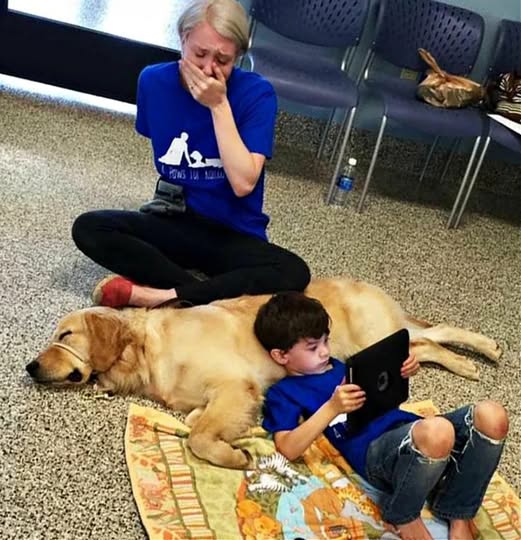
The Healing Power of Connection: A Mother's Joy as Her Son with Autism Finds a Lifelong Friend in His Service Dog
For many families, the journey of raising a child with autism is filled with both challenges and moments of extraordinary beauty. One mother recently experienced an unforgettable breakthrough when her young son, who has autism, formed a deep and meaningful bond with his service dog. What began as cautious introductions quickly turned into a heartwarming story of trust, companionship, and healing.
A Boy Who Struggled To Connect
The boy had always struggled with communication and social interaction, often finding it difficult to connect with the world around him. Like many children on the spectrum, he longed for comfort and understanding but found it hard to express those needs.
Autism is a developmental condition that affects how a person communicates, interacts socially, and experiences the world. Every autistic child is different. Some speak fluently but struggle with social cues. Others are minimally speaking. Many experience the sensory world intensely, finding ordinary sounds, lights, or textures overwhelming. What they often share is a need for connection expressed in ways the world does not always recognize.
The Day Everything Changed
That changed the day his service dog came into his life. At first, the bond was subtle: small glances, gentle touches, and quiet moments shared together. Soon, however, the dog became not just a companion but also a bridge to the world.
The loyal animal seemed to understand the boy without words, offering comfort during stressful situations, calming him during moments of anxiety, and standing faithfully by his side wherever he went. Dogs do not require conversation. They do not judge awkwardness or misunderstand silence. For a child who finds human interaction exhausting or confusing, a dog's simple, steady presence can feel like the first relationship that truly makes sense.
A Mother's Life-Changing Moment
For his mother, watching the transformation was nothing short of miraculous. She described the connection as "life-changing," explaining that the service dog gave her son something she could not provide alone: a constant source of unconditional love and reassurance.
The joy she felt watching her child laugh, play, and finally relax in the presence of his new best friend was immeasurable. Parents of autistic children often describe a particular kind of hope mixed with worry: hope for their child's happiness, worry about a world that may not accommodate them. Seeing her son at ease, perhaps for the first time in a social context, gave this mother something precious, the sight of her child simply being happy.
What Autism Service Dogs Actually Do
Beyond emotional comfort, service dogs trained to work with children with autism provide valuable support in daily life. These are not ordinary pets. They are highly trained working dogs, and their skills are specific and practical:
- Preventing wandering. Many autistic children are prone to bolting or wandering, which is one of the most dangerous behaviors families face. Service dogs can be tethered to the child with a special harness, gently anchoring them and preventing them from running into traffic or away in public.
- Tracking. If a child does wander off, some service dogs are trained to track the child's scent and lead parents to them quickly.
- Interrupting harmful behaviors. Dogs can be trained to recognize repetitive or self-injurious behaviors and interrupt them with a nudge or by placing their head in the child's lap.
- Deep pressure therapy. During meltdowns or moments of sensory overload, a trained dog can apply calming deep pressure by lying across the child's lap or leaning against them. Many autistic children find this grounding.
- Maintaining routines. Dogs thrive on routine, and their needs for walks, feeding, and play can help anchor a child's day in predictable structure.
- Easing sensory overload. In overwhelming environments like crowded stores or noisy events, the dog's presence can serve as a calming focal point.
- Building social bridges. A dog is a natural conversation starter. For children working on social skills, the dog provides a safe, shared topic and can make interactions with peers feel less intimidating.
More importantly, these dogs foster independence, confidence, and a sense of security that allows children to engage more fully with the world.
Service Dogs vs. Therapy Dogs vs. Emotional Support Animals
The terms get mixed up often, so here is a clear general guide:
- Service dogs are individually trained to perform specific tasks for a person with a disability. In many countries, they have legal public access rights, meaning they can accompany their handler in places pets cannot go.
- Therapy dogs provide comfort to many people in settings like hospitals and schools. They do not have the same public access rights as service dogs.
- Emotional support animals provide comfort through their presence but are not task-trained, and their legal protections are more limited.
An autism service dog falls into the first category: a working dog with specialized training matched to a child's specific needs.
How Families Get an Autism Service Dog
Obtaining a service dog is a significant commitment. Reputable service dog organizations typically have application processes, waiting lists that can stretch for months or years, and costs that reflect the extensive training involved, often many months of professional training per dog. Some organizations are nonprofits that fundraise to provide dogs at reduced or no cost to families; others charge fees. Families should research carefully, ask about training methods, health guarantees, and ongoing support, and be wary of any organization promising instant results.
It is also worth noting that a service dog is not the right fit for every family. Dogs need care, exercise, and attention of their own. The best outcomes happen when the whole family is committed to the dog as both a worker and a beloved family member.
The Bond That Heals
Stories like this serve as powerful reminders of the healing power of connection, whether it comes through human relationships or the extraordinary bond between people and animals. For this family, the service dog was more than a helper. He became part of the family, a guardian, and a friend who opened the door to a brighter future.
The mother's joy is the heart of this story. She watched her son find, in a dog, what the world had struggled to give him: patience without conditions, comfort without words, and companionship without demands. That is not a small thing. For a child on the spectrum, and for the mother who loves him, it is everything.
How You Can Help
If this story moved you, here are meaningful ways to support service dogs, autistic children, and their families:
- Adopt: Many wonderful dogs in shelters have the temperament for therapy or assistance work. While not every shelter dog can become a service dog, adoption gives a deserving animal a home.
- Foster: Some service dog organizations need volunteer puppy raisers and foster homes to socialize young dogs during early training.
- Donate: Training a single service dog costs thousands. Donations to accredited service dog organizations help families who could not otherwise afford one.
- Volunteer: Autism support organizations, special education programs, and service dog nonprofits all need volunteers, from event help to administrative support.
- Spay and neuter: Responsible pet ownership, including spaying and neutering, keeps dog populations healthy and reduces the number of animals in shelters.
- Be kind in public: If you see a service dog team, do not distract the dog. A working dog needs to focus on its handler, and your restraint is a genuine act of support.