
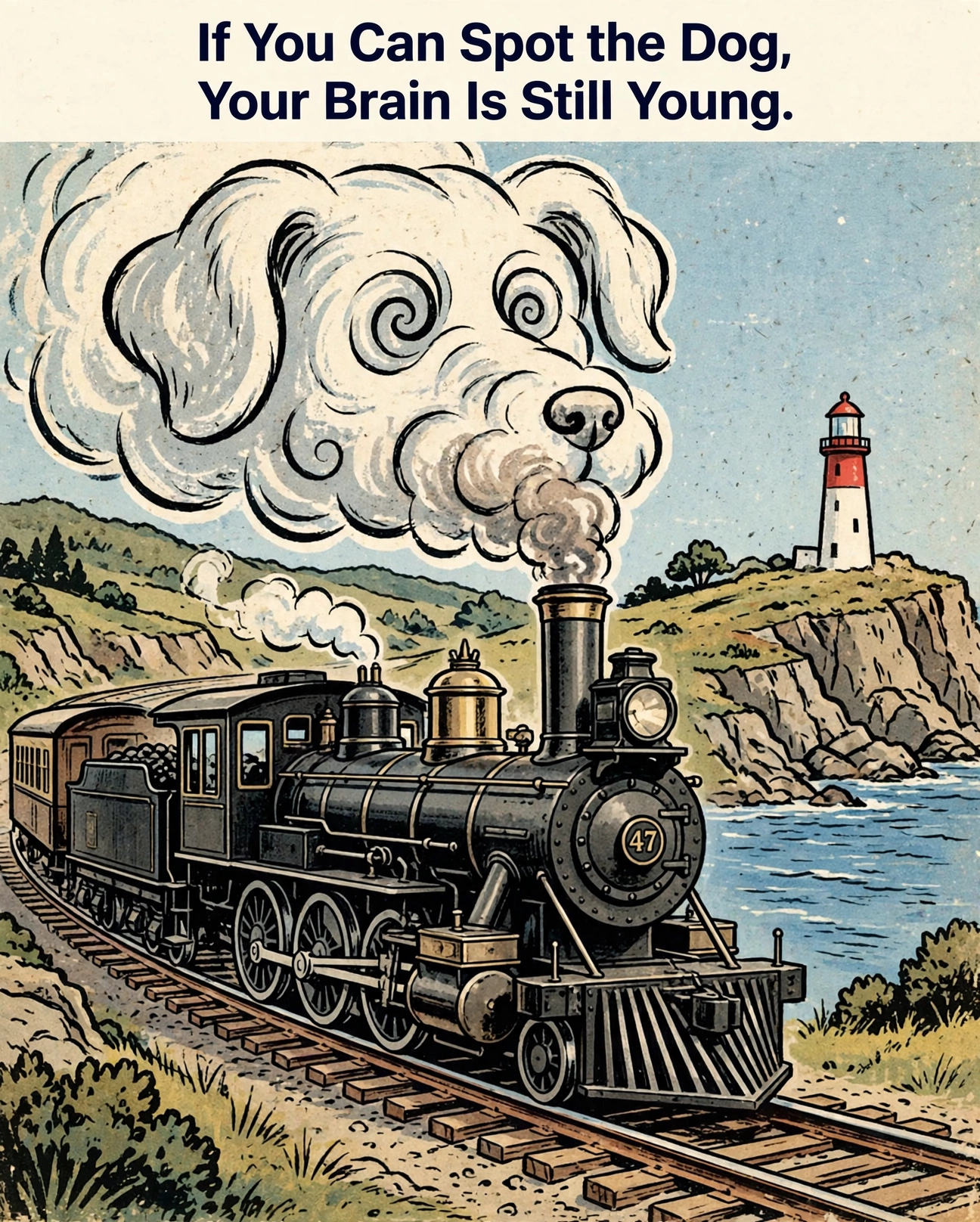
There’s a picture going viral right now, and it’s driving people absolutely crazy. At first glance, it’s just a charming vintage illustration — an old steam train chugging along coastal tracks, a lighthouse standing watch in the distance, and thick white smoke billowing from the chimney.
But look closer. Hidden inside that smoke is a dog. And once you see it, you can never unsee it.
Thousands of people have stared at this image for minutes without finding it. Others spot it in three seconds flat. Which one are you? Before you scroll down for hints, give it an honest try — because the moment someone tells you where it is, the game is over.
Why Your Brain Can’t Find It
This is what’s called a pareidolia illusion — your brain’s tendency to find familiar patterns, especially faces, in random shapes. It’s the same phenomenon that makes people see a man in the moon or Jesus on a piece of toast. Your visual system is wired to detect faces in milliseconds, because recognizing faces kept our ancestors alive.
So why doesn’t it work here? Because your brain is too busy processing the obvious parts of the image: the train, the lighthouse, the tracks. The smoke registers as “background noise” — formless, unimportant, not worth examining. Your visual system literally decides the smoke isn’t worth its energy, and moves on.
Eye-tracking studies on visual perception show that most people scan an image in a predictable pattern: top to bottom, locking onto large, high-contrast objects first. The dog hides in the one place your eyes are trained to skip. It’s not that the dog is well hidden — it’s that your brain refuses to look there.
A Century of Hidden Pictures
This trick is far older than the internet. Hidden-image puzzles have been entertaining people for well over a hundred years. In the early 1900s, newspapers and magazines ran “find the hidden faces” illustrations as weekend entertainment for the whole family. Artists would conceal profiles, animals, and figures inside landscapes, trees, and clouds.
One of the most famous examples is the “hidden tiger” painting style from the 1800s, where a jungle scene secretly contained the face of a great beast. During wartime, these puzzles even served a practical purpose — the military used camouflage-detection training based on the same principle, teaching soldiers to spot what their eyes wanted to skip.
Today’s viral versions are the direct descendants of those newspaper puzzles. The format hasn’t changed: one bold claim (“your brain is still young!”), one innocent-looking picture, and one maddening secret. What changed is the speed — instead of a weekly magazine, millions of people now attempt the same puzzle within hours.
The 10-Second Challenge
Here’s the game: set a timer for 10 seconds and try to find the dog. Research on visual cognition suggests that people who spot hidden figures quickly tend to have strong visual-spatial processing — the mental skill behind reading maps, solving puzzles, packing a suitcase efficiently, and even certain kinds of mathematical thinking.
But don’t feel bad if you fail. Speed isn’t everything. Some of the most detail-oriented people take the longest, because their brains insist on examining every part of the image systematically instead of letting the pattern “pop” into view.
Can’t find it? Here are three hints, from gentle to obvious:
Stop looking at the train. The train is a decoy. Your eyes keep returning to it because it’s the biggest, darkest object. Force yourself to ignore it completely.
Let your eyes go soft. Instead of focusing hard, relax your gaze the way you would for a Magic Eye puzzle. Look at the largest cloud of smoke without staring at any single point.
Tilt your head slightly to the right. Now look for the curled ear at the top of the smoke, the round nose in the middle, and the spiral-shaped eyes. See him? That good boy has been watching you the whole time.
Why We Can’t Resist These Puzzles
There’s something deeply satisfying about the “aha!” moment when the hidden image finally clicks into place. Psychologists say it’s because your brain rewards pattern recognition with a small hit of dopamine — the same chemical behind the pleasure of solving a riddle or getting a joke. That rush is exactly why these posts get shared millions of times. Nobody keeps a good “aha!” to themselves.
There’s also a social element. These puzzles are secretly competitions. “I found it in 5 seconds” is a flex, whether we admit it or not. Sharing the image is a way of challenging your friends without saying a word — and the comments section becomes a battleground of spotters versus the still-searching.
Your Brain on Illusions: The Perceptual Shift
Here’s the most fascinating part: the moment you spot the dog, your brain physically rewires how it sees the image. Before, the smoke was just smoke. After, you can’t look at the picture without seeing the dog. Scientists call this a perceptual shift, and it’s powerful proof of how much of “seeing” actually happens in your brain, not your eyes.
Your eyes are just cameras. Your brain is the editor, director, and audience all at once — deciding what matters, filling in blanks, and occasionally lying to you for your own convenience. Every optical illusion is a little reminder that your experience of reality is a construction, not a recording.
Can You Train Your Eye?
The good news: getting better at these puzzles is absolutely possible. Artists, radiologists, and air-traffic controllers all develop the same skill — the ability to notice what doesn’t belong, or what hides in plain sight. The training is simple:
Practice peripheral looking. Don’t stare directly at what you’re searching; let the edges of your vision do the work.
Flip the image. Turning a picture upside down breaks your brain’s assumptions and forces it to see shapes instead of objects.
Squint. Reducing detail strips away the “story” of the image and leaves only the big shapes — which is exactly where hidden figures live.
Walk away and come back. A fresh glance often succeeds where ten minutes of staring failed, because your brain resets its assumptions.
Do these regularly and you’ll start spotting hidden figures faster — not because your eyes changed, but because your brain learned to distrust its first impression.
The Verdict
So — did you find the dog in under 10 seconds? Be honest. There’s no shame in taking a full minute, and there’s real pride in spotting it instantly. Either way, your brain just did something remarkable: it found order in chaos, a face in smoke, meaning in randomness.
That’s not a parlor trick. That’s the most human thing there is.
Now it’s your turn to test someone else. Share this with the person who always claims to notice everything — and watch them squint.
Found it fast? Still searching? Drop a comment and tell us exactly how long it took you. And if you want more brain-bending illusions like this one, you know what to
