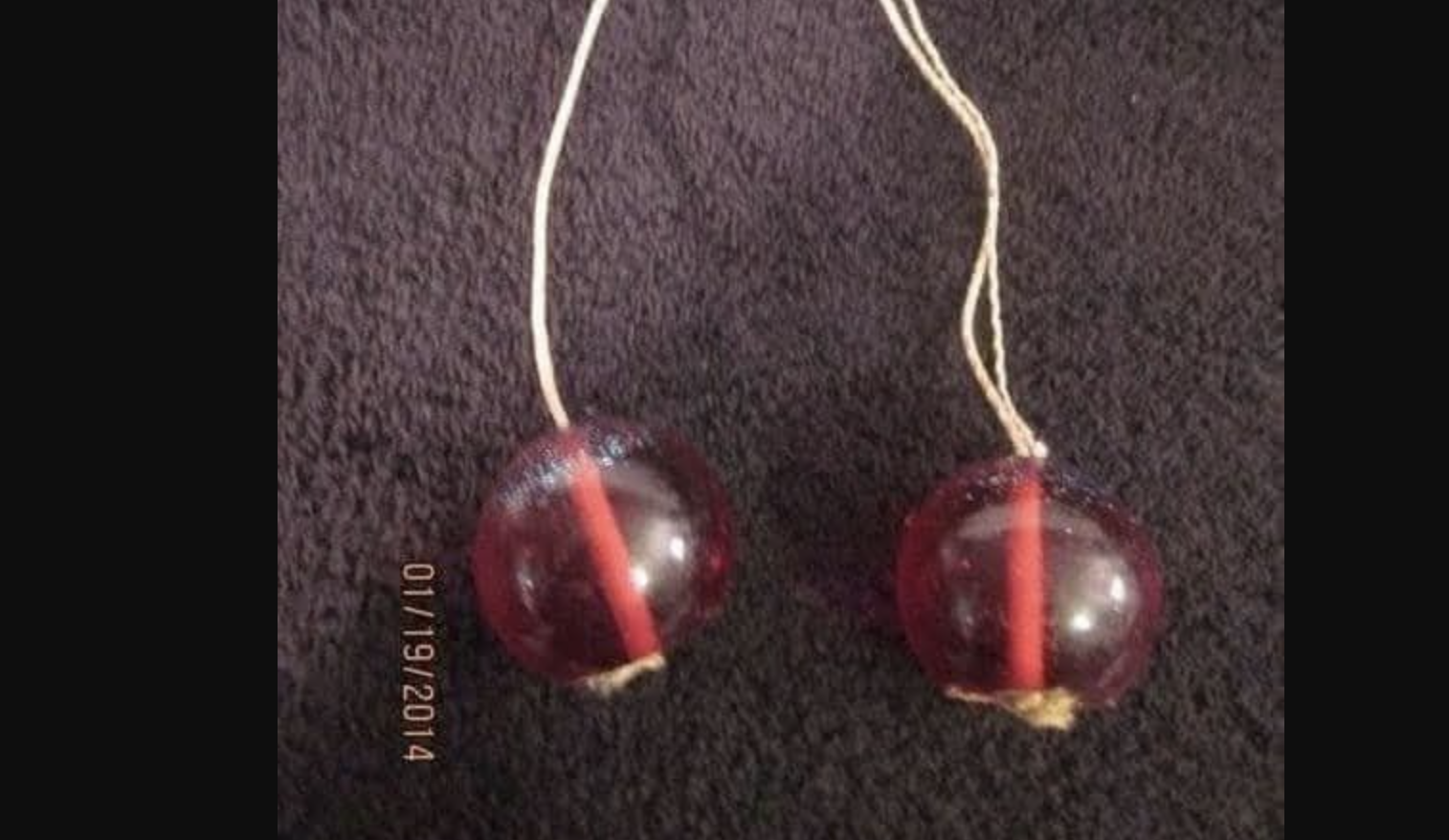
The Internet Was Baffled by This Mysterious Object: Almost No One Recognized It
The internet loves a good mystery, and this one had people genuinely stumped. An image of a strange object began circulating online, and despite thousands of comments, guesses, and shared posts, most viewers had no idea what they were looking at. In fact, nearly 90 percent of people who encountered it for the first time could not identify it at all.
The surprising truth? The object was not new or unusual. It was simply unfamiliar to a younger generation. The mystery item turned out to be a classic toy from decades past known as Clackers.
What Are Clackers?
Clackers, sometimes referred to as Lik Klaks, were a hugely popular toy in the early 1970s. At first glance, they appear simple: two hard plastic balls attached to the ends of a string, with a small ring or handle in the center.
The toy is played by moving the hand up and down, causing the balls to swing and strike each other repeatedly, producing a loud, rhythmic clacking sound. That sound, sharp, percussive, and impossible to ignore, was the whole point.
The Toy That Took Over Playgrounds
The toy was invented in 1969 by Wham-O, a company famous for creating some of the most iconic toys of the 20th century, including the Hula Hoop, Frisbee, and Super Ball. When Clackers hit the market, they became an instant sensation. Within a year, Wham-O reportedly sold more than ten million units, and the sound of clacking balls quickly became a familiar part of playgrounds across the country.
Part of what made Clackers so popular was the challenge. Keeping the balls swinging in rhythm required coordination and practice. Skilled players could get the balls clacking above and below the hand in rapid succession, and playground hierarchies formed around who could keep the rhythm going longest. Like the yo-yo before them and the fidget spinner decades later, Clackers combined simplicity with a skill curve that rewarded practice.
Why the Toy Disappeared
If Clackers were so popular, why did nearly 90 percent of young internet users fail to recognize one? The answer involves safety concerns that feel very much of their era.
The original Clackers were made from a hard plastic that could shatter under the repeated impacts of play. Shattering toys meant flying shards, and flying shards near children's faces meant injuries. Reports of broken Clackers and hurt children accumulated, and by the mid-1970s, the toy had been effectively driven from the market by safety concerns and regulatory attention.
Later versions used safer materials, but the moment had passed. The toy that defined playground sound in 1971 was a curiosity by 1980 and a mystery by the 2020s. An entire generation grew up never having seen one, which is exactly why the internet photo caused such confusion.
Why Old Toys Baffle Young Eyes
The Clackers mystery is part of a recurring internet phenomenon: objects from the recent past that younger generations cannot identify. Other examples include:
- Rotary phones, whose operation is genuinely mysterious to anyone raised on touchscreens.
- Typewriter correction ribbons and white-out, from the era when mistakes on paper were physical problems.
- Floppy disks, immortalized as the "save" icon, unrecognized as actual objects.
- TV antennas and rabbit ears, once adjusted ritualistically for better reception.
- Cassette rewinding with a pencil, a skill an entire generation possessed and the next finds absurd.
Each of these confusions marks the same thing: the speed of technological and cultural change. Objects that were ubiquitous for a decade can become archaeological within two. The internet, which archives everything and explains nothing, is the perfect engine for these moments of generational bewilderment.
The Nostalgia Cycle
For those who do recognize Clackers, the photo triggers something powerful: the specific, embodied memory of the sound. Nostalgia researchers note that sensory memories, particularly sounds and smells, are among the most emotionally potent. The rhythmic clacking of the toy is, for a certain generation, as evocative as a song from the same era.
This is why "mystery object" posts get shared so widely. They function as generational bat signals. Those who know, know instantly, and the rush of recognition compels them to comment, to tag friends, to say "we had these." The 90 percent who are baffled provide the engagement. The 10 percent who remember provide the answers. Everyone gets something from the exchange.
Could Clackers Come Back?
Toy revivals happen constantly, and the conditions for a Clackers comeback arguably exist: nostalgia marketing is powerful, skill toys cycle in and out of fashion, and modern materials could solve the shattering problem that killed the original. Whether parents would embrace a toy whose entire purpose is making a loud, repetitive noise is another question. Some toys disappear for safety reasons. Others disappear because adults collectively decide they have suffered enough.
What the Confusion Reveals About How We Learn Objects
There is a deeper cognitive point hidden in the Clackers confusion. Humans learn what objects are through exposure and context, not through reasoning from first principles. Nobody looks at two balls on strings and deduces "1970s playground toy." Recognition is memory, not logic.
This is why the generational divide in the comments was so sharp. For those who grew up with Clackers, identification was instant and effortless, the way recognizing a familiar face is effortless. For those who did not, no amount of staring helped, because the necessary memory simply was not there. The photo demonstrated, in miniature, how much of what we call knowledge is really just shared experience.
It also shows how fragile that shared experience has become. In a world where entertainment, toys, and media fragment across countless niches, fewer objects achieve the universality that Clackers once had. Future generations may have fewer "everyone knows this" artifacts and more "my corner of the internet knows this" ones. The mystery object posts of tomorrow may baffle not 90 percent of viewers but 99 percent, simply because collective experience keeps narrowing.
Frequently Asked Questions
What is the mysterious object in the viral photo?
Clackers (also called Lik Klaks), a popular early-1970s toy consisting of two hard plastic balls on strings that clack together when swung rhythmically.
Who made Clackers?
Wham-O, the company behind the Hula Hoop, Frisbee, and Super Ball. The toy was introduced in 1969 and sold over ten million units within a year.
Why did Clackers disappear?
The original hard plastic balls could shatter during play, causing injuries. Safety concerns drove the toy from the market by the mid-1970s.
Why couldn't young people identify it?
An entire generation grew up after the toy left the market, so they had never seen one. The photo became a classic example of how quickly once-ubiquitous objects can become unrecognizable.