The Red Cardigan That Taught Me What Love Really Means
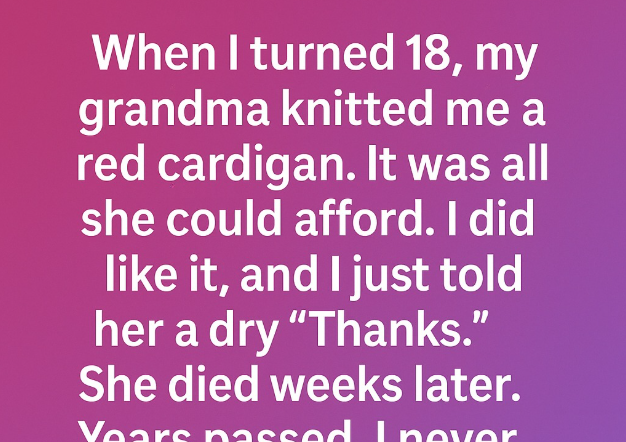
When I turned eighteen, my grandmother gave me a red cardigan she had knitted herself. It wasn't fancy or expensive, just soft yarn and her gentle hands weaving care into every stitch. I smiled, thanked her politely, and tucked it away at the back of my closet. I didn't realize it then, but that simple gift would one day become one of my greatest treasures.
My grandmother passed away a few months later. Life moved forward, and the cardigan stayed folded and forgotten until years later, when my fifteen-year-old daughter found it and asked if she could try it on. As she slipped her arms into the sleeves, something rustled in the pocket. Inside was a small envelope, yellowed with age, my name written in my grandmother's handwriting. My hands trembled as I opened it and read her words.
Back then, I had been too young to see love in something so humble. I thought gifts had to sparkle, come in shiny boxes, or bear famous labels. I never saw the love in her tired hands, the hands that had worked a lifetime, the hands that created something just for me.
My daughter hugged herself in the cardigan and smiled softly. "It feels so warm," she said. Tears filled my eyes. That warmth wasn't just from the wool. It was from generations of love stitched together. In that moment, I finally understood. Love doesn't always shout or shine. Sometimes it is quiet. Sometimes it is woven into a simple red cardigan.
Stories like this resonate because almost everyone has an object that carries a person with it: a watch, a recipe card, a quilt, a letter. This article explores why handmade gifts and keepsakes hold such power, how to preserve them, and how to pass their meaning to the next generation.
Why Handmade Gifts Carry So Much Weight
A handmade gift is never just an object. It is hours of someone's life, converted into something you can hold. When researchers talk about why we value certain possessions, three ingredients come up again and again, and handmade gifts contain all of them:
- Time. You can earn more money, but you cannot earn more time. Hours spent knitting, carving, or sewing are hours someone chose to give to you.
- Effort and skill. The imperfections in a hand-knitted sleeve are proof that a human being, not a machine, made it. Those small irregularities become signatures of care.
- Intention. A handmade gift is made for one specific person. It cannot be regifted casually or bought at the last minute. The intention is baked in.
That is why a simple cardigan can outshine an expensive present. The price tag measures money. The handmade gift measures devotion.
The Quiet Psychology of Keepsakes
Objects become memory anchors. Psychologists have long observed that physical items can trigger vivid recollections more powerfully than photographs alone, because touch, smell, and weight engage the senses together. A sweater still carries, faintly, the scent of a home. A handwritten note preserves the pressure of someone's pen, the loops of letters no one else writes quite the same way.
This is also why grief often attaches to objects. After someone dies, their belongings become some of the last physical connections we have. Keeping a grandmother's cardigan is not sentimentality for its own sake; it is a way of keeping a relationship alive in a form the heart can understand.
There is a healthy balance to find. Keeping one meaningful object and caring for it honors a memory. Keeping everything out of guilt can become a burden. The question to ask is simple: does this object connect me to love, or does it connect me to obligation?
How to Preserve Heirloom Textiles
If you are lucky enough to own a handmade garment from someone you love, a little care will keep it intact for decades, long enough to hand to your own children. Textile conservators recommend these basics:
- Clean before storing. Body oils and invisible stains attract insects and cause yellowing over time. Hand wash gently with a mild detergent made for delicates, or have the piece professionally cleaned.
- Store flat, never on a hanger. Gravity stretches knitwear out of shape. Fold the garment loosely.
- Use acid-free tissue. Place sheets of acid-free tissue paper between folds to prevent creases from becoming permanent and to buffer the fibers.
- Choose a cool, dark, dry place. Avoid attics and basements where temperature and humidity swing. A closet shelf in a living area is ideal.
- Protect against moths. Cedar blocks or lavender sachets help, but keep them from touching the fabric directly. Check stored textiles once or twice a year.
- Handle with clean, dry hands. Oils from skin transfer to fibers. This matters most for very old or fragile pieces.
- Document the story. Write down who made the item, when, and why. A note pinned to the storage box ensures the meaning survives even when memory fades. That yellowed envelope in the cardigan pocket did exactly this, by accident. You can do it on purpose.
Passing the Meaning to the Next Generation
An heirloom only stays meaningful if someone tells its story. Children will not automatically understand why an old sweater matters; they need the narrative. Here are ways to pass it on:
- Tell the story while the object is in use. Let your child wear the cardigan while you describe the hands that made it. Experience plus story creates lasting memory.
- Connect the object to values, not just nostalgia. "Your great-grandmother believed love shows up in actions" teaches more than "this is old."
- Invite participation. Fold it together, mend a loose button together, or add a small new detail, like a stitched initial and date. Each generation can leave a gentle mark.
- Create new handmade traditions. You do not need to knit. A yearly handwritten letter, a recorded recipe, or a photo album with captions all become future keepsakes.
- Let go of perfection. The goal is connection, not a museum. A cardigan that gets worn with love honors its maker more than one sealed in plastic.
When a Gift's Meaning Arrives Late
One of the most moving parts of the cardigan story is the delay. At eighteen, the gift was politely shelved. Years later, it became a treasure. This is more common than we admit.
Youth often measures love in excitement: the newest phone, the trendiest brand, the biggest surprise. Maturity measures love in consistency: the phone call every Sunday, the meal cooked without being asked, the sweater knitted stitch by stitch. Neither perspective is wrong; they are stages of understanding.
If you once undervalued someone's quiet love, that realization is not a reason for guilt. It is an invitation: to tell the story, to love the next generation in the same quiet, steady way. Love that arrives late is still love, and it still counts.
Frequently Asked Questions
Why do handmade gifts feel more meaningful than expensive ones?
Because they contain irreplaceable ingredients: the giver's time, effort, and specific intention toward you. An expensive gift can be impressive, but a handmade one is personal in a way money cannot replicate.
How should I store an old knitted garment so it lasts?
Clean it, fold it (never hang knitwear), layer acid-free tissue between folds, and keep it somewhere cool, dark, and dry. Check it yearly for pests or damage.
What if I don't have any heirlooms from my family?
You can start the tradition yourself. Write letters to your children, record family stories, or make something simple by hand. Future generations will treasure what you create today far more than you imagine.
Is it okay to use a keepsake instead of preserving it untouched?
In most cases, yes. Gentle, respectful use honors the maker's intention better than sealing the object away. Just take basic precautions and repair damage promptly.
How do I explain the value of old family objects to my kids?
Tell the story while they can touch and use the object. Connect it to a value ("she showed love through patience") rather than just its age. Children remember stories far longer than lectures.
The Takeaway
The most precious gifts aren't the ones that dazzle at first sight. They're the ones that wait quietly until your heart is ready to understand their worth. A red cardigan, soft with age, taught one family that love doesn't always shout or shine. Sometimes it is patient. Sometimes it is stitched, one loop at a time, by tired hands that loved you more than you knew.
Look around your own closet, your own drawers. Something there may be waiting for the day your heart is ready. And when that day comes, tell the story, wear it with pride, and pass it on. That is how quiet love becomes a legacy.