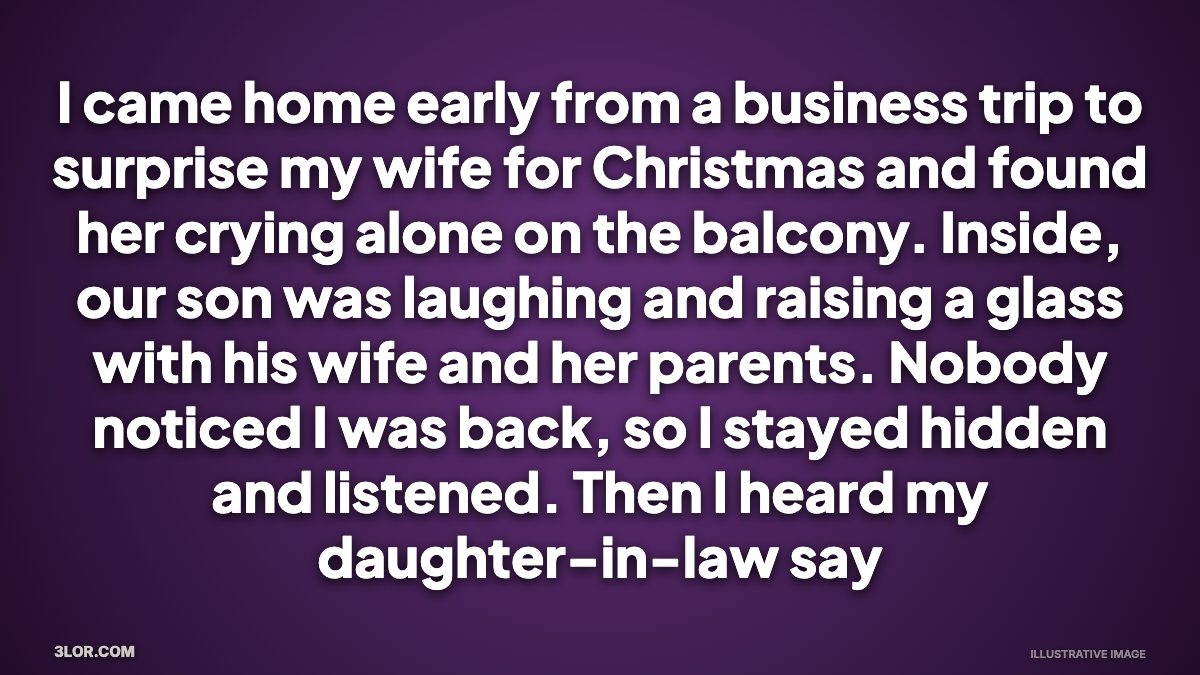
And they were doing it inside our house.
Martha Had Been Under Pressure for Weeks
I quietly walked back outside.
Martha was sitting on the patio, wrapped in a shawl and staring toward the garden.
When she saw me, she looked surprised.
“You came home early.”
Then her expression changed.
She began to cry.
I sat beside her and took her hand.
“How long has this been going on?” I asked.
She wiped her eyes.
“Three weeks.”
She explained that the conversations had started innocently enough.
At first, family members talked about “the grandchildren’s future.” Then they started bringing documents to her.
“They kept saying they were just papers,” she told me. “They said I only needed to sign them.”
“Did you sign anything?”
“No.”
She looked at me.
“I told them I wouldn’t sign anything without you.”
I asked why she hadn’t called me.
Her answer hurt more than I expected.
“You were finishing an important deal. I didn’t want to become another problem for you.”
I looked at my wife of thirty-five years.
She had spent much of her life supporting our family, working alongside me, and helping build the life we had together.
And somehow, she had reached the point where she was afraid that asking for help would make her a burden.
“Martha,” I said, “you are not the problem.”
She started crying again.
I squeezed her hand.
“Don’t sign anything. Whatever happens next, we’ll deal with it together.”
There was one other thing I didn’t tell her yet.
I already had an idea of what I needed to do.
A Call to Our Attorney
The next morning, before everyone else woke up, I called Daniel, our longtime attorney.
Two years earlier, Martha had expressed concerns about what could happen to our property and finances in the future.
I had asked Daniel whether there was a way to protect our home.
Now I needed to know exactly what we had done.
“Daniel,” I said, “remind me where we stand with the Monterey house.”
He immediately knew what I meant.
“The house was placed into an irrevocable trust,” he explained. “Martha is the lifetime beneficiary.”
“So nobody can simply transfer it?”
“Not without going through the legal requirements of the trust. It’s protected.”
I sat quietly for a moment.
For two years, the people pressuring Martha had apparently believed that one signature could give them control of the property.
They were wrong.
But I wasn’t finished.
I asked Daniel about the rest of our estate.
Our son Julian had previously been expected to receive a significant inheritance.
I decided it was time to reconsider that arrangement.
“Prepare new documents,” I told him. “I want Martha protected first. Julian’s inheritance should be structured differently.”
Daniel paused.
“You’re certain?”
“Yes.”
My decision wasn’t meant to punish my son simply because he had made mistakes.
It was about recognizing that continually protecting someone from the consequences of their choices can sometimes prevent them from becoming independent.
Christmas Morning
By Christmas morning, the house was full.
The tree was lit.
The grandchildren were opening presents.
Everyone appeared cheerful.
But I knew something they didn’t.
After breakfast, Audrey approached Martha with a folder.
“Martha,” she said, “while everyone is together, maybe we can finally take care of those papers.”
The room became noticeably quieter.
Martha looked uncomfortable.
Julian stared at the floor.
Richard leaned forward.
I stood up.
“Before we do that,” I said, “I have a few Christmas gifts.”
Everyone looked at me.
I walked toward the tree and picked up three envelopes.
The first one was for Julian.
“Open it.”
He slowly opened the envelope.
Inside was a record of the financial support I had provided him over the years.
It included money for living expenses, transfers, and other forms of assistance.
At the bottom was a total.
Julian stared at it.
Then he looked at me.
“What is this?”
“A reminder,” I said.
I handed him another sheet.
It was a job opportunity at one of our hotels.
The position was entry-level.
It wasn’t glamorous.
But it was honest work.
“The financial support ends January first,” I told him. “You’ve had plenty of opportunities. Now it’s time to build something for yourself.”
His face changed.
“Dad, I—”
“I love you,” I said. “That’s exactly why I can’t keep making every difficult part of your life disappear.”
He didn’t answer.
The Second Envelope
Then I turned toward Richard and Eleanor.
“This one’s for you.”
Richard opened it.
Inside was documentation concerning the trust protecting our home.
He read through the first pages.
His expression gradually changed.
Eleanor looked over his shoulder.
The confidence disappeared from both of their faces.
“There was never a simple form that Martha could sign to hand over the house,” I said.
Nobody spoke.
Then I looked toward Audrey.
“I also heard the conversation the night I came home.”
Her face went pale.
“I heard you discussing how to convince Martha to sign something while I was away.”
The room became completely silent.
I didn’t shout.
I didn’t need to.
“I heard every word.”
The Family Finally Had to Face the Truth
Richard tried to explain.
He talked about the children.
He talked about financial planning.
He insisted that everyone had misunderstood the situation.
But the explanations didn’t change what had happened.
Martha had been pressured inside her own home.
The people who claimed they were thinking about the family’s future had made her feel isolated and afraid.
I looked around the room.
“Everyone needs to leave.”
Nobody argued for long.
One by one, they collected their coats.
Julian was the last person standing near the door.
He looked devastated.
“Dad, I didn’t know how far they were going to take it.”
“I believe you,” I said.
And I did.
That was what made everything more complicated.
Julian wasn’t an evil person.
He was an adult who had become too dependent on his parents and too comfortable believing someone else would always solve his problems.
I gave him the job information again.
“The opportunity is still there,” I said. “But the financial support is ending.”
He nodded.
His eyes were wet.
Then he walked out.
A Quiet Evening With Martha
That evening, the house finally became quiet.
The Christmas lights were still glowing.
Martha sat on the couch with her feet tucked underneath her.
I sat beside her.
For several minutes, neither of us said anything.
Then I took her hand.
“You were right,” I said.
She looked at me.
“About what?”
“About our son.”
Years earlier, she had warned me that constantly rescuing him might eventually prevent him from learning how to stand on his own.
I hadn’t wanted to hear it.
I had believed that helping my son was simply part of being a good father.
But sometimes love means knowing when to stop protecting someone from every consequence.
Martha smiled.
“Took you long enough.”
I laughed quietly.
After thirty-five years together, she still knew exactly how to bring me back to reality.
I held her hand.
“Merry Christmas.”
“Merry Christmas.”
For the first time in weeks, the house felt peaceful.
Not because everything had been solved.
Not because our family was suddenly perfect.
But because the pressure and secrecy were finally gone.
And Martha knew she didn’t have to face any of it alone.
A Lesson About Family, Trust, and Boundaries
Family relationships can become complicated when money, property, and expectations are involved.
Helping relatives can be an important expression of love, but there also comes a point when healthy boundaries become necessary.
Financial support should not be used to control another person’s choices, and important legal documents should never be signed under pressure.
When property, inheritance, or major financial decisions are involved, getting independent legal advice can help everyone understand their rights and responsibilities.
Most importantly, trust within a family should be built on honesty rather than secrecy.
Final Thoughts
The most difficult part of the situation wasn’t discovering that people had discussed the house.
It was realizing how easily family members could convince themselves that their actions were justified because they believed they were doing something “for the family.”
Sometimes protecting the people you love means saying no.
Sometimes it means setting financial boundaries.
And sometimes, it means coming home early and finally seeing what has been happening when you weren’t there.
Fictional Story Disclaimer: This is a fictional story created for entertainment purposes. The characters, events, conversations, and circumstances are fictional. Any resemblance to actual people, families, or locations is coincidental. This story should not be interpreted as a factual account or as legal advice.