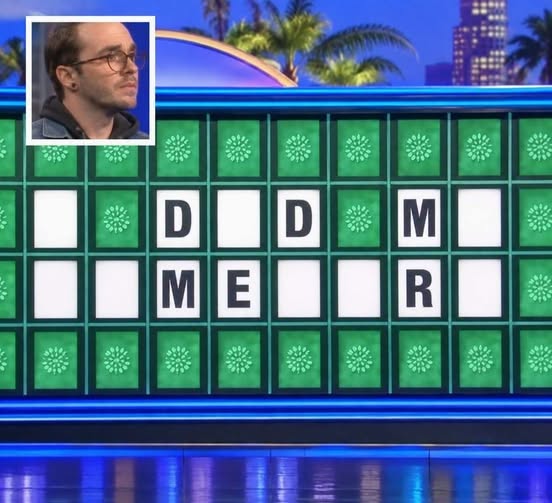
A recent Valentine’s Day episode of Wheel of Fortune gave viewers plenty to talk about after a difficult bonus-round puzzle ended with a contestant missing the answer by just seconds.
What began as a familiar game-show finale quickly became one of the more discussed moments of the episode. Viewers debated the wording of the puzzle, the difficulty of the “Phrase” category, and even the bonus prize that was revealed at the end.
At the center of the moment was Conner Kemmsies, a young pilot who had successfully made it through the game and earned a spot in the bonus round.
With a major prize potentially waiting behind the final puzzle, the pressure was high.
Then the clock started.
The Final Puzzle Proved Difficult
When the bonus round began, Kemmsies was presented with the familiar puzzle board and a limited amount of time to figure out the answer.
The category was “Phrase.”
As letters appeared on the board, viewers at home began trying to solve the puzzle themselves. Some believed the visible letters suggested a phrase beginning with something similar to “I DID MY,” leading to considerable discussion about what the completed answer could be.
But despite having only a short amount of time to work through the possibilities, Kemmsies was unable to provide the correct answer before the timer reached zero.
For viewers watching from home, the solution may have seemed easier once it was displayed. That is one of the interesting aspects of game shows like Wheel of Fortune: an answer can appear obvious after all of the letters and words have been revealed, while recognizing it under pressure can be much more difficult.
The moment immediately divided opinions.
Some viewers felt the puzzle was unusually challenging for a “Phrase” category. Others argued that contestants should expect difficult clues during the bonus round and that solving an unfamiliar expression with only seconds remaining is part of the challenge.
Why the Puzzle Created So Much Discussion
The biggest disagreement was not necessarily about Kemmsies’ performance.
Instead, many viewers focused on the construction of the puzzle itself.
Fans who were disappointed by the outcome questioned whether the answer felt like the kind of familiar phrase they would normally expect to see in that category. For these viewers, the difficulty appeared to come not simply from missing letters but from recognizing the intended expression.
Other fans were less critical.
They pointed out that the bonus round is designed to test a contestant’s ability to think quickly. Contestants do not receive unlimited time to consider every possible interpretation of the words on the board.
Under those conditions, even a phrase that seems familiar can suddenly become difficult to identify.
This difference in perspective helped fuel the online discussion.
One group looked at the puzzle and thought the answer was too difficult to reasonably identify in the time allowed. Another group viewed the same situation as an ordinary example of the uncertainty that makes the bonus round exciting.
The Pressure of the Bonus Round
There is another factor that is easy to overlook when watching from home.
Contestants are not solving these puzzles in a relaxed environment.
They are standing in front of a studio audience, cameras, and a television production crew while knowing that a substantial prize may depend on what they say during a few seconds.
That pressure can affect how quickly someone recognizes a word or phrase.
A contestant might know the individual words but struggle to connect them into the correct expression. Another contestant might immediately recognize the pattern. Neither outcome necessarily reflects how well someone would solve the same puzzle while sitting comfortably at home.
That is part of the appeal of the format.
Viewers can play along without having the same consequences attached to an incorrect guess.
Then Came the Bonus Prize Reveal
The puzzle was only part of the story.
After the round ended, the bonus prize was revealed as $40,000.
For some viewers, that added another layer of disappointment.
A $40,000 prize is still a substantial amount, but longtime Wheel of Fortune fans are familiar with the excitement surrounding the show’s larger bonus prizes. As a result, viewers who had been hoping for a bigger amount reacted strongly when the $40,000 card was revealed.
Some online comments also revived an old type of discussion surrounding game-show bonus wheels: how often particular prize amounts appear.
Certain viewers have claimed that they seem to see particular amounts more frequently than others. However, an individual episode—or even a viewer’s personal impression over several episodes—is not enough to establish that the wheel is manipulated.
Without complete official data showing how frequently each prize appears, such observations remain opinions rather than proven conclusions.
That distinction is important when discussing television moments online, where speculation can quickly be repeated as fact.
A Familiar Show Under a New Era
The timing of the episode also made the discussion interesting.
Wheel of Fortune is one of television’s best-known game shows, with generations of viewers familiar with its basic format.
The program has also entered a new chapter with Ryan Seacrest serving as host.
Whenever a long-running television show goes through a major hosting change, viewers naturally pay close attention. People compare the current presentation with what they remember from previous years, including everything from the host’s style to the pacing of the game and the way different rounds are presented.
That does not mean every unusual reaction is directly connected to the host.
In many cases, longtime fans simply notice more because they are deeply familiar with the program.
A difficult puzzle, an unexpected answer, or an unusual prize result can therefore generate more conversation than it might on a newer or less familiar show.
Why Viewers Love to Solve Alongside Contestants
One reason Wheel of Fortune continues to encourage strong audience participation is that viewers can play along.
Unlike many television competitions, the audience does not simply watch contestants compete. People at home can look at the letters on the screen and try to solve the puzzle themselves.
That creates a unique connection between the contestant and the audience.
When someone solves a difficult puzzle, viewers can celebrate the achievement.
When a contestant misses an answer that someone at home believes they knew, viewers can experience a very different reaction.
And when the solution itself surprises people, the discussion can continue long after the episode has ended.
The Kemmsies bonus round followed exactly that pattern.
Was the Puzzle Really Too Difficult?
There is no single answer that will satisfy everyone.
Puzzle difficulty is partly subjective.
A phrase that one person recognizes immediately may be completely unfamiliar to someone else. Age, vocabulary, reading habits, regional expressions, and personal experience can all affect how quickly someone recognizes a phrase.
The category also matters.
Viewers may approach a “Phrase” puzzle with certain expectations about what kind of expression will appear. If the final answer does not match those expectations, the puzzle can feel more difficult even when the individual words are recognizable.
That appears to be one of the main reasons this particular round generated so much discussion.
Rather than simply asking whether Kemmsies should have solved the puzzle, viewers began asking whether the puzzle itself matched their expectations for the category.
The Difference Between Playing at Home and Playing on Stage
Another important part of the debate is the difference between watching and competing.
At home, viewers can take their time.
They can look at the board without worrying about a ticking clock. They can discuss possible answers with family members. They can even pause or rewind a recording.
Contestants have none of those advantages.
The bonus round is intentionally fast.
A player has to process incomplete information and make a decision almost immediately. Even a contestant who is very good at word puzzles can have an unlucky moment when the right phrase does not come to mind quickly enough.
That is why a missed bonus puzzle does not necessarily tell the entire story about a contestant’s ability.
Sometimes the answer simply does not arrive before the clock does.
Social Media Keeps the Conversation Going
In the past, viewers might have discussed a surprising game-show moment with friends or family after an episode.
Today, those conversations can spread much more quickly.
A difficult puzzle can become the subject of posts, comments, screenshots, and short videos almost immediately after the program airs.
That creates a feedback loop.
One viewer expresses frustration, another viewer disagrees, and soon dozens of people are discussing the same few seconds of television.
The original event may have lasted less than a minute, but the online conversation can continue for days.
That appears to be what happened with this bonus round.
A Bigger Conversation About Modern Game Shows
The reaction also raises a broader question about what viewers want from modern game shows.
Should bonus puzzles be relatively familiar so that audiences have a reasonable chance of solving them alongside contestants?
Or should the final round be difficult enough that even experienced viewers are left guessing until the last moment?
There is no universally accepted answer.
Some fans enjoy the satisfaction of solving a puzzle before the contestant.
Others prefer the suspense created when the solution remains uncertain until the final seconds.
Game-show producers have to balance both experiences.
If puzzles are consistently too easy, the bonus round may lose some of its suspense. If puzzles become too difficult, viewers may feel disconnected from the game because they cannot recognize the intended answer.
The reaction to this episode shows just how closely audiences pay attention to that balance.
One Difficult Moment Became the Story
For Conner Kemmsies, the episode will likely be remembered for the bonus round that got away.
For viewers, however, the moment became something larger.
It brought together several familiar ingredients of a memorable game-show discussion: a contestant under pressure, a difficult puzzle, a ticking clock, an unexpected result, and a prize reveal that left some people wanting more.
None of those elements necessarily points to anything unusual behind the scenes.
Sometimes a television moment simply catches people’s attention because the outcome is surprising.
That appears to be the most straightforward explanation for why the episode generated so much conversation.
The Debate May Continue
Ultimately, viewers are likely to remain divided over the puzzle.
Some will continue to argue that the phrase was particularly difficult for a bonus round. Others will see it as an example of exactly what makes the final stage of Wheel of Fortune challenging.
The $40,000 prize reveal added another talking point, while speculation about prize frequency gave fans another reason to compare their impressions of previous episodes.
But opinions about the puzzle and prize should remain separate from claims about how the game is operated. Without verified evidence, assumptions about fairness or manipulation cannot be treated as established facts.
What is clear is that a few seconds at the end of a Valentine’s Day episode were enough to get viewers talking.
And that may be one of the enduring strengths of Wheel of Fortune: even after decades on television, a single puzzle can still give an audience something to argue about long after the final letters disappear from the board.