Brain teasers have become increasingly popular online, and for good reason. They’re fun, quick to read, and give your brain a small workout without feeling like hard work. One riddle in particular—the classic “six eggs” puzzle—continues to capture attention because it looks incredibly simple at first, yet often leads people to the wrong answer. The reason isn’t a lack of math skills, but how easily our minds rush past small details.
What makes riddles like this so appealing is their ability to challenge our assumptions. Instead of relying on complicated calculations, they test how carefully we read and how logically we process information. That’s why puzzles like this are shared widely on social media, in classrooms, and even during casual conversations. They spark curiosity and encourage people to pause and think.
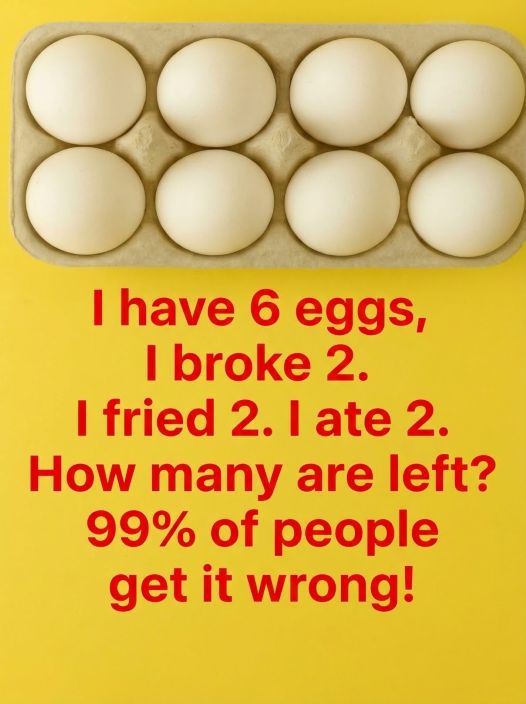
The riddle is usually presented in this way: “I have six eggs. I broke two, fried two, and ate two. How many eggs are left?” When people first see this question, many instinctively respond with “zero.” It feels natural to assume that each action involves a different pair of eggs. Adding the numbers together seems like the obvious approach, and most readers move on without questioning it further.
However, this quick answer is exactly where the trick lies. The riddle isn’t testing math skills at all—it’s testing attention to detail. When you take a moment to think about the steps involved, the situation becomes much clearer. Eggs must be broken before they can be cooked, and they must be cooked before they can be eaten. That means the same two eggs went through all three actions.
In other words, no extra eggs were used along the way. Only two eggs were broken, those same two were fried, and those same two were eaten. The remaining eggs were never touched. This small shift in perspective completely changes the outcome and shows how important it is to slow down and examine what’s actually being said.
Once the logic is clear, the answer becomes easy. You started with six eggs and used only two. That leaves four eggs remaining. The riddle works so well because it gently reminds us that our first instinct isn’t always correct, especially when we’re in a hurry.
Simple puzzles like this are a great reminder that good problem-solving isn’t about speed—it’s about clarity. Taking an extra moment to read carefully and think logically can make all the difference. That’s why riddles like the “six eggs” puzzle continue to entertain, educate, and surprise readers every time they’re shared.