A Fun Egg Riddle That Really Makes You Stop and Think
Brain teasers have become increasingly popular online, and for good reason. They are fun, quick to read, and give your brain a small workout without feeling like hard work. One riddle in particular, the classic "six eggs" puzzle, continues to capture attention because it looks incredibly simple at first, yet often leads people to the wrong answer. The reason is not a lack of math skills, but how easily our minds rush past small details.
What makes riddles like this so appealing is their ability to challenge our assumptions. Instead of relying on complicated calculations, they test how carefully we read and how logically we process information. That is why puzzles like this are shared widely on social media, in classrooms, and even during casual conversations. They spark curiosity and encourage people to pause and think.
The Riddle
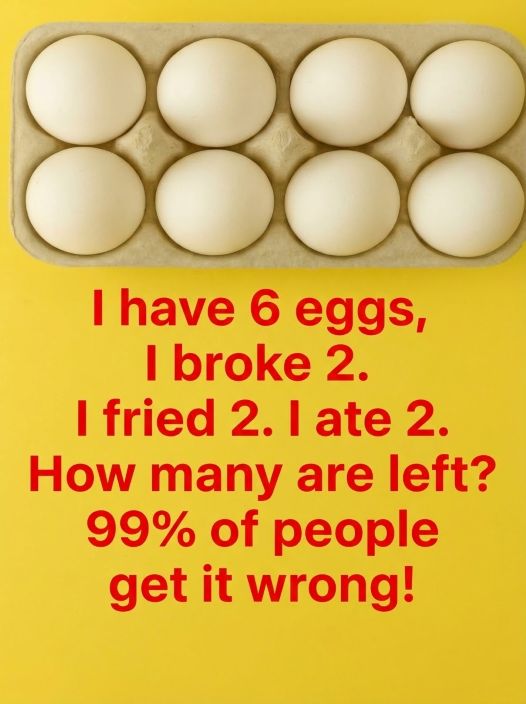
The riddle is usually presented in this way: "I have six eggs. I broke two, fried two, and ate two. How many eggs are left?"
When people first see this question, many instinctively respond with "zero." It feels natural to assume that each action involves a different pair of eggs. Adding the numbers together seems like the obvious approach, and most readers move on without questioning it further.
However, this quick answer is exactly where the trick lies. The riddle is not testing math skills at all. It is testing attention.
The Answer (and Why It Works)
Think it through step by step. You have six eggs. You break two. Which two would you break? The same two you are about to fry, of course. You break two eggs, then you fry those same two eggs, then you eat those same two eggs.
Two plus two plus two does not equal six different eggs here. It equals two eggs, each going through three stages: broken, fried, and eaten.
So how many eggs are left? Six minus two equals four. Four eggs remain, untouched.
The trick works because our brains love shortcuts. We see three actions involving the number two, and we add: 2 + 2 + 2 = 6, and 6 – 6 = 0. The fast, intuitive answer feels right, which is exactly why it is wrong. The riddle punishes rushing and rewards careful reading.
Why Our Brains Fall for It
Psychologists call this kind of error a failure of "slow thinking." Our minds have two modes: fast, automatic thinking that jumps to conclusions, and slow, deliberate thinking that checks the details. Riddles like the egg puzzle are designed to trigger the fast mode and punish it.
Several cognitive quirks are at work:
- Assumption of distinctness: We assume "broke two, fried two, ate two" refers to six different eggs, because the sentence lists them as separate actions.
- Number salience: The repeated number two dominates our attention, pushing us toward addition.
- Overconfidence: The riddle looks so simple that we do not bother to double check our reasoning.
- Narrative momentum: We read forward quickly, building a story, instead of stopping to model the actual situation.
These same quirks affect real world decisions far beyond riddles, from misreading contracts to misunderstanding statistics. Practicing on puzzles trains the valuable habit of slowing down.
More Riddles That Trick Smart People
If you enjoyed the egg riddle, try these classics on friends and family:
The bat and ball: A bat and a ball cost $1.10 in total. The bat costs $1.00 more than the ball. How much does the ball cost? Most people say ten cents. The correct answer is five cents. The intuitive answer feels right but fails the math.
The lily pads: Lily pads double in area every day. If the pond is fully covered on day 30, on which day was it half covered? Most people say day 15. The answer is day 29, since doubling means half coverage comes just one day before full coverage.
The farmer's eggs (a cousin of our riddle): A farmer has 17 sheep. All but 9 die. How many are left? Many people start subtracting. The answer is simply 9.
The light bulb: You have three switches and one bulb in another room. How do you determine which switch controls the bulb with only one trip? Turn on two switches, wait, turn one off, then go check: the warm dark bulb belongs to the switch you turned off.
Each of these works the same way as the egg riddle: the obvious answer is a trap, and careful thought reveals the truth.
Using Riddles to Sharpen Your Mind
Riddles are more than party tricks. Regular engagement with puzzles offers genuine cognitive benefits:
- Improved attention to detail: Riddles train you to notice what others skim past.
- Better logical reasoning: Working through puzzles strengthens step by step thinking.
- Cognitive flexibility: The best riddles require abandoning your first interpretation, a skill useful everywhere.
- Stress relief: A short puzzle provides a mental break that refreshes focus.
- Social bonding: Sharing riddles sparks conversation, debate, and laughter.
Teachers use riddles to make lessons memorable. Team builders use them to encourage creative thinking. And families use them to turn a quiet evening into a lively debate.
Tips for Solving Tricky Riddles
- Read every word twice: The trick is usually hiding in plain sight, in a word you glossed over.
- Question your assumptions: Ask yourself what you are taking for granted. The egg riddle assumes six different eggs.
- Draw it out: Visualizing the situation often reveals what pure thinking misses.
- Consider the simplest interpretation: Riddles rarely require advanced math. The answer is usually simpler than you think.
- Embrace being wrong: Every wrong answer teaches your brain to slow down next time.
Frequently Asked Questions
What is the answer to the six eggs riddle?
Four eggs are left. You break two eggs, fry those same two eggs, and eat those same two eggs, leaving four untouched.
Why do most people get it wrong?
Because the brain assumes each action involves different eggs and rushes to add 2 + 2 + 2. The riddle exploits fast, intuitive thinking.
Are riddles good for your brain?
Yes. They improve attention to detail, logical reasoning, and cognitive flexibility. They also provide enjoyable mental breaks that can refresh focus.
What age is appropriate for these riddles?
The egg riddle works for all ages. Children enjoy the surprise of the answer, while adults appreciate the lesson about careful thinking. They are popular in classrooms from elementary school through adult education.
Where did the six eggs riddle come from?
Like many classic brain teasers, its exact origin is unclear. It belongs to a family of "trick wording" puzzles that have circulated orally for generations before finding new life on social media.
The next time someone poses the egg riddle, you will know the answer. But the real prize is not getting it right. It is the reminder the riddle offers every time: slow down, read carefully, and never trust your first answer without checking. Four eggs remain, and one valuable lesson.