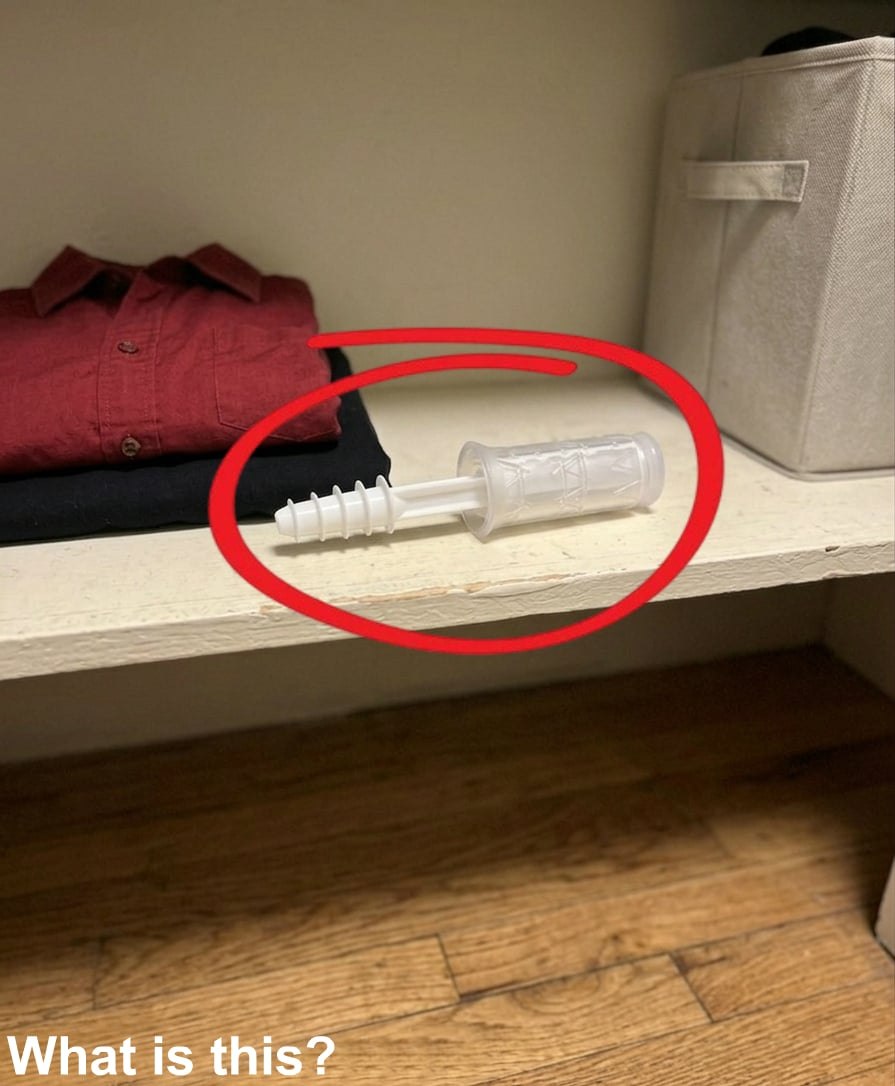
Earlier this evening, I opened my wife’s wardrobe while searching for an old jacket and noticed something unusual hidden behind a stack of folded clothes.
At first glance, the object looked like some kind of mysterious plastic gadget. I picked it up, turned it around several times, and spent nearly half an hour trying to understand what it could possibly be.
It had a strange shape — long and plastic with ridges on one side and a hollow section on the other. The more I looked at it, the more curious I became.
Naturally, my imagination started coming up with all kinds of theories.
Was it part of a kitchen appliance?
Maybe a tool left over from assembling furniture?
Or perhaps some forgotten attachment from a vacuum cleaner or garage equipment?
The fact that it was sitting alone inside the wardrobe only made the mystery feel even bigger.
But after finally identifying it, the answer turned out to be surprisingly simple.
It was actually a large plastic drywall anchor.
For anyone unfamiliar with home improvement tools, drywall anchors are commonly used when mounting items onto drywall or hollow walls. They may look unusual at first, but they serve a very practical purpose in many homes and apartments.
Drywall anchors come in many different shapes and sizes, which is why they often confuse people. Some are tiny and simple, while larger heavy-duty versions can look much more complicated.
The ridged or threaded section is designed to grip securely inside the wall once inserted into a drilled hole. When a screw is placed into the anchor, the plastic expands and locks firmly into position. This creates a much stronger and safer hold than inserting a screw directly into drywall.
Without anchors, screws can loosen over time or even pull out completely, especially when supporting heavier objects. Since drywall is relatively soft, anchors help distribute weight more evenly and improve stability.
Large drywall anchors are often used for mounting shelves, curtain rods, mirrors, towel racks, wall organizers, floating shelves, decorative fixtures, and other household items. Some heavy-duty versions can even support larger installations depending on their design and weight rating.
What first looked like a strange mystery object turned out to be nothing more than a simple piece of hardware commonly found in many homes.