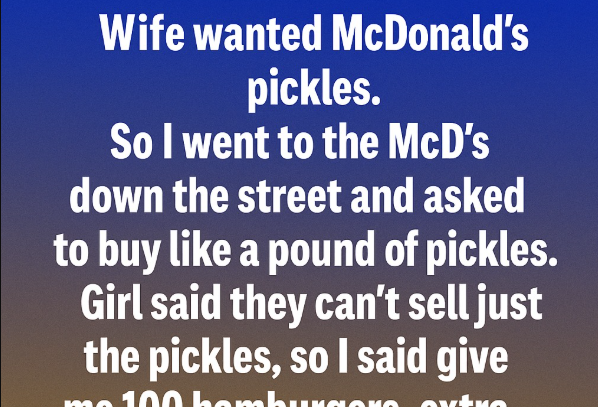
A Heartwarming Tale of Pickles and Kindness
Sometimes the simplest cravings lead to the most memorable moments. One evening, my wife, who was expecting our first child, developed an intense craving for the tangy pickles from our local fast food restaurant. Knowing how meaningful this was for her, I hopped in the car and drove off, determined to make her night.
When I arrived at the counter, I politely asked the cashier if it was possible to buy a container of just pickles. She apologized and explained that store policy did not allow pickles to be sold separately. For a moment, I considered turning back empty handed, but then inspiration struck. With a smile, I jokingly said, "In that case, I'll take 100 hamburgers with extra pickles, but hold everything else."
The cashier looked puzzled and went to get the manager. When the manager appeared, I quickly explained: "My wife is pregnant and craving your pickles. I just want to make her happy." The manager listened, smiled kindly, and disappeared into the back. A few moments later he returned holding a large container filled with fresh pickles. Handing it over, he said, "Take these to your wife. No charge."
That night, as my wife enjoyed her pickles with a huge grin, I realized it was not just about satisfying a craving. It was about love, understanding, and the unexpected generosity of a stranger. A simple act of kindness from that manager gave us a story, and a memory, that will stay with us forever.
Why Pregnancy Cravings Feel So Urgent
Anyone who has been through a pregnancy, or loved someone going through one, knows that cravings are not ordinary hunger. They arrive suddenly, feel intensely specific, and carry an emotional weight that is hard to explain to anyone who has not experienced it.
Scientists believe pregnancy cravings are linked to hormonal shifts, heightened senses of taste and smell, and the body's changing nutritional needs. But the psychology matters too. A craving becomes a mission because it represents care: the pregnant person's body is asking for something, and the people who love them want to deliver.
That is why the drive to the restaurant mattered as much as the pickles themselves. It was a husband saying, without words, "Your needs matter to me, even the small strange ones, especially the small strange ones."
The Manager's Choice: Policy vs. Compassion
The most remarkable part of this story is the manager's decision. Store policy was clear: pickles were not sold separately. Enforcing that policy would have been easy, defensible, and completely unremarkable. Nobody would have blamed him.
Instead, he chose compassion over procedure. He listened to the explanation, recognized a moment that mattered, and used his discretion to make someone's night better. The container of pickles cost the restaurant almost nothing. The goodwill it created was priceless.
This is the quiet power of frontline kindness. Managers, cashiers, and service workers make dozens of small discretionary decisions every day. Most go unnoticed. But every so often, one of those decisions becomes a story a family tells for years.
Good leadership often looks like this: knowing when the rule serves the customer and when the customer is better served by bending it.
Small Acts, Lasting Impact
Psychologists have a term for moments like this: they call them "moral elevation," the warm, uplifting feeling we get when we witness kindness. Stories of small generous acts spread because they remind us that goodness is ordinary, not exceptional.
Consider what that container of pickles actually accomplished:
- It validated a craving: The wife felt seen and cared for during a physically demanding time.
- It honored effort: The husband's late night drive was rewarded instead of frustrated.
- It modeled generosity: The manager showed his staff that kindness is part of the job.
- It created a memory: Years from now, this family will still talk about the pickle container.
- It inspired retelling: Every person who hears this story is slightly more likely to be kind to a stranger.
None of this required money, planning, or heroism. It required attention and a willingness to say yes.
Kindness in Everyday Places
We tend to associate meaningful kindness with grand gestures: charity galas, disaster relief, life saving rescues. But most kindness happens in unremarkable places: drive thru windows, grocery lines, parking lots, and fast food counters.
The manager in this story was not trying to be a hero. He was just a person who, for thirty seconds, chose to see the human being in front of him rather than the policy manual behind him. That is all it took.
If you work in customer service, you hold this power every shift. If you are a customer, you can create the conditions for it with patience, politeness, and a clear explanation of what you need. Kindness is collaborative: the husband's good humor and honesty made it easy for the manager to say yes.
Lessons for Expecting Couples
Beyond the heartwarming surface, this story carries practical wisdom for couples navigating pregnancy together:
- Take cravings seriously: They may seem funny, but honoring them communicates love and attentiveness.
- Communicate needs clearly: The wife expressed what she wanted. The husband acted on it. Simple, but essential.
- Share the load: Pregnancy is physically demanding. Small acts of service, like a late night drive, distribute the weight.
- Find humor together: The "100 hamburgers" joke turned a potential frustration into a funny memory.
- Notice kindness: Actively appreciating the good in strangers trains you to see more of it everywhere.
Years from now, the baby will not remember the pickles. But the parents will remember how they felt that night: cared for, connected, and lucky.
Frequently Asked Questions
Are pregnancy cravings real or just psychological?
They are very real. Hormonal changes during pregnancy alter taste and smell sensitivity, and the body's shifting nutritional needs can drive specific food desires. The emotional component is real too, but the cravings themselves have a physiological basis.
Why are pickles such a common pregnancy craving?
Pickles are sour, salty, and crunchy, a combination that many pregnant people find satisfying. Some researchers suggest the salt craving may relate to increased blood volume during pregnancy, while others point to the way strong flavors cut through pregnancy related nausea.
Is it okay for restaurants to bend policy like the manager did?
Most businesses give managers discretion to handle special situations. Using that discretion to create a positive customer experience, especially at minimal cost, is widely considered good management rather than a policy violation.
How can I show kindness in small everyday moments?
Listen fully before responding, look for low cost ways to say yes, remember that the person in front of you has a story you cannot see, and treat policy as a guide rather than a cage when compassion calls for flexibility.
Why do small acts of kindness feel so powerful?
Because they are unexpected and personal. Grand gestures are impressive, but small kindnesses feel intimate. They signal that someone noticed you specifically, and that sense of being seen is deeply meaningful.
That night ended with a wife's huge grin, a husband's quiet satisfaction, and a manager who probably never realized his container of pickles would become a family legend. But that is how kindness works. It rarely announces itself. It just shows up, in a paper container, free of charge, and changes the flavor of an ordinary evening forever.