
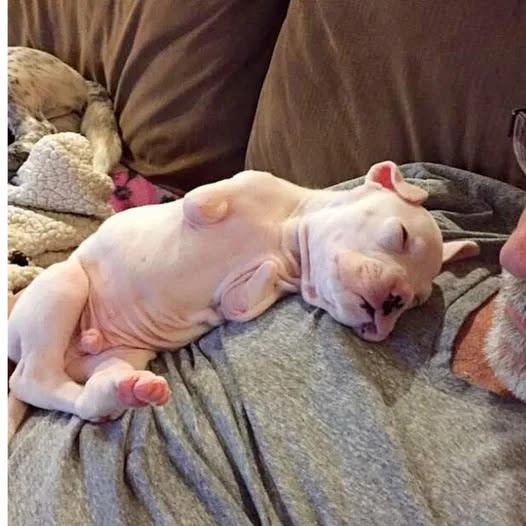
Born Without Front Legs, Puppy Defies Odds Thanks to His Loving Foster Parents
Nubby's life nearly ended before it even began. Born without front legs and unable to nurse properly, the tiny pup faced overwhelming challenges from his very first hours. At just four hours old, a veterinarian, believing his chances of survival were slim, suggested euthanasia as the best option.
However, Lou and Mark Robinson, a compassionate couple from Texas known for rescuing and fostering unwanted dogs, saw something different in Nubby. They saw a will to live, a spark of hope that was too precious to extinguish.
Despite the difficult prognosis, the Robinsons decided they couldn't give up on this tiny puppy. They saw potential where others saw only limitations. Determined to give Nubby the best chance at life, Lou and Mark took immediate action, providing the loving care and attention he so desperately needed.
Nubby's journey was far from easy, but with the Robinsons' unwavering dedication, he began to thrive. He adapted to life without front legs with the help of specially designed equipment and intense physical therapy. With each step, he proved that no obstacle was too great to overcome.
Today, Nubby is a happy, playful pup who defies the odds. His transformation from a helpless newborn to a thriving dog is a testament to the extraordinary bond between animals and humans, and the life-changing impact of foster care and rescue. Lou and Mark Robinson's decision to never give up on Nubby has inspired countless others to believe in the power of second chances.
Nubby's First Hours: Why They Were So Critical
A newborn puppy's first day is a race against the clock even under the best circumstances. Puppies are born blind, deaf, and unable to regulate their own body temperature. They depend entirely on nursing, both for nutrition and for the antibody-rich first milk that protects them while their immune systems develop.
For Nubby, born without front legs, even this most basic task was a struggle. Nursing requires a puppy to brace, push, and maneuver itself into position against its mother. Without front legs to anchor himself, Nubby could not nurse properly, which meant he was at immediate risk of dehydration, low blood sugar, and fading, a term rescuers use for newborns who lose the will to fight.
That is the context behind the veterinarian's suggestion of euthanasia at just four hours old. From a purely medical standpoint, the odds looked overwhelming: a puppy who could not feed himself, with a congenital condition that would require a lifetime of specialized care. The vet's recommendation was not made lightly, and it is one that veterinarians sometimes face with severely compromised newborns.
But odds are not certainties, and Lou and Mark Robinson chose to bet on the puppy in front of them.
The Couple Who Saw a Spark
Lou and Mark Robinson of Texas were already known in rescue circles for taking in unwanted dogs, the animals other people had given up on. That experience mattered enormously. Caring for a newborn with Nubby's needs is not something a first-time foster could easily manage; it requires round-the-clock feeding, careful monitoring, and the confidence to make hard decisions.
What the Robinsons saw in Nubby was what experienced rescuers learn to recognize: the will to live. A puppy who fights to nurse, who responds to warmth and touch, who keeps trying, is telling you something. The Robinsons listened.
Their decision illustrates a principle at the heart of rescue work: every life, no matter how fragile, is worth fighting for. It is easy to agree with that in the abstract. It is much harder at 3 a.m., bottle-feeding a puppy the size of your palm, knowing the road ahead is long. The Robinsons did it anyway.
The Hard Work Behind the Happy Ending
Stories like Nubby's can make recovery look simple, but the reality involves months of patient, skilled care. While every case is different, here is what rehabilitation for a puppy with a condition like Nubby's generally involves:
Around-the-clock feeding. A newborn who cannot nurse needs bottle or tube feeding every couple of hours, day and night, with careful attention to temperature, formula, and the puppy's weight gain. Even a small setback can be dangerous at that size.
Physical therapy. As the puppy grows, targeted exercises build strength in the muscles he does have, improve balance, and teach him to move confidently. Hydrotherapy, gentle range-of-motion work, and supervised play on safe surfaces are common tools.
Specially designed equipment. Nubby's story mentions equipment built for his needs. For dogs missing limbs, this can mean custom carts or wheelchairs that support the body while allowing independent movement, protective gear for the chest and remaining limbs, and adapted bedding and feeding setups. Modern mobility aids have transformed what is possible for disabled dogs.
Ongoing veterinary care. Regular checkups monitor weight, joint health, skin condition (dogs who move differently can develop pressure sores), and overall development. The care plan evolves as the dog grows.
Patience above all. Progress is measured in weeks and months, not days. Setbacks happen. The caregivers who succeed are the ones who keep showing up.
A Note on the Euthanasia Decision
It is worth pausing on the hardest moment in Nubby's story: the veterinarian's suggestion of euthanasia when he was four hours old. It is easy to cast this as the villain of the story, but the reality is more nuanced.
Veterinarians who suggest euthanasia for severely compromised newborns are usually trying to prevent suffering. They see the medical probabilities, the likelihood of pain, and the enormous resources required, and they weigh those against the animal's chance of a good life. In many cases, that judgment is correct, and it spares an animal prolonged distress.
What makes Nubby's story remarkable is not that the vet was wrong to raise the question, but that the Robinsons had the experience, resources, and devotion to prove the exception. Not every puppy in Nubby's position would have had that outcome, and not every family could provide what he needed. That is not a failure; it is a reminder of why experienced foster homes are so precious, and why supporting them matters.
Life With a Two-Legged Dog: What It Really Looks Like
Dogs are astonishingly adaptable. Canine behaviorists often note that dogs do not mourn their limitations the way humans might; they simply learn to work with the body they have. A dog missing front legs learns to balance, scoot, hop, or use a cart with a cheerfulness that regularly surprises their humans.
That said, special-needs dogs do need thoughtful care:
- Weight management is crucial, since extra pounds strain the remaining limbs and joints.
- Joint support, including vet-approved supplements and low-impact exercise, helps protect the body over a lifetime.
- Skin checks catch pressure sores or irritation early, especially where the dog's body contacts the ground.
- Mental stimulation matters as much as physical care. Puzzle toys, training, and play keep a disabled dog's mind engaged and happy.
- A safe environment with ramps instead of stairs, non-slip surfaces, and adapted spaces lets the dog move independently and confidently.
The reward, fosters consistently report, is a bond of unusual depth. Dogs like Nubby seem to know they were given a chance, and they repay it with boundless affection.
How You Can Help
Nubby's story ended in joy because two experienced fosters said yes. Here is how you can be part of more stories like his:
- Foster. Shelters and rescues are desperate for foster homes, especially for medical and special-needs cases. Fostering is temporary, and rescues typically cover vet costs.
- Adopt a special-needs animal. Disabled pets are often the last to be adopted and the most grateful. Ask shelter staff for an honest picture of the care involved so you can prepare.
- Donate. Medical fosters like Nubby's generate real bills: formula, equipment, therapy, vet visits. Even small donations to local rescues add up.
- Volunteer. Transport, socializing, cleaning, fundraising: rescues run on volunteer hours.
- Spay and neuter. Fewer unwanted litters means fewer puppies born into situations where a condition like Nubby's becomes a death sentence.
Every second chance starts with someone willing to see potential where others see only limitations. Lou and Mark Robinson were those people for Nubby. Perhaps you can be that person for another animal waiting in a shelter right now.



