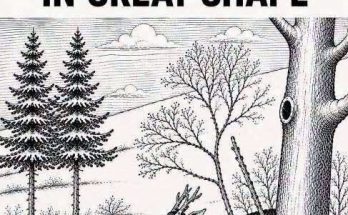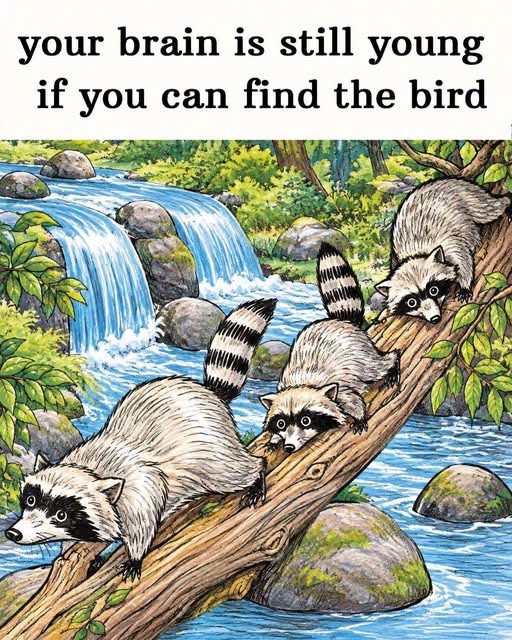
At first glance, this peaceful forest illustration looks like a simple nature scene.
Several playful raccoons appear to be enjoying their surroundings. A fallen tree stretches across the landscape, while rocks, leaves, branches, and a small stream fill the background with intricate details.
Nothing seems particularly unusual.
But there is a secret hiding inside the picture.
Somewhere among those trees, rocks, animals, and winding lines is a cleverly concealed bird.
The challenge is simple: Can you find it?
It sounds easy when you know exactly what you are looking for. Yet many people discover that knowing there is a bird somewhere in the image does not necessarily make it easier to spot.
The reason is that the bird has been incorporated into the surrounding artwork rather than being placed in an obvious, isolated position.
Your eyes may pass over it several times before your brain finally recognizes the shape.
That is what makes this type of visual puzzle so entertaining.
The Forest Scene Looks Simple at First
When you first look at the illustration, your brain immediately begins identifying familiar objects.
You may notice the raccoons first.
Then your attention might move toward the large fallen tree.
After that, you may notice the rocks, leaves, branches, and stream.
Because each object is familiar, your brain quickly creates a mental picture of the entire scene.
This is useful when looking at an ordinary landscape.
However, it can make hidden-object puzzles more difficult.
Instead of carefully analyzing every line, your brain tends to group lines together and decide what they represent.
A curved collection of lines becomes a tree branch.
Several overlapping shapes become leaves.
A rounded outline becomes a rock.
A dark section becomes part of an animal.
Once your brain has made those decisions, you may stop questioning them.
And that is exactly where the hidden bird can remain unnoticed.
The Raccoons Are Designed to Capture Your Attention
The raccoons are among the most obvious elements in the picture.
Their faces and bodies immediately stand out because they are recognizable animals.
Their striped tails also provide strong visual patterns.
When viewers first examine the image, they often spend most of their attention looking at these characters.
That makes perfect sense.
When someone tells you there is a hidden bird in a forest scene, you might expect the bird to be near another animal or somewhere in the center of the picture.
But the most obvious objects can actually become distractions.
The more time you spend examining the raccoons, the less attention you may give to the surrounding scenery.
The hidden bird takes advantage of that.
It becomes part of the forest rather than competing with the raccoons for attention.
Why the Hidden Bird Can Be So Difficult to See
The challenge is not necessarily about eyesight.
Instead, it has a lot to do with how we interpret visual information.
The illustration contains numerous overlapping lines.
Some belong to animals.
Others belong to trees, branches, rocks, leaves, and other parts of the landscape.
Because all these elements are drawn in a similar style, they can visually blend together.
A line that seems completely ordinary at first may become important once you recognize the larger shape it helps create.
This is why hidden-picture puzzles can feel almost impossible at first and surprisingly obvious later.
Before you find the bird, you see dozens of unrelated lines.
After you find it, those same lines suddenly appear to make sense.
Try Ignoring the Main Characters
If you have been focusing on the raccoons, try something different.
For a moment, pretend they are not there.
Move your attention away from the animals and toward the surrounding environment.
Look at the fallen tree.
Then examine the rocks.
Look at the branches and leaves.
Follow the outline of the stream.
Pay attention to the areas where several different objects overlap.
This can help because your brain is no longer locked onto the most recognizable features of the illustration.
Instead of searching for a bird directly, search for an unusual shape.
Ask yourself whether a section of the picture could be interpreted differently.
A shape that looks like part of a tree might actually contribute to the outline of the hidden animal.
Search the Picture in an Organized Way
Another useful strategy is to avoid scanning randomly.
When people try to solve visual puzzles, they often jump from one interesting area to another.
They notice a raccoon.
Then a rock.
Then the tree.
Then another animal.
Then they return to the same areas.
This can create the illusion that they have carefully searched the entire picture when they actually have not.
A more organized approach is to divide the illustration into sections.
Start at the top.
Move slowly from left to right.
Examine each area before continuing downward.
Once you reach the bottom, you will have systematically covered the entire picture.
If you do not find the bird on your first pass, repeat the process.
But this time, look specifically for shapes that could form a bird’s body.
Look for the Basic Shape of a Bird
You do not need to recognize a complete bird immediately.
Instead, look for individual features.
Could one shape be a head?
Could another line form a beak?
Is there a curved area that could represent a wing?
Could a pointed shape be a tail?
Sometimes recognizing just one of these features is enough.
Once you notice one part of the hidden figure, the rest may suddenly become visible.
This is especially helpful in a detailed black-and-white illustration because there may not be a clear boundary separating the hidden animal from the surrounding scenery.
Pay Attention to the Fallen Tree
The fallen tree is another major feature that can distract your eyes.
Its size makes it one of the most noticeable elements in the landscape.
Branches and irregular shapes around the trunk create additional visual complexity.
That makes the area worth examining carefully.
Do not simply look at the tree as a tree.
Study the individual lines surrounding it.
Look at the spaces above and below the trunk.
Examine where the branches meet other objects.
Sometimes hidden shapes are created by the combination of several objects rather than by one single line.
The Empty Spaces May Be More Important Than You Think
Most people concentrate on the objects in a picture.
They look at the animals.
They look at the trees.
They look at the rocks.
But the empty spaces between those objects can also create meaningful shapes.
Try looking at the background itself.
What shape does the gap between two branches create?
What does the space between a rock and the tree look like?
Could several small empty areas combine to form part of another figure?
This way of looking at a picture can feel strange at first.
Instead of asking, “What is this object?” you are asking, “What shape does this space create?”
That change can sometimes reveal details that were previously overlooked.
The Black-and-White Style Adds Another Challenge
Color can make visual information easier to separate.
For example, a bright green leaf might immediately stand apart from a brown tree trunk.
A colorful bird might be easy to identify against a pale background.
But this illustration uses a black-and-white style.
Many objects are constructed from similar lines and patterns.
As a result, there is less visual separation between the different elements.
The hidden bird does not have a bright color that announces its presence.
Instead, it relies on shape.
That means you need to pay attention to outlines, curves, angles, and the way several lines interact with one another.
Your First Interpretation May Be Misleading
One of the most interesting aspects of hidden-picture puzzles is that your first interpretation of an object can influence everything you see afterward.
Imagine looking at a particular group of lines and deciding that they belong to a tree.
Once you have made that decision, your brain is likely to continue interpreting those lines as part of the tree.
You may not stop to consider that the same lines could also contribute to another shape.
This is one reason staring at the exact same area for a long time may not help.
Your brain can become comfortable with its first interpretation.
Instead, change your approach.
Look away from the picture for a moment.
Then look back and pretend you have never seen the image before.
Try to observe the shapes without immediately assigning them names.
You may notice something new.
Try Looking From Farther Away
If you are looking at the puzzle on a computer or phone, changing your viewing distance can sometimes be useful.
Move slightly farther away from the screen.
When you are close to the image, individual lines and tiny details can dominate your attention.
From farther away, those details may combine into larger shapes.
You can also try making the image smaller on your screen.
The hidden figure may become easier to recognize when you see the overall composition rather than focusing on individual lines.
Of course, the opposite approach can work too.
Zoom in and inspect one small section at a time.
The important thing is to change the way you are processing the image.
Don’t Rush Because of the Challenge
A visual puzzle can create a natural sense of urgency.
Once you know there is something hidden in the picture, you may want to find it immediately.
That can lead to rapid scanning.
But speed is not always helpful.
When your eyes move too quickly, you may repeatedly skip over the same subtle details.
Instead, slow down.
Spend a few seconds examining each section.
Give yourself time to question the shapes you see.
The goal is not simply to look at every part of the image.
The goal is to look at each part differently.
Try Looking at the Illustration Upside Down
If you are completely stuck, another interesting experiment is to change the orientation of the picture.
Turn your screen or image around if possible, or simply imagine the scene from a different direction.
Changing orientation can sometimes interrupt the way your brain has been interpreting familiar shapes.
A tree may no longer look like a tree in exactly the same way.
A rock may appear to have a different outline.
And a hidden figure that was difficult to recognize from one direction may become easier to identify from another.
This does not always work, but it can be an interesting way to reset your visual attention.
Take a Short Break
If you have been searching for several minutes without success, stop for a moment.
Look away.
Give your eyes a short break.
Then return to the image.
This may sound too simple, but it can help because you are no longer staring at the same patterns continuously.
When you return, try to approach the puzzle as though you are seeing it for the first time.
Look beyond the raccoons.
Look beyond the tree.
Look beyond the obvious objects.
Search for the unexpected.
Why Hidden-Object Puzzles Are So Entertaining
Part of the appeal of these puzzles is the feeling of discovery.
At the beginning, the image appears ordinary.
Then you learn that something is hidden inside it.
Suddenly, every detail becomes interesting.
A branch might be important.
A rock might be part of the answer.
An unusual curve might suddenly make sense.
The viewer becomes an investigator, trying to understand how the artist constructed the illusion.
And when the hidden figure is finally recognized, the experience changes completely.
The picture may suddenly seem much easier than it did just a few moments earlier.
The Moment Everything Finally Makes Sense
There is often a satisfying moment when the hidden bird becomes visible.
Before that moment, you might think you have searched everywhere.
You may even begin to wonder whether the bird is actually there.
Then you notice a small shape.
You look again.
Suddenly, you can see the head.
Then the body.
Then the rest of the outline.
And once you have recognized it, it becomes difficult to stop seeing it.
That is one of the most enjoyable characteristics of hidden-object puzzles.
The artist has not changed anything.
Your brain has simply changed the way it interprets the same information.
Can You Find the Hidden Bird Without a Hint?
Before searching for any additional clue, give yourself another chance.
Start from one corner of the illustration.
Move slowly across the image.
Examine the spaces around the raccoons.
Look carefully at the fallen tree.
Inspect the rocks and vegetation.
Then follow the stream and the surrounding areas.
Do not assume that the most detailed part of the picture is necessarily the most important.
Sometimes the answer is hidden in a surprisingly ordinary-looking section.
And remember: the bird is supposed to blend in.
If it immediately stood out, there would not be much of a puzzle.
A Different Way to Think About the Challenge
Instead of searching for something that looks exactly like a bird, search for something that could become a bird once you change your perspective.
Look for curves.
Look for angles.
Look for a possible head and beak.
Look for a shape that could represent a wing.
Look for an outline that does not quite match the object you initially thought it belonged to.
This approach can be more effective than simply scanning the picture and hoping the bird suddenly catches your eye.
Don’t Give Up Too Quickly
If you have not found the bird yet, you are certainly not alone.
Hidden-object puzzles are designed to take advantage of the way people naturally process images.
The more familiar the surrounding objects are, the easier it can be for the hidden shape to disappear into them.
The key is to keep changing your perspective.
Look at the large objects.
Then look at the small details.
Look at the spaces between objects.
Then look at the overall picture.
Move closer.
Move farther away.
Take a short break.
Then try again.
Each approach gives your brain a different way to interpret the same scene.
Have You Finally Spotted It?
The raccoons may be the first thing you notice when you look at the forest illustration.
The fallen tree may be the second.
The rocks, branches, leaves, and stream may fill the rest of your attention.
But somewhere among all those details, the hidden bird is waiting to be discovered.
The real challenge is not simply seeing more.
It is learning to see differently.
So take one final look at the illustration.
Forget the raccoons for a moment.
Ignore the obvious scenery.
Follow the unusual lines.
Study the empty spaces.
Look for a shape that could have another meaning.
And most importantly, give yourself enough time to examine the picture carefully.
Can you find the hidden bird?
If you spotted it quickly, you may have a sharp eye for visual details.
If it took several minutes, that is exactly what makes the puzzle fun.
Once you finally see the hidden bird, take another look at the rest of the picture.
You may be surprised by how obvious it suddenly seems.