Excluded Yet Asked to Cook? My Response Rooted in Self-Respect: A Story About Knowing Your Worth
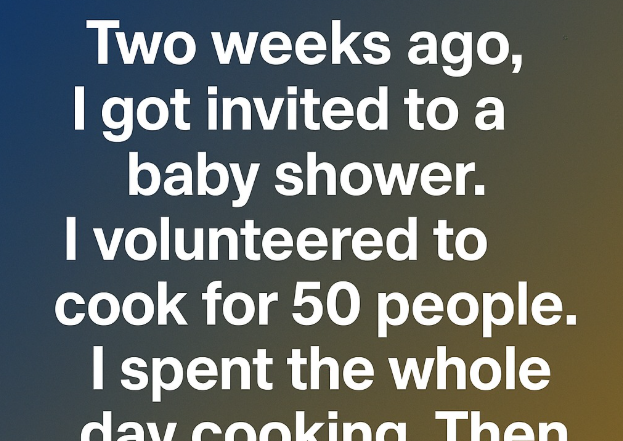
There's a fine line between generosity and being taken for granted, and sometimes, life offers the perfect moment to remind us of that truth. Just two weeks ago, I was thrilled to help a close friend with her baby shower. Cooking has always been my love language. What happened next taught me something I will never forget about boundaries, worth, and the difference between giving freely and being used.
The Joy of Cooking for Someone You Love
Cooking has always been my love language, and the idea of preparing a joyful feast for fifty guests filled me with excitement. I spent hours planning a beautiful menu, shopping for the best ingredients, and filling my kitchen with the aromas of anticipation. Every dish was made with care, every detail considered.
This is what generosity feels like at its best: voluntary, joyful, and rooted in love. I was not keeping score. I was not expecting payment or even public credit. The pleasure was in the act itself, in imagining my friend's face when she saw the table, in knowing I had contributed something meaningful to a milestone in her life.
Anyone who cooks for people they love understands this feeling. The kitchen becomes a place of devotion. The hours do not feel like labor. They feel like love made tangible.
The Message That Changed Everything
Then, the night before the event, everything changed. A message popped up on my phone from the host, cheerful in tone, yet cutting in meaning. She informed me that due to "space constraints," I would no longer be attending the celebration. However, she still expected me to deliver all the food.
No apology, no explanation, just instructions, as if my time, effort, and presence did not matter.
I stared at my screen in disbelief. Let me be clear about what was being asked: I was good enough to cook for fifty people, to spend my money on ingredients, to give my time and skill, but not good enough to occupy a chair at the event. My labor was welcome. I was not.
Generosity Is Not Obligation
For a moment, I sat with the hurt. Then I sat with the principle underneath it. Generosity should never be mistaken for obligation. I had offered to cook as a friend celebrating a friend. That offer was inseparable from the relationship. You cannot remove the person from the gift and still call it the same gift.
I calmly reached out, asking for clarification. Her reply was vague and dismissive, and that hurt more than I expected. There was no acknowledgment of what she was asking, no recognition that uninviting the cook while keeping the food was, to put it plainly, an astonishing thing to do.
Cooking for others has always been a gesture of love for me, not a transaction. And a gesture of love, once its conditions are rewritten without my consent, becomes something else entirely.
Setting the Boundary
So, after taking a deep breath, I decided to set a boundary, respectfully but firmly. I replied that if I was not welcome at the event, I would not be able to provide the food.
I want to be precise about what this was and was not:
- It was not revenge. I did not spoil the food or sabotage the event. I simply withdrew my labor.
- It was not an ultimatum. I did not demand to be invited. I accepted the uninvitation and followed it to its logical conclusion.
- It was not dramatic. No public confrontation, no group chat exposé, no scorched earth. A private, clear message.
- It was self-respect. If my presence was not valued, my cooking would not be available either. The two were never separate.
Her response, or lack of one, confirmed everything. When someone shows you that your worth to them is purely functional, believe them the first time.
Why Boundaries Feel So Hard
If setting this boundary was the right thing, why did it feel so awful? Because boundary-setting, especially for people who express love through giving, triggers a cascade of uncomfortable feelings:
- Guilt. Am I being petty? Am I ruining her baby shower?
- Fear. Will this end the friendship? Will people think I am difficult?
- Grief. The friendship I thought I had may not exist in the form I imagined.
- Self-doubt. Maybe I am overreacting. Maybe space constraints are real.
Here is what I have learned: guilt is not evidence of wrongdoing. It is often just the discomfort of doing something unfamiliar. I had spent years saying yes reflexively. Saying no, even a justified no, felt like breaking a law of my own personality. It was not. It was the first honest thing I had done for myself in that friendship in a long time.
The Difference Between Being Kind and Being Used
This experience clarified a distinction I now carry everywhere:
- Kindness is offered. It flows from willingness and can be withdrawn without guilt.
- Being used is extracted. It flows from someone else's assumption that your giving is automatic.
- Kind people can say no. In fact, the ability to say no is what makes yes meaningful.
- Gratitude matters. A simple, genuine thank you sustains generosity. Its absence starves it.
My friend did not just uninvite me. She revealed that she saw my cooking as a service rather than a gift. Services can be canceled. Gifts given in love deserve the giver's presence.
What I Would Tell Anyone in This Situation
- Pause before responding. The first reply you want to send is rarely the best one. Breathe, then decide.
- Name what happened plainly. "I was uninvited but asked to deliver the food" is clearer than the story your guilt wants to tell.
- Withdraw, do not retaliate. There is a world of difference between declining to cook and trying to ruin the event.
- Accept what the response tells you. How someone reacts to your boundary tells you everything about the relationship.
- Keep cooking. Do not let one person's entitlement poison the love language itself. Cook for people who cherish both the food and the cook.
The Aftermath
In the days that followed, mutual friends heard versions of the story. Some understood immediately. Others suggested I was overreacting, which taught me something valuable about whose opinions to weigh. The people who have never set a boundary will always find yours excessive. That is their limitation, not your error.
My friend and I are not as close as we were. Perhaps we will find our way back to something honest. Perhaps not. What I know is that I can now enter my kitchen without the quiet resentment that had been building for longer than I admitted. The food I cook now goes to tables where I am also welcome, and it tastes better for it.
Frequently Asked Questions
What happened with the baby shower?
The narrator volunteered to cook for a friend's baby shower for fifty guests, then received a message the night before uninviting her due to "space constraints" while still expecting her to deliver all the food.
How did she respond?
She calmly declined to provide the food, explaining that if she was not welcome at the event, she could not cater it. The response was respectful and private, not retaliatory.
Why is this a story about self-respect rather than revenge?
Because she simply withdrew her own labor rather than sabotaging anything. The boundary was about her worth, not about punishing her friend.
What is the main lesson?
That generosity must be voluntary to remain generosity, that boundaries protect both the giver and the gift, and that how someone responds to your boundary reveals the true nature of the relationship.