Firefighter Suffers Severe Burns His Life Seven Years Later
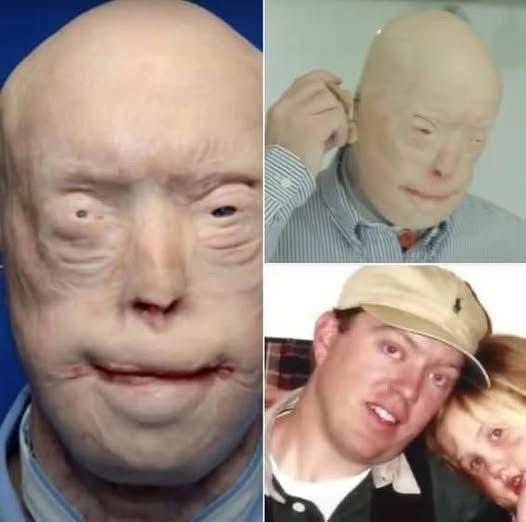
Patrick Hardison’s life changed forever during a house fire rescue that began like many others. While responding to the emergency, he attempted to save a woman he believed was still inside the burning home. During the rescue effort, Patrick sustained severe injuries that left him with third-degree burns across his face and scalp.
What followed was a journey through years of pain, isolation, and perseverance, and then a medical breakthrough that gave him his life back. His story remains one of the most remarkable examples of what modern medicine and human resilience can achieve together.
The Fire That Changed Everything
Before the accident, Patrick was known as a devoted father and an active member of his community. As a volunteer firefighter, he regularly put others first, responding to emergencies and supporting local families. Like many parents, he enjoyed attending his children’s sporting events and spending time at home with his loved ones.
The fire in 2001 changed his physical appearance and daily life in an instant. Entering a burning home to search for someone believed trapped inside is an act of extraordinary courage, the kind firefighters perform without hesitation. But this time, the rescue attempt left Patrick with devastating third-degree burns across his face and scalp, injuries that would define the next chapter of his life.
Living with Severe Burns
In the years that followed, everyday activities became difficult in ways most people never consider. Eating, seeing, and simply going out in public all carried new challenges. To protect himself and feel more comfortable in public, Patrick often wore a baseball cap, sunglasses, and prosthetic ears.
He later shared that reactions from strangers, especially children, were often painful and isolating. A child’s stare is honest but can cut deeply. Adults who looked away quickly could hurt just as much. Despite these challenges, he remained focused on his family and continued moving forward, drawing strength from his wife and children.
The psychological toll of severe facial burns is well documented. Beyond the physical pain of injuries and reconstructive surgeries, survivors often face:
- Social isolation driven by self consciousness and others’ reactions
- Depression and anxiety linked to changed appearance
- The exhaustion of dozens of surgeries over many years
- Difficulty with basic functions like eating, blinking, and breathing
- A grieving process for the face, and the life, they once had
Patrick endured all of this for more than a decade, holding his family together through sheer determination.
A Turning Point in 2015
Patrick’s journey took a remarkable turn in 2015, when he became the recipient of the most extensive face transplant performed at that time. The decision to undergo the procedure was not made lightly. According to medical reports, doctors estimated that he had a 50 percent chance of surviving the operation.
The surgery lasted 26 hours and involved more than 100 medical professionals working in coordinated teams. Two teams worked simultaneously: one preparing the donor’s face, the other preparing Patrick. The complexity was staggering, involving bone, muscle, nerves, blood vessels, and skin, all of which had to be connected with microscopic precision.
The operation was successful and marked a major milestone in modern medicine. For Patrick, it meant the possibility of a life he had feared was gone forever.
Advances in Modern Medicine
Medical science has made extraordinary progress over the past few decades. Doctors and surgeons now perform complex procedures that once seemed impossible, including organ transplants and advanced reconstructive surgeries. Face transplants, first performed in 2005, are among the most challenging and carefully planned procedures in modern healthcare.
A face transplant is far more complex than a skin graft. It is a vascularized composite tissue transplant, meaning it includes multiple tissue types that must all survive and integrate. Recipients must take immunosuppressant drugs for life to prevent rejection, trading one set of medical challenges for another. The psychological adjustment is profound as well: learning to see a new face in the mirror, one that belongs partly to a donor who gave the ultimate gift.
Patrick Hardison’s transplant represented a significant achievement in this field and highlighted what collaboration, innovation, and dedication in medicine can accomplish. Each such procedure teaches surgeons lessons that improve outcomes for the next patient.
Life After the Transplant
Today, Patrick is able to enjoy daily life with his wife and children, something he once feared might never be possible again. Simple things that most people take for granted, going to a ball game, eating a meal in a restaurant, walking through a store without stares, became possible again.
Seven years after the transplant, his life stands as proof that recovery is not just about survival. It is about reclaiming joy, normalcy, and connection. His children got back a father who could be fully present in public. His wife got back a partner who could move through the world without armor.
A Life of Service, Before and After
Patrick’s story begins and ends with service. As a volunteer firefighter, he ran toward danger for strangers. As a transplant recipient, his willingness to undergo a pioneering procedure advanced medical knowledge that will help future patients.
His journey continues to inspire conversations about medical progress, recovery, and the strength of the human spirit. It reminds us that behind every medical milestone is a person who said yes to the unknown, and a donor family whose generosity made it possible.
Frequently Asked Questions
Who is Patrick Hardison?
Patrick Hardison is a former volunteer firefighter who suffered severe third-degree burns to his face and scalp during a 2001 house fire rescue attempt. In 2015 he received what was then the most extensive face transplant ever performed.
What happened during the fire?
While responding to a house fire, Patrick entered the burning home to search for a woman he believed was trapped inside. During the rescue effort he sustained devastating burns that changed his life.
What did the 2015 surgery involve?
The face transplant lasted 26 hours and involved more than 100 medical professionals. Doctors estimated Patrick had a 50 percent chance of surviving the procedure. It was the most extensive face transplant performed at that time.
When was the first face transplant performed?
The world’s first partial face transplant was performed in France in 2005. The field has advanced significantly since then, though the procedures remain extremely complex and rare.
How is Patrick doing today?
According to reports, the transplant was successful and Patrick has been able to enjoy daily life with his wife and children, regaining activities and normalcy he once feared were lost forever.