Have You Looked at the Whole Image?
If you’re still searching, try changing your approach.
Instead of examining one tiny section for a long time, look at the entire illustration from a short distance. Allow your eyes to take in the overall composition rather than concentrating on individual details.
Then slowly scan across the image.
Pay particular attention to unusual curves and shapes that don’t seem to belong naturally to the objects around them. A branch may have a shape that looks slightly different from the others. A space between two objects may have an interesting outline. A collection of several small shapes may begin to resemble part of an animal.
The goal is not to force yourself to see a pig everywhere. Instead, you’re looking for an arrangement of shapes that makes sense when viewed from another perspective.
Don’t Ignore the Empty Spaces
One of the most useful ideas when solving visual puzzles is to pay attention to empty space.
Most people naturally focus on the objects that are actually drawn. We notice the people, trees, and other visible elements while treating the spaces between them as unimportant.
In an optical puzzle, that can be a mistake.
Sometimes the outline of a hidden object is created partly by the objects themselves and partly by the empty areas surrounding them. The shape you’re searching for may become visible only when you stop concentrating on the individual objects.
Look between branches. Examine the spaces around the people. Notice unusual gaps and outlines.
You may find that an apparently meaningless space starts to resemble something familiar.
Try Changing Your Viewing Distance
Another useful trick is to change how far away you are from the image.
Look at it closely for a few seconds and then move farther away. When you do this, individual details become less dominant and the overall shape of the illustration becomes easier to see.
Sometimes a hidden figure is difficult to recognize when you’re looking at every small detail separately. When you step back, several shapes can visually combine into one larger form.
You can also slightly change the angle at which you’re looking at the picture. Even a small adjustment can sometimes make an unusual shape easier to recognize.
What Makes the Pig Difficult to Recognize?
The hidden animal doesn’t necessarily look like a conventional drawing of a pig.
That’s an important part of the challenge.
When people search for a hidden pig, they often expect to see a complete animal with a clearly visible body, ears, nose, and legs. But optical puzzles often work differently.
The artist can use existing elements of the illustration to suggest an object without drawing it in a straightforward way.
A curved branch might resemble part of the animal’s body. Another shape may suggest the head. The surrounding negative space can help complete the impression.
Your brain has to connect those separate visual clues before the hidden image becomes clear.
Give Your Eyes a Break
If you’ve been staring at the image for several minutes without success, stepping away can actually help.
Constantly looking at the same area can cause you to become overly focused on your original interpretation. You may keep searching for a pig using the same strategy even though that strategy isn’t working.
Look away for a few moments and then return to the image.
When you come back, try to approach it as if you’re seeing it for the first time. Don’t assume that the important part must be located where you were previously searching.
A fresh look can sometimes reveal details that were invisible before.
The Fun of Seeing Something for the First Time
One of the most satisfying things about hidden-picture puzzles is the moment when the answer finally becomes visible.
Before that moment, the image may look completely ordinary. You can search through it repeatedly and still feel as though there is nothing unusual to find.
Then, suddenly, a familiar shape appears.
Once your brain recognizes it, it can become surprisingly difficult to understand how you missed it in the first place.
This happens because perception isn’t simply about receiving information through your eyes. Your brain also plays a major role in interpreting that information.
The same lines can mean one thing when you see them as part of a tree and something completely different when you recognize them as part of an animal.
Can Someone Else Find It Faster?
A fun way to enjoy this puzzle is to show it to someone else.
Give them the picture without explaining where the pig is located. Ask them to find it and see how long they need.
You may notice that different people approach the same image in completely different ways. One person might immediately examine the trees, while another might concentrate on the people or the open spaces.
Someone could even find the hidden animal within seconds while another person spends several minutes searching.
That difference is part of what makes visual puzzles so entertaining.
There isn’t always a single obvious way to approach the picture.
Don’t Let the First Impression Fool You
The first impression of an image can be powerful.
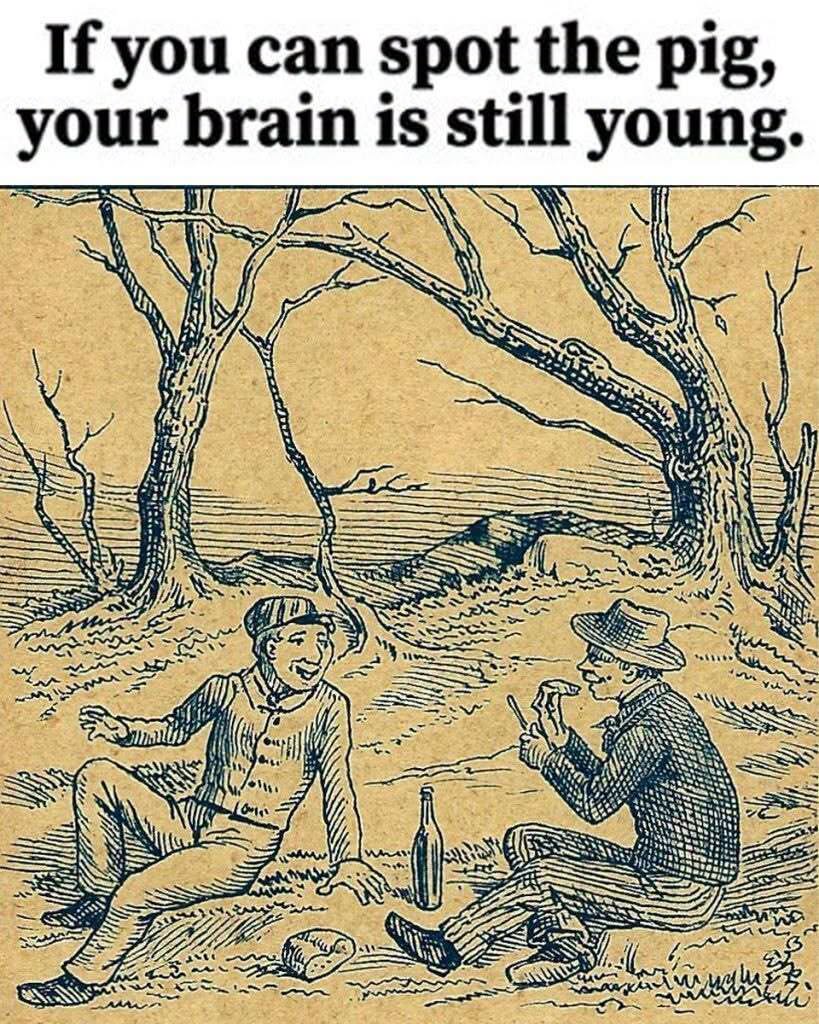
When you immediately recognize a familiar scene, your brain creates a quick explanation of what you’re looking at. In this case, you may see a simple outdoor picnic and assume there is nothing else to discover.
But hidden-picture puzzles encourage you to question that first impression.
Look again.
Could one of the branches be more than just a branch? Could an unusual curve be part of another shape? Could two areas that seem unrelated actually work together to create an image?
Once you start asking these questions, the picture becomes much more interesting.
A Different Way to Think About the Puzzle
Instead of asking yourself, “Where is the pig?” try asking, “Which part of this image looks unusual?”
That small change in thinking can make the search easier.
Rather than trying to force your eyes to locate a specific animal, allow yourself to explore the illustration naturally. Look for patterns, unusual outlines, repeated curves, and shapes that don’t seem to fit perfectly into the surrounding scenery.
When something catches your attention, examine it from different perspectives.
You may eventually discover that the unusual shape is actually the clue you’ve been looking for.
Why People Enjoy Optical Puzzles
Visual puzzles have remained popular for generations because they are simple to understand but surprisingly challenging to solve.
You don’t need special equipment or complicated instructions. All you need is the picture and a little patience.
They can also be enjoyed by people of different ages. Children may approach the puzzle with curiosity, while adults may find themselves becoming unexpectedly competitive about finding the hidden object first.
The best puzzles create that feeling of curiosity where you know there is something hidden, but you don’t know exactly where to look.
Take One More Look
If you haven’t found the pig yet, don’t immediately give up.
Return to the illustration and examine it again.
This time, don’t focus only on the people or the obvious parts of the picnic scene. Study the tree branches and the shapes around them. Look carefully at the spaces between objects and pay attention to outlines that seem slightly unusual.
Try looking from farther away.
Then move closer again.
Give your eyes a moment to adjust and allow yourself to see the illustration as a collection of shapes rather than simply a picture of two people outdoors.
You might be closer to the answer than you think.
The Moment Everything Makes Sense
The most enjoyable part of a hidden-picture puzzle isn’t necessarily how quickly you solve it.
It’s the moment when the hidden object suddenly makes sense.
Before you notice it, the illustration can seem completely normal. After you recognize the pig, the same picture can look entirely different.
That change in perception is what makes these puzzles so fascinating.
The image hasn’t changed. Your interpretation of it has.
And that is the real trick behind the challenge.
Final Challenge
So, how sharp is your observation?
Take another careful look at the vintage illustration and search beyond the obvious objects. Examine the branches, the unusual curves, and the negative spaces surrounding the main scene.
Don’t rush.
Sometimes the hidden answer is easiest to find when you stop searching for a perfect outline and start looking for a collection of shapes that work together.
If you spot the pig, remember where you found it and then challenge a friend or family member to solve the same puzzle.
You may be surprised by how quickly they find it—or how long they spend searching in exactly the wrong place.
Either way, the hidden pig puzzle offers a simple and entertaining reminder that what we see at first isn’t always the whole story.