When I was thirty-five, I made a decision I never imagined I would make.
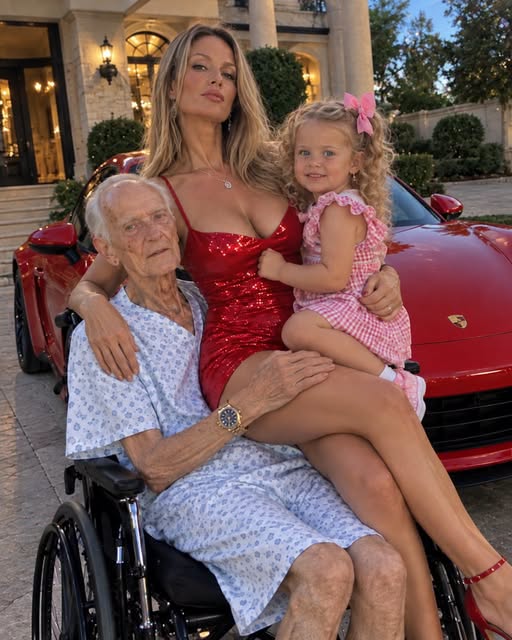
I married a man who was thirty-seven years older than me.
His name was William. He was seventy-two, wealthy, widowed, and living alone in a large house where I worked as a housekeeper.
People who knew our story probably assumed they understood why I married him.
The truth was more complicated.
At the time, I wasn’t searching for romance.
I was searching for security.
And I was terrified that my young daughter and I were about to lose everything.
I Had Already Lost So Much
My childhood had never been easy.
I spent years moving between foster homes, learning not to become too attached to any particular place because I never knew when I would have to leave.
As an adult, I desperately wanted to build the kind of stable family I had never experienced growing up.
For a while, I thought I had.
My first husband, Ben, had also grown up in the foster system.
Maybe that was one reason we connected so quickly.
We didn’t have much money, but we didn’t need much.
Ben worked as a mechanic, and I worked at a small store. We rented a modest apartment and drove an old car.
Then our daughter, Sophie, was born.
For the first time in my life, I felt like I belonged somewhere.
Our little family wasn’t wealthy.
But it was ours.
Then Ben became seriously ill.
For more than a year, we tried everything we could to help him.
Eventually, we lost him.
I was suddenly alone with a young daughter, medical bills, and expenses I didn’t know how I would pay.
I took every job I could find.
That’s how I eventually became a housekeeper for William.
The Man Who Offered Me a Home
William lived in a beautiful house, but despite his wealth, his life seemed strangely quiet.
His wife had died years earlier, and he had no children of his own.
My job was simple.
I cleaned the house, prepared meals, organized groceries, and helped with everyday tasks.
He was polite and reserved.
We weren’t particularly close at first.
Then Sophie became sick.
Her medication was expensive, and I was already struggling to keep up with rent and other bills.
One evening, my landlord gave me a final warning.
I had fallen behind, and I was told that I needed to catch up quickly or find somewhere else to live.
I remember standing alone in William’s kitchen that evening, trying not to cry.
But William noticed.
“Laura, what’s wrong?”
I tried to explain.
I told him about Ben, Sophie, the bills, and the possibility that we could lose our home.
He listened without interrupting.
Several days later, he asked me to come into his study.
What he said next changed the direction of my life.
“I know this may sound unexpected,” he told me. “But I care about you. I would like you to marry me.”
I couldn’t believe what I was hearing.
Then he added something that made the decision even harder.
“You and Sophie would always have a home here.”
I knew how strange the situation sounded.
I also knew what was at stake.
I was responsible for a child.
And I couldn’t bear the thought of Sophie growing up without a safe place to live.
So I said yes.
Five Years Changed Everything
Our marriage wasn’t what most people would have expected.
At first, I knew exactly why I had agreed to it.
Security.
A home.
A future for my daughter.
But over time, something unexpected happened.
William became part of our family.
He taught Sophie how to play chess.
He attended her school events.
He listened to her stories.
He remembered the little things that mattered to her.
And slowly, he became more than the wealthy older man I had married during a desperate period of my life.
He became someone I genuinely loved.
Then William’s health began to decline.
After a serious fall, he needed help with everyday activities.
Doctors recommended hiring a full-time caregiver.
I refused.
I wanted to take care of him myself.
I helped him get ready each morning.
I pushed his wheelchair through the garden.
When he couldn’t sleep, we sometimes sat in the kitchen late into the night, drinking tea and talking.
By then, I wasn’t staying because of the house.
I wasn’t staying because of money.
I was staying because William had become family.
Five years after our marriage, he died.
And I thought I knew what would happen next.
I was wrong.
The Lawyer Arrived After the Funeral
The day after William’s funeral, his lawyer came to the house.
His name was Mr. Harris.
He carried a briefcase and a folder containing William’s legal documents.
I expected him to explain the estate.
Instead, he looked directly at me and said something I will never forget.
“Laura, William left instructions about what I was supposed to tell you.”
I waited.
“According to his official will, you inherit nothing.”
I felt my stomach drop.
“Nothing?”
He shook his head.
“Not the house. Not his investment accounts. Nothing from the estate.”
I couldn’t understand it.
I was his wife.
We had spent five years together.
How could he have left me with nothing?
Then Mr. Harris placed a thick white envelope on the table.
My name was written across it in William’s handwriting.
I reached for it.
But the lawyer stopped me.
“There’s something you should know first.”
I looked at him.
“William specifically instructed me to tell you that you inherited nothing before giving you this.”
“Why?”
Mr. Harris studied me for a moment.
“Because he believed he knew exactly what you would think.”
My heart started beating faster.
“What did he know?”
The lawyer pushed the envelope toward me.
“Open it.”
The Letter William Left Behind
Inside was a handwritten letter.
I immediately recognized William’s handwriting.
It began:
“Dear Laura,
If you’re reading this, then I am no longer there to explain everything myself.
By now, Harris has told you that you inherited nothing from my official will.
You are probably wondering why.”
My hands were trembling.
I continued reading.
Then I found something beneath the letter.
A photograph.
It showed a much younger William standing beside several children.
I turned it over.
There was an address written on the back.
My heart stopped.
I knew that address.
It was the address of the foster home where I had spent part of my childhood.
I looked at Mr. Harris.
“Why would William have this?”
He didn’t answer.
I continued reading.
That’s when I discovered something I had never known.
William Had Known About Me Long Before Our Marriage
Years earlier, William and his wife had struggled with infertility.
Instead of having children of their own, they decided to support children who were growing up without stable families.
Through a charitable foundation, William had anonymously helped pay for education, clothing, medical care, and other needs for children in foster care.
I was one of them.
I stared at the page in disbelief.
Mr. Harris finally explained.
“Some of the programs and medical expenses that helped you as a child were funded through William’s foundation.”
I couldn’t speak.
Then I read the next part of William’s letter.
He explained that he hadn’t recognized me when he first hired me.
But several weeks after I began working in his home, he saw information that connected me to my childhood foster home.
That’s when he realized who I was.
I had been one of the children he had quietly helped years earlier.
He Had Been Watching My Choices
William could have simply given me money.
But he knew I would probably refuse.
And he had proof.
When Sophie needed medication, he once offered to help.
I insisted that I would repay him.
When he offered to buy me a new car, I chose a used one instead.
When he suggested an expensive gift, I reminded him that Sophie’s education mattered more.
Then his letter explained something that brought tears to my eyes.
He wrote that he understood why I had married him.
I had been afraid.
Afraid of losing our home.
Afraid of failing my daughter.
Afraid of returning to the instability I had experienced as a child.
He didn’t blame me for that.
Instead, he wrote that something had changed over the years.
He remembered the day he became seriously ill.
I could have hired someone else to care for him.
But I stayed.
I was there every morning.
I helped him through difficult days.
I sat with him when he couldn’t sleep.
And eventually, he knew that I wasn’t staying because of what he owned.
I was staying because I loved him.
The Real Reason He Left Me “Nothing”
The final part of the letter explained everything.
William wrote:
“I was never angry that you initially married me because you needed security.
You chose a home for your daughter.
And somehow, that decision gave me something I had wanted for years—a family.”
He wrote about Sophie calling him “Grandpa.”
He wrote about attending her school events.
He wrote about the ordinary moments that had become the most meaningful parts of his life.
Then came the sentence that confused me most.
That was why, according to William, he had left me nothing in his will.
I looked at Mr. Harris.
“I don’t understand.”
He opened the second folder.
“The things William wanted you to have were transferred before his death.”
The first document was a property deed.
I read the name carefully.
It was mine.
The house was already legally in my name.
I covered my mouth.
Then Mr. Harris showed me another document.
It was an investment account created for Sophie several years earlier.
It had been set aside specifically for her education.
But William wasn’t finished.
There was another document.
It established a charitable foundation dedicated to helping children in foster care and families struggling with housing and financial difficulties.
And William had named me as its director.
I sat there silently.
Suddenly, the meaning of his so-called “trap” became clear.
He knew I would be frightened when I heard that I had inherited nothing.
He knew my first thought would be about Sophie.
And he had arranged everything so that I would discover the truth only after experiencing that moment of uncertainty.
One Last Gift
As Mr. Harris prepared to leave, he stopped at the door.
“There is one more thing.”
He handed me a small box.
Inside was a white chess queen.
Beneath it was a handwritten note.
The message was simple.
William wanted Sophie to have it when she was old enough to understand why he had chosen it.
The note explained that family isn’t always defined by biology.
Sometimes family is created by the people who choose to remain beside one another.
I couldn’t hold back my tears.
For years, I had believed that William had saved us by giving us a home.
Only after his death did I understand that our relationship had become something much deeper.
We had helped each other.
William’s Legacy Continued
A few months later, the foundation helped its first family.
It was a young mother with two children who was struggling to keep their home.
When I told her that the foundation would cover several months of housing expenses, she began to cry.
I understood immediately.
I had once cried the same way.
I remembered standing in William’s kitchen, terrified that my daughter and I would lose our home.
Now I was standing on the other side of that experience.
And I finally understood what William had really left behind.
It wasn’t simply a house.
It wasn’t an investment account.
It wasn’t even the foundation.
His greatest gift was the opportunity to help another family experience the security I had once desperately needed.
That was the inheritance he wanted me to carry forward.
And every time the foundation helps another family, I feel as though a small part of William’s story is still continuing.
Sometimes the most meaningful inheritance isn’t something we receive. It’s the opportunity to pass kindness forward.