I Panicked When I Opened My Teen Daughter’s Door: But What I Found Left Me Speechless
As parents, we often let our imaginations run wild when it comes to our kids, especially during their teenage years. I learned that lesson one Sunday afternoon, standing in my daughter's doorway, feeling equal parts relieved and ashamed. What I found behind that closed door wasn't what I feared. It was something far better.
The Setup Every Parent Recognizes
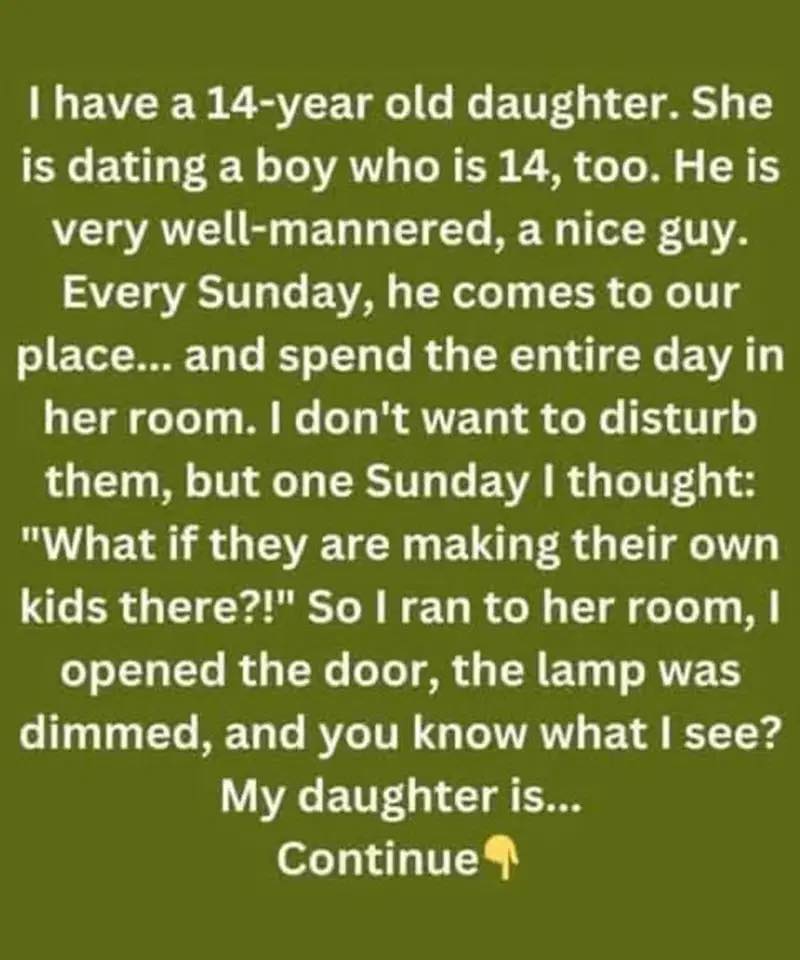
My daughter, Emma, is 14 years old. She's bright, kind, and recently started seeing a boy from her class, also 14. He's polite, always greets us respectfully, and never forgets to thank me when I offer snacks or drive them somewhere.
Every Sunday, he comes over to our house. The two of them head straight to her room and stay there for hours. I trusted her, but still, a small part of me couldn't help but wonder what they were really doing behind that closed door.
If you're a parent of a teenager, you know exactly how this feels. Trust and worry coexist uneasily. You believe in your child, genuinely, and at the same time your brain serves up worst case scenarios with impressive creativity. It is not that you think your child is bad. It is that you know the world is complicated, hormones are real, and closed doors have a way of amplifying every parental fear ever felt.
The Moment Curiosity Won
Last weekend, curiosity got the best of me. I suddenly thought, “What if something inappropriate is happening?” The thought sent my heart racing. Before I could stop myself, I walked quickly down the hall and opened her door.
The lamp was dimmed, and my mind prepared for the worst.
I want to be honest about this moment, because I think many parents have lived some version of it. There is a split second between the hand on the doorknob and the door swinging open when your entire body braces. Your heart pounds. You've rehearsed confrontations in your head. You are ready to be the responsible parent who caught it in time.
But what I actually saw stopped me in my tracks.
What Was Really Behind the Door
There they were, sitting on the floor, surrounded by open textbooks, highlighters, sticky notes, and notebooks. My daughter had her headphones on, patiently explaining math formulas to him while he scribbled in his notebook, brow furrowed in concentration.
A plate of cookies I'd brought earlier sat untouched on the desk. They were too focused even to eat.
Let me repeat that: two 14-year-olds, alone in a bedroom on a Sunday afternoon, so absorbed in algebra that they forgot about cookies. If there is a better advertisement for trusting your teenager, I haven't seen one.
When they finally noticed me standing there, they both jumped a little. My daughter pulled off her headphones and asked softly, “Mom, is everything okay?”
I could only smile, feeling both relieved and a little ashamed of my earlier thoughts.
Why Our Fears Say More About Us
What I had assumed to be something worrisome turned out to be something heartwarming: a moment of teamwork, patience, and genuine friendship.
That day, I realized something every parent eventually learns: sometimes our fears say more about us than about our children.
My panic wasn't really about Emma. It was about me: my anxieties, my memories of being 14, the cautionary tales I'd absorbed from other parents and the news. I had projected a whole narrative onto my daughter that had nothing to do with who she actually is. She is the girl who patiently explains math formulas on a Sunday afternoon. That is who I raised. My fear had briefly made me forget it.
Psychologists call this catastrophizing, and parents of teenagers are especially prone to it. The adolescent years feel high stakes because, in some ways, they are. But constant worst case thinking doesn't protect our kids. It just erodes the trust we've spent years building, one suspicious doorway moment at a time.
The Boy Deserves Credit Too
It's worth noting what this story says about the boy as well. He shows up every Sunday, greets the parents respectfully, says thank you for snacks and rides, and then spends hours being tutored in math by his girlfriend. Whatever else the future holds, that is a young man with his priorities in order, and a young man who respects the household he's visiting.
Too often, teenage boys in these stories are cast as the threat by default. This one turned out to be a kid working hard on his math homework. He deserves better than our automatic suspicion too.
What I Did Next
I didn't make a big speech. I didn't launch into an apology monologue that would have embarrassed everyone. I smiled, told them I was just checking in, and quietly closed the door.
But something shifted in me that afternoon. I decided to trust what I see rather than what I fear. Emma has given me every reason to trust her: she's responsible, kind, communicative. My job now is to let that evidence outweigh my imagination.
And sometimes, behind a closed door, there's not a secret to fear, but a story to be proud of.
Lessons for Parents of Teenagers
- Trust the track record. If your teen has consistently shown responsibility, let that history speak louder than your anxiety.
- Notice before you assume. Hours in a bedroom could mean many things. Most of them are boring and wholesome.
- Respect privacy while staying present. I bring cookies. I check in casually. Presence without surveillance builds trust.
- Interrogate your own fears. Ask yourself: is this about my child, or about my worries?
- Apologize when you're wrong. If your suspicion was unfounded and your teen knows it, a simple acknowledgment goes a long way.
- Celebrate the good. I told Emma later how impressed I was. Positive reinforcement matters as much as boundaries.
Frequently Asked Questions
What did the mother find when she opened the door?
Emma and her boyfriend were sitting on the floor studying, surrounded by textbooks, highlighters, sticky notes, and notebooks. Emma was patiently explaining math formulas while he took notes.
How old are Emma and the boy?
Both are 14 years old and in the same class at school.
Why was the mother worried?
The two spent hours alone in Emma's bedroom every Sunday with the door closed, and the mother's imagination filled in worst case scenarios despite trusting her daughter.
What lesson did the mother learn?
That parental fears often say more about the parent than the child, and that trusting a teenager's proven track record matters more than indulging anxious imagination.
How should parents balance trust and supervision with teens?
Stay present and engaged without surveilling. Keep communication open, know your teen's friends, trust established patterns of responsibility, and address concerns through conversation rather than ambush.