
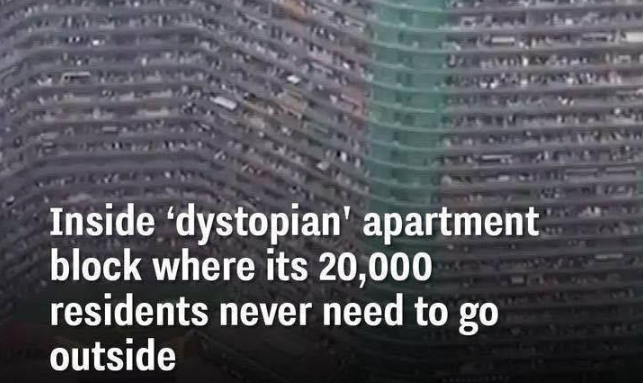
Inside One of the World's Largest Apartment Complexes Housing More Than 20,000 Residents
In the rapidly growing city of Hangzhou, an enormous residential complex known as Regent International has gained global attention for its remarkable scale and modern urban design. Built to accommodate up to 30,000 residents, the massive S-shaped structure currently houses around 20,000 people, making it one of the most densely populated residential buildings in the world.
A Building Like No Other
To grasp the scale: 20,000 residents is the population of a small town, all living under one roof. The building rises 675 feet into the Hangzhou skyline, its distinctive S-curve visible from across the district. It was designed by architect Alicia Loo, who is also known for work connected to the famous Marina Bay Sands in Singapore.
The 675-foot-tall complex was created to function as a self-contained community. The idea behind the project is to provide residents with convenient access to everyday services without needing to travel far from home. This is vertical urbanism taken to its logical extreme: instead of spreading a neighborhood across streets and blocks, stack it.
The City Within a Building
Inside the building, residents can find a wide variety of amenities, including restaurants, supermarkets, swimming pools, fitness areas, beauty salons, and other essential services. This "city within a building" concept means that daily life can unfold almost entirely indoors.
Imagine the convenience: groceries downstairs, dinner at one of several restaurants without leaving the building, a swim before work, a haircut on the way home. For busy young professionals and students, the elimination of commuting for daily errands is a genuine quality-of-life improvement.
The concept has become especially popular among students, young professionals, and people looking for affordable housing in a busy urban area. These demographics value convenience, affordability, and social opportunity, all of which high-density vertical living provides in abundance.
Affordability in an Expensive Era
Rental prices are considered relatively affordable compared to many large cities, with monthly costs typically ranging from around $200 to $600 depending on the size and type of apartment. In an era of global housing crises, where young people in major cities routinely spend half their income on rent, these prices are remarkable.
The affordability is partly a function of scale. When a single structure houses 20,000 people, the per-unit cost of construction, maintenance, and amenities drops dramatically. Elevators, pools, and gyms that would be luxuries in a small building become economical when shared among thousands.
The convenience and accessibility of the complex continue to attract thousands of residents each year. Demand remains strong, suggesting the model meets a real need in Hangzhou's fast-growing economy.
The Challenges of High-Density Living
At the same time, the building has sparked conversations about the challenges of high-density living. Some people have raised concerns about:
- Privacy. With thousands of neighbors, true solitude is hard to find. Corridors, elevators, and shared spaces are perpetually busy.
- Limited outdoor space. Vertical living means trading private yards for shared amenities. Access to nature requires leaving the building.
- The psychological experience of living among so many people in one structure. Some residents thrive on the energy; others find it overwhelming.
- Noise and congestion. Even with good design, 20,000 people generate significant activity.
- Community cohesion. Can a genuine neighborhood feeling emerge at this scale, or does it remain anonymous?
However, many apartments include balconies and shared community areas that help create a more comfortable living environment. Design choices, natural light, ventilation, communal gardens, and varied shared spaces, make an enormous difference in whether density feels vibrant or oppressive.
An Innovative Response to Urban Growth
Supporters of the project view it as an innovative response to modern urban housing demands, especially in fast-growing cities where space is limited. By combining residential units with shopping, dining, and recreation in one location, Regent International reflects a growing trend toward compact and highly efficient city living.
The logic is compelling from a sustainability perspective too. High-density living reduces per-capita land use, makes public transit more viable, shortens commutes, and concentrates infrastructure efficiently. A town of 20,000 spread across suburbs requires vastly more roads, pipes, wires, and energy than the same population in one well-designed tower.
Cities like Hangzhou are growing at extraordinary rates, adding hundreds of thousands of residents per year. Traditional low-density development cannot keep pace without consuming enormous amounts of land and generating punishing commutes. Vertical communities offer an alternative path.
What the Future Might Look Like
As cities around the world continue to expand, developments like Regent International may offer insight into how future urban communities could be designed to balance convenience, affordability, and sustainability.
The key lessons for future projects:
- Mixed use is essential. Residential-only towers become dormitories. Integrating commercial, recreational, and service spaces creates genuine community.
- Design quality determines livability. Density without thoughtful design fails. Light, air, green space, and acoustic management are non-negotiable.
- Affordability must be protected. The model's social value depends on remaining accessible to ordinary workers and students.
- Community needs cultivation. Shared spaces need programming and management to become real neighborhoods rather than just crowded buildings.
Whether Regent International represents the future of urban living or an extreme experiment, it forces an important question: as billions more people move to cities in the coming decades, how will we house them? The answer will likely involve building up as well as out, and this S-shaped giant in Hangzhou is showing the world what building up can look like.
Frequently Asked Questions
What is Regent International?
A massive S-shaped residential complex in Hangzhou, China, designed by architect Alicia Loo. Built to house up to 30,000 residents, it currently accommodates around 20,000 people, making it one of the world's most densely populated residential buildings.
How tall is the building?
The complex rises approximately 675 feet. Its distinctive S-curve design maximizes natural light and views for its thousands of units.
What amenities are inside?
Restaurants, supermarkets, swimming pools, fitness centers, beauty salons, and various other shops and services. The building functions as a self-contained community where residents can meet most daily needs without leaving.
How much does it cost to live there?
Monthly rents typically range from around $200 to $600 depending on apartment size and type, considered affordable compared to housing costs in many major global cities.
Who lives in Regent International?
The resident population skews toward students, young professionals, and people seeking affordable housing in Hangzhou. The convenience and price point are the main draws.
What are the downsides of living there?
Common concerns include limited privacy, less personal outdoor space, noise, congestion, and the psychological effects of extreme density. Supporters argue that thoughtful design, balconies, and shared community areas mitigate these issues significantly.



