Why Your Eyes May Miss the Face
There is an interesting reason why hidden-image puzzles can be so challenging.
Your eyes collect visual information, but your brain is responsible for interpreting what you see. When you look at a familiar scene, your brain quickly tries to identify the objects that make the most sense.
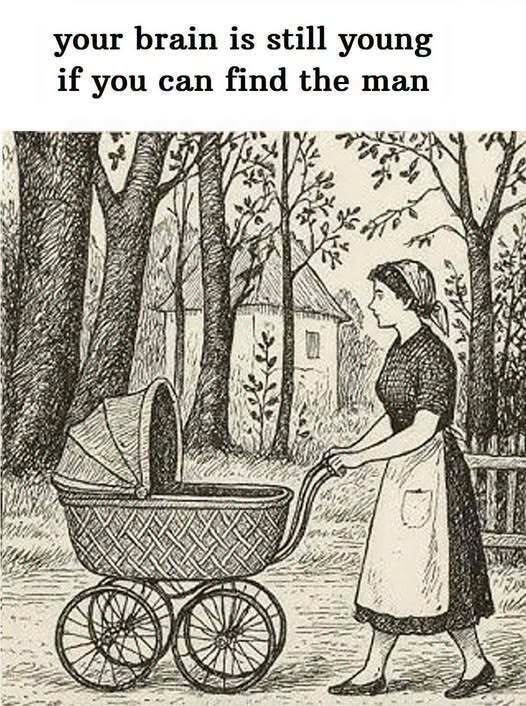
A woman, a stroller, trees, and a countryside setting are all easy for the brain to recognize. Once your brain has created a general understanding of the picture, it may stop paying close attention to smaller details that appear to be ordinary parts of the scenery.
This is one reason optical illusions can fool us.
The hidden man’s face may be sitting in an area that your eyes have already examined, but because the surrounding shapes look like natural elements, your brain doesn’t immediately interpret them as a face.
It is not necessarily a matter of having better eyesight. Instead, it is often about how your brain organizes the information coming from your eyes.
Try Changing Your Perspective
If you haven’t found the hidden man yet, don’t immediately give up.
One simple trick is to move farther away from your screen. Looking at the picture from a greater distance can sometimes make the larger shapes easier to recognize because the smaller details become less distracting.
You can also slightly change the angle at which you are viewing the image. Tilt your head, look at the picture from a different position, or briefly look away before returning to it.
This small reset can sometimes make a surprising difference.
When you return to the image, try not to search for a complete face immediately. Instead, look for patterns that could eventually form the outline of a head.
Once your brain recognizes even one or two facial features, the rest of the image may suddenly become much easier to understand.
The Hidden Face Is Blended Into the Scenery
What makes this particular puzzle entertaining is the way the hidden face appears to belong to the landscape.
The surrounding trees and branches create many irregular shapes. Some are darker than others, while certain areas naturally form curves and lines. These details provide the perfect environment for a hidden image.
Your brain normally interprets these irregular shapes as parts of nature. That makes it much harder to recognize that they have been arranged in a way that creates another image.
This technique is common in visual puzzles and optical illusions. The creator takes advantage of the way people naturally recognize patterns and uses that expectation to hide another shape in plain sight.
The result is an image that can look completely ordinary at first.
Then, suddenly, everything changes.
The Moment You Finally See Him
There is a special moment that often happens with hidden-picture puzzles.
You may stare at the image without finding anything unusual. You might even wonder whether there is actually a hidden man at all.
Then you notice something.
Perhaps you recognize what looks like an eye. Then another shape begins to resemble a nose. A curved section suddenly looks like part of a cheek or jaw.
Within seconds, the random shapes start connecting in your mind.
The face becomes obvious.
This is sometimes called the “now you see it” effect. Once your brain has discovered the pattern, it becomes much easier to recognize it again.
What looked like ordinary branches a moment earlier suddenly seems to have a completely different meaning.
Why Hidden-Image Puzzles Are So Fascinating
Visual puzzles like this are more than simple games. They demonstrate how differently people can interpret the same image.
Two people can look at exactly the same picture at exactly the same time, yet notice completely different details.
One person may find the hidden face almost immediately. Another person may need several hints before recognizing it.
That doesn’t necessarily mean one person has better vision than the other. Attention, experience, expectations, and the way the brain processes patterns can all influence what stands out.
This is part of what makes optical illusions so enjoyable. They encourage us to question what we think we are seeing.
Don’t Focus Only on the Obvious Subjects
One of the biggest mistakes people make when solving hidden-image puzzles is concentrating too heavily on the main subject.
When a picture clearly contains a person, an animal, or an object, your attention naturally goes there first.
Try doing the opposite.
Look around the edges of the main subject. Examine the background and the spaces between objects. Look at areas that might normally seem unimportant.
In many optical illusions, the hidden image is placed somewhere your brain considers secondary.
The background may actually be more important than the foreground.
That is certainly the case with this puzzle.
Give Your Brain Time to Adjust
Another reason people sometimes struggle with hidden images is that they expect to find the answer instantly.
There is no need to rush.
Take a few seconds to look at the picture as a whole. Let your eyes move naturally across the scene instead of jumping from one detail to another.
If nothing appears, take a short break and look again.
Sometimes your brain needs time to stop interpreting the image in its original way. Once you stop expecting to see only a countryside scene, you may become more receptive to the unusual pattern hidden inside it.
The change can happen surprisingly quickly.
Can You Find the Man Without a Hint?
Now that you know there is a hidden face somewhere in the picture, try looking again.
Start with the larger shapes in the landscape. Examine the darker areas and the branches carefully. Instead of trying to identify individual objects, look for a larger pattern that could resemble the structure of a human face.
Don’t be discouraged if you still can’t see it.
Hidden-image puzzles are designed to challenge your natural way of looking at things. Sometimes the answer can be directly in front of you while your brain continues to interpret it as something completely different.
And that’s what makes finally discovering the hidden image so satisfying.
Once You See It, It Becomes Difficult to Ignore
Perhaps the most interesting part of this puzzle comes after you’ve found the hidden man.
Once your brain understands how the shapes fit together, the face may suddenly become much more obvious. The same branches and shadows that seemed meaningless before now appear to have a clear purpose.
You may even wonder how you failed to notice it the first time.
That experience is one of the reasons people enjoy sharing optical illusions with friends and family. It is fun to watch someone struggle with an image and then experience the moment when they finally recognize the hidden detail.
Sometimes, all it takes is a slightly different way of looking.
What Did You See First?
The next time you look at the picture, pay attention to your first reaction.
Did you immediately notice the woman and stroller? Did you start examining the trees? Or did the hidden man’s face appear almost instantly?
There is no right or wrong answer.
The fun comes from discovering how your own attention moves through the image and how quickly your brain can switch from seeing a simple landscape to recognizing the hidden pattern.
If you haven’t found the man yet, give the picture another look before checking for any additional clues.
You may be closer than you think.
A Simple Reminder for Future Optical Illusions
When you come across another hidden-picture challenge, remember that the answer isn’t always located where your eyes naturally want to look.
Take your time and examine the complete image. Step back if necessary, change your viewing angle, and pay attention to shapes that seem slightly unusual.
Most importantly, don’t assume that every branch, shadow, or background shape is exactly what it appears to be.
Sometimes an ordinary-looking detail is actually part of something much larger.
And once you finally see the hidden face in this picture, you may find yourself wondering how it managed to stay hidden for so long.
That’s the charm of a good optical illusion: the image never actually changes. What changes is the way your brain sees it.