People Are Confused About What This Might Be The Answer Is Surprisingly Simple
A curious image has been making the rounds online, leaving many people scratching their heads. At first glance, the object looks unusual and a bit mysterious, and it didn't take long for social media users to start guessing what it could be. From creative theories to wild assumptions, the internet quickly turned this small puzzle into a shared moment of curiosity.
A Viral Riddle
Like many viral riddles, this one caught attention because it seemed harder than expected. Even people who enjoy solving puzzles found themselves unsure. The more it spread, the more people joined in, hoping to finally uncover the answer.
There's a particular joy in these collective mysteries. Everyone gets to be a detective for a day, and the comment sections become a delightful mix of wild guesses, confident wrong answers, and the occasional expert who actually knows.
The Answer: Dolly Pegs
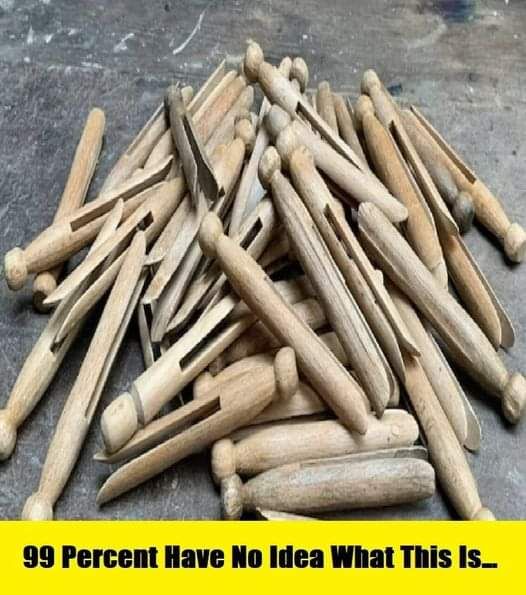
So what exactly is it? It turns out the object is something quite simple, and even nostalgic for some. These are known as dolly pegs, traditional wooden clothespins that were once commonly used for hanging laundry.
Unlike modern plastic clips, dolly pegs have a unique design that makes them instantly recognizable once you know what you're looking at. And once you know, you can't unsee it: of course that's what they are.
What Dolly Pegs Look Like
Dolly pegs are small wooden pins shaped a bit like tiny figures, with a rounded top and a split base that allows them to grip fabric. The design is beautifully simple: a single piece of wood, carved so that the two "legs" flex apart to grip a clothesline and hold fabric in place.
No springs. No metal parts. No plastic. Just wood, shaped by someone who understood exactly how much tension was needed to hold a wet sheet on a windy day.
A Practical Tool With a Creative Second Life
While they were originally designed for practical use, they also became popular for creative projects. Many people used them in crafts, turning them into miniature dolls or decorative items.
The doll-like shape made this almost inevitable. With a rounded head and a body-like form, dolly pegs were practically begging to be painted, dressed in fabric scraps, and turned into tiny people. Generations of children have made peg dolls as craft projects, and the tradition continues in schools and homes today.
Beyond dolls, crafters use them for:
- Christmas ornaments and decorations
- Place card holders for weddings and parties
- Small gift tags and labels
- Educational toys and counting aids
- Rustic home decor projects
Why They Confuse Modern Eyes
Part of the reason dolly pegs baffle people today is that the spring-loaded clothespin has almost completely replaced them in most countries. If you grew up after the 1980s, you may never have seen a dolly peg in actual laundry use.
Out of context, in a close-up photo with no scale reference, they look like they could be anything: chess pieces, strange tools, parts of some unknown device. It's only when someone provides the key, "they're old-fashioned clothespins," that the image snaps into focus.
Nostalgia in a Small Wooden Pin
Beyond their everyday function, dolly pegs hold a special place in vintage charm. They remind people of simpler times, when household items were often made from natural materials and built to last.
For older generations, the image triggers specific memories: mothers and grandmothers pegging sheets on backyard lines, the smell of sun-dried laundry, the satisfying feel of smooth wood worn by years of use. These are the kinds of memories that live in objects, waiting to be unlocked by a photo.
Today, they're still appreciated for both their usefulness and their decorative appeal. Some people still prefer them for delicate fabrics, and they remain popular in eco-friendly households as a plastic-free alternative.
The Bigger Picture
This viral mystery is a great example of how something ordinary can become fascinating when seen out of context. Sometimes, the simplest objects can spark the biggest curiosity, and bring back a touch of nostalgia along the way.
In a world of complex technology, there's something refreshing about a mystery whose answer is a carved piece of wood. It reminds us that clever design doesn't require complexity, and that the most enduring tools are often the simplest ones.
The next time a puzzling object crosses your feed, take a moment to guess before reading the comments. You might be wrong, you probably will be, but you'll be participating in one of the internet's most wholesome traditions: collective curiosity. And every once in a while, the answer will be as charming as a tiny wooden figure that once held up someone's bedsheets.
It's worth noting how these small mysteries bring generations together. Grandparents who used dolly pegs daily get to share stories with grandchildren who have never seen one. A confusing photo becomes a bridge across decades, sparking conversations that might never have happened otherwise. In that sense, the humble dolly peg has done something remarkable: it turned a moment of confusion into a moment of connection.
Frequently Asked Questions
What are dolly pegs?
Traditional wooden clothespins, small pins shaped like tiny figures with a rounded top and split base, once commonly used for hanging laundry.
How do dolly pegs work?
The split base flexes to grip fabric against a clothesline. The single-piece wooden design uses tension rather than springs or metal parts.
Why did the photo confuse people?
Most people today only know spring-loaded plastic or wooden clothespins. Out of context and in close-up, dolly pegs don't match the modern image of a clothespin.
What are dolly pegs used for besides laundry?
Crafts are the biggest second use: peg dolls, ornaments, place card holders, gift tags, and rustic decor. They're also valued as eco-friendly, plastic-free alternatives.
Are dolly pegs still available?
Yes. They're sold by craft suppliers and eco-friendly household stores, and remain popular for both practical use and creative projects.