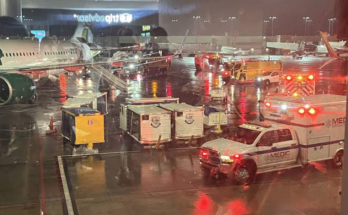
Six Lives Lost in Maine Plane Incident Involving Private Jet Linked to Houston Law Firm
A tragic aviation incident in Maine has claimed the lives of six people after a private jet connected to a Houston-based law firm crashed during takeoff at Bangor International Airport. The aircraft, a Bombardier Challenger 600, was traveling from Houston to France with a scheduled stop in Maine when the accident occurred amid severe winter weather conditions.
What Happened on the Runway
According to reports, the jet failed to lift off properly on the snow-covered runway during Winter Storm Fern. The aircraft overturned and caught fire shortly after the attempted takeoff. Emergency crews responded immediately, but all six passengers on board were pronounced deceased at the scene.
Takeoff is one of the most critical phases of any flight, and winter conditions multiply the risks dramatically. Investigators will examine a chain of factors that must all align for a safe departure:
- Runway contamination. Snow, slush, and ice reduce braking effectiveness and can prevent an aircraft from reaching takeoff speed. Contaminated runways are a well-documented factor in takeoff accidents.
- Aircraft de-icing. Even a thin layer of frost on wings can destroy lift. Proper de-icing and anti-icing procedures are mandatory in winter operations, and their timing is critical.
- Weight and performance calculations. Pilots must calculate whether the aircraft can safely take off given the runway length, weather, and weight. Contaminated runways require adjusted calculations.
- Decision speed. Every takeoff has a critical decision point. Beyond it, the crew must continue even with problems. Before it, they can abort. Winter conditions compress these margins.
Authorities are continuing to investigate the incident, with weather conditions being considered as a possible contributing factor. Investigators continue to examine technical factors, weather conditions, and runway safety to determine what led to the failed takeoff.
Remembering the Victims
Among those on board was Tara Arnold, an attorney known for her work in offshore workplace legal cases and the wife of one of the law firm's co-founders. Colleagues and friends described her as dedicated, compassionate, and highly respected in her profession.
The pilot, Jacob Hosmer, was also remembered as a skilled aviator and devoted family man, admired for his professionalism and kindness.
The remaining victims were also members of professional and family communities now facing deep loss. The tragedy has left loved ones, colleagues, and local communities in mourning. Family members of the victims have received an outpouring of support, as people come together to honor their lives and offer comfort during this difficult time.
Behind every aviation statistic are people like these: professionals at the height of their careers, parents, spouses, friends. Their loss ripples outward through law firms, families, and communities that will feel the absence for years.
A Second Tragedy in Georgia
Just days earlier, another devastating accident occurred in Georgia, where a highway collision claimed the lives of a mother and two of her children. Authorities suspect impaired driving may have been involved, and the incident has renewed calls for accountability and road safety awareness.
Community members have since rallied to support the surviving family members through donations, memorials, and emotional support.
The pairing of these two tragedies, one in the air, one on the road, underscores a sobering truth: travel in all its forms carries risk, and safety depends on countless decisions made by countless people. In the Georgia case, the suspected factor was impaired driving, a choice. In the Maine case, investigators are still determining the chain of events. Both demand the same response: renewed commitment to safety.
Winter Aviation Safety
Winter Storm Fern's role in the Maine crash highlights dangers that aviation professionals take extremely seriously. Winter is the most challenging season for flying, and the industry has built layers of defense:
- De-icing and anti-icing fluids applied to aircraft before takeoff, with strict holdover times.
- Runway condition reporting using standardized codes so crews know exactly what they're facing.
- Enhanced crew training for winter operations, including contaminated runway procedures.
- The authority to delay or cancel. Pilots and dispatchers can and do ground flights when conditions exceed safe limits.
When accidents happen despite these defenses, investigators look for where the chain broke. The findings, whatever they are, will likely lead to safety recommendations aimed at preventing the next tragedy.
How Communities Heal
These heartbreaking events serve as reminders of how quickly lives can change and how important safety, responsibility, and preparedness are in all forms of travel. As investigations continue, communities in both Maine and Georgia are focusing on remembrance, unity, and healing, honoring those lost while working toward preventing similar tragedies in the future.
Community healing after sudden tragedy typically follows recognizable patterns: vigils and memorials, fundraising for surviving families, and eventually, advocacy for prevention. Each step matters. Grief shared becomes grief carried together.
Frequently Asked Questions
What happened at Bangor International Airport?
According to reports, a Bombardier Challenger 600 private jet crashed during takeoff on a snow-covered runway during Winter Storm Fern. The aircraft overturned and caught fire. All six people on board were pronounced deceased at the scene.
Who were the victims?
Those identified include Tara Arnold, an attorney with a Houston-based law firm, and pilot Jacob Hosmer. The remaining victims were described as members of professional and family communities. Authorities have worked with families on notifications and identification.
What causes planes to fail during takeoff in winter?
Contaminated runways (snow, slush, ice), inadequate de-icing, incorrect performance calculations for conditions, and the compressed decision margins that winter weather creates. Investigators examine all of these factors systematically.
What is being investigated?
Authorities are examining technical factors, weather conditions, runway conditions and maintenance, de-icing procedures, crew decisions, and aircraft performance data to determine the sequence of events that led to the failed takeoff.
What happened in the Georgia highway collision?
Days earlier, a highway collision in Georgia claimed the lives of a mother and two of her children. Authorities suspect impaired driving may have been involved. The incident has renewed calls for road safety awareness and accountability.
How can travelers stay safer in winter weather?
Allow extra time, check weather and road conditions before traveling, never drive impaired, respect closures and warnings, keep emergency supplies in vehicles, and for flyers, understand that delays and cancellations for winter weather are safety decisions, not inconveniences.