The Simple Store Riddle That Confuses Almost Everyone
Some riddles look incredibly simple at first, yet they continue to confuse people long after they hear them. One classic example is a short math puzzle involving a store, a stolen bill, and a purchase. Even though the numbers are small, people often arrive at completely different answers. The reason is simple: the wording tricks many readers into counting the same money more than once.
Let's break it down carefully, explore why it's so tricky, and understand the thinking traps that make this riddle a timeless favorite.
The Riddle
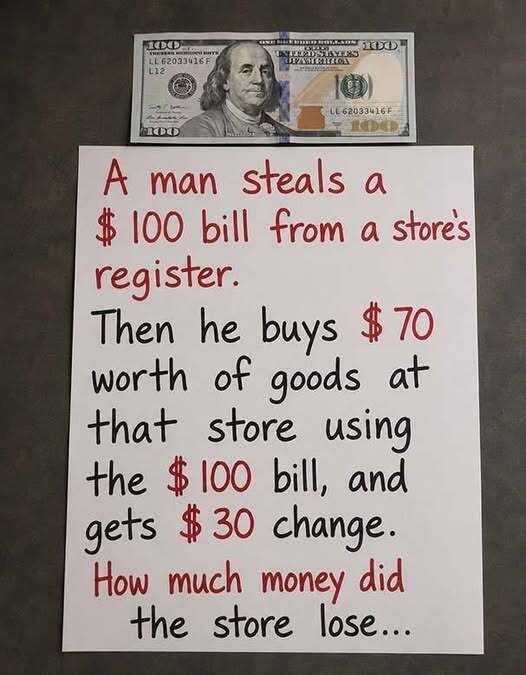
A man steals a $100 bill from a store register. Later, he returns to the same store and uses that same $100 bill to buy $70 worth of merchandise. The cashier gives him $30 in change.
So the question is: How much money did the store actually lose?
Take a moment to think about it before reading on. What's your answer?
Why People Get Different Answers
Many people quickly respond with answers like:
- $200
- $170
- $130
At first, those numbers may seem reasonable because the situation feels complicated. Some people count the stolen money separately from the merchandise and change. Others try to add every transaction together step by step.
Here's how the wrong answers typically happen:
The $200 answer. People add the stolen $100 to the $70 in merchandise plus $30 in change, counting everything as separate losses. This double-counts the original bill.
The $170 answer. People add the stolen $100 to the $70 in merchandise, forgetting that the $100 bill came back to the store during the purchase.
The $130 answer. People add the stolen $100 to the $30 in change, making a similar double-counting error.
But the key detail is that the original $100 bill eventually returns to the cash register during the purchase. That means the store ends up with the same $100 bill back in the drawer.
The Correct Answer
What the store permanently loses is:
- $70 worth of merchandise
- $30 in cash given as change
When added together: $70 + $30 = $100
So the store's total loss is exactly $100.
A Simpler Way to Understand It
Imagine the thief walked into the store and simply took:
- $70 worth of products
- $30 in cash
In that case, the total loss would clearly be $100. The confusion only happens because people accidentally count the same $100 bill twice: once when it is stolen and again when it is used during the purchase.
Another way to think about it: after the purchase, the $100 bill is back in the register where it started. So the theft of the bill cancels out. What remains is what the thief walked out with: $70 in goods and $30 in cash. Total: $100.
You can also think of it from the store's perspective at each step:
1. Theft: Store is down $100 cash.
2. Purchase: Thief gives back $100 cash, takes $70 in goods and $30 cash. Net effect of this step: store is down $70 in goods and $30 in cash, but up $100 in cash (the returned bill).
3. Combined: The $100 cash lost in step 1 is recovered in step 2. Final loss: $70 in merchandise + $30 in cash = $100.
Why These Riddles Are So Popular
Puzzles like this are entertaining because they test logical thinking more than difficult math skills. The wording encourages readers to overthink a situation that is actually straightforward once broken down carefully. That is why this riddle continues to spark debates online, even though the final answer stays the same every time.
These riddles also reveal something interesting about how our brains work. We're wired to track narratives, and the story here (theft, then a purchase) feels like two separate losses. Our brains want to add them up. The trick is recognizing that the two events are connected: the second event partially undoes the first.
This is the same kind of thinking error that appears in many classic puzzles and even in real-life financial mistakes. Learning to spot double-counting is a genuinely useful skill, whether you're solving riddles, balancing a budget, or evaluating a business deal.
More Riddles to Test Your Logic
If you enjoyed this one, here are a few more classics that play similar tricks on your brain:
- The missing dollar. Three people pay $30 for a hotel room ($10 each). The clerk realizes it should be $25 and gives $5 to the bellhop to return. The bellhop keeps $2 and gives each guest $1 back. Now each guest paid $9 ($27 total) plus the bellhop's $2 equals $29. Where's the missing dollar? (Trick: the $27 already includes the bellhop's $2. There's no missing dollar.)
- The bat and ball. A bat and ball cost $1.10 total. The bat costs $1.00 more than the ball. How much does the ball cost? (Answer: $0.05, not $0.10.)
- The lily pads. Lily pads double every day and cover a lake in 30 days. When were they half covering the lake? (Answer: day 29, not day 15.)
Each of these works the same way: the obvious answer feels right until you slow down and think it through.
The Takeaway
The store lost exactly $100. Not $200, not $170, not $130. Just $100: $70 in merchandise and $30 in change.
The next time someone shares this riddle, you'll know the answer. But more importantly, you'll understand why it's tricky, and you can enjoy watching others fall into the same delightful trap. Share it, debate it, and appreciate the simple pleasure of a puzzle that reminds us to think twice before counting twice.
Frequently Asked Questions
What is the answer to the $100 store riddle?
The store lost exactly $100: $70 worth of merchandise plus $30 given as change. The stolen $100 bill was returned to the register during the purchase, so it cancels out.
Why do people answer $200?
They count the stolen $100 separately from the $70 in merchandise and $30 in change, accidentally counting the same $100 bill twice: once when stolen, once when spent.
Why is the purchase step confusing?
Because it feels like a second, separate transaction. But the thief used the stolen bill to pay, so the store got its $100 back. The only real losses are the goods and change the thief walked out with.
Are there other riddles like this?
Yes. Classics like the missing dollar riddle, the bat-and-ball problem, and the lily pad puzzle all exploit similar thinking errors, where the intuitive answer feels right but careful logic reveals a different result.
What does this riddle teach us?
It teaches the importance of tracking what actually changes versus what just moves around. The $100 bill moved (stolen, then returned), but the net loss was only the merchandise and change. Spotting double-counting is a useful skill in puzzles and in real-life financial thinking.