Riddles are a fun way to test how we think and interpret clues. This one sounds intense at first, but the answer is simpler than you might expect.
Take a moment to read it carefully:
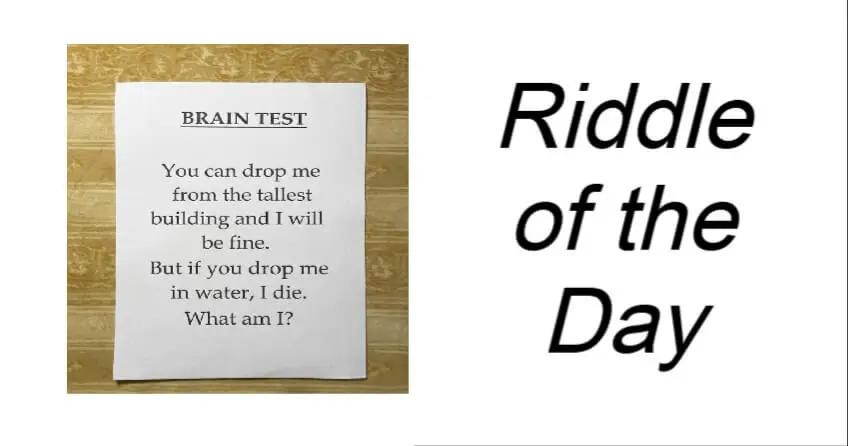
“You can drop me from the tallest building and I will be fine.
But if you drop me in water, I die.
What am I?”
At first glance, it seems like the answer must be something tough or nearly indestructible. After all, surviving a fall from a great height sounds impossible for most objects.
You might start thinking of things like metal, rubber, or something extremely light. But the second line changes the direction completely:
“But if you drop me in water, I die.”
The word “die” is the key. It suggests we’re not dealing with something traditionally alive, but something that can be extinguished or stopped.
So what fits both conditions?
It can survive falling through the air without damage, yet water immediately destroys it.
The Answer: Fire
Here’s why it works:
If something is on fire and falls from a high place, the flame can continue burning during the fall. The drop itself doesn’t necessarily put it out.
However, when fire comes into contact with water, it is quickly extinguished—meaning it “dies.”
Why This Riddle Is So Clever
This riddle plays with expectations. It leads you to think about strength and durability, but the answer isn’t a solid object at all. Instead, it’s something fragile in a completely different way.
That twist is what makes riddles like this enjoyable. They challenge not just what we know, but how we interpret words and clues.
What Survives a Huge Fall but “Dies” in Water? – Riddle of the Day
Riddles are a timeless way to challenge the mind. They encourage us to think beyond the obvious, question our assumptions, and look at simple ideas from a new angle. Today’s riddle is a perfect example—it sounds dramatic at first, but the answer turns out to be surprisingly straightforward.
Take a moment to read it slowly:
“You can drop me from the tallest building and I will be fine.
But if you drop me in water, I die.
What am I?”
At first glance, this feels like a question about strength or durability. Surviving a fall from a very tall building sounds like something only the toughest materials could handle. Naturally, your mind might jump to guesses like metal, rubber, or something extremely lightweight like a feather.
Those are reasonable ideas. After all, some materials can withstand impact better than others, and lighter objects might float gently to the ground. But then comes the second part of the riddle:
“But if you drop me in water, I die.”
This line shifts everything. The use of the word “die” is especially important. It suggests that we’re not dealing with a typical solid object. Instead, we’re looking for something that can be “alive” in a metaphorical sense—something that can stop, disappear, or be extinguished.
So now the question becomes: what can survive falling through the air, yet be completely destroyed by water?
To solve this, it helps to think less about physical strength and more about how different elements interact. Air, gravity, and water each affect things in different ways. Some things are unaffected by falling but are very sensitive to moisture or liquid contact.
When you think about it from that perspective, the answer starts to become clearer.
The Answer: Fire
Fire fits every part of the riddle perfectly.
If something is burning and falls from a high place, the flame can continue to burn as it moves through the air. The fall itself doesn’t necessarily put it out. In fact, as long as there is fuel and oxygen, the fire can remain active even while descending.
However, when fire comes into contact with water, the reaction is immediate. Water cools the fuel and removes the heat needed to sustain combustion. As a result, the flame is extinguished—meaning it “dies.”
Why This Riddle Works So Well
What makes this riddle clever is the way it guides your thinking in the wrong direction before revealing a simple truth. It sets you up to focus on physical objects and their ability to survive impact, when the real answer isn’t a solid object at all.
Instead, it’s something intangible—something you can’t hold, but that clearly behaves in predictable ways under different conditions.
The riddle also plays with language. Words like “survive” and “die” are often associated with living things, which makes the brain search for something biological. But in this case, those words are used metaphorically, which adds an extra layer of challenge.
A Fun Reminder About Thinking Differently
Riddles like this are more than just entertainment. They remind us that the first answer that comes to mind isn’t always the correct one. Sometimes, the solution requires stepping back, rethinking the clues, and looking at the problem from a completely different perspective.
That’s part of what makes them so engaging—they train the mind to be flexible, creative, and open to unexpected answers.
So the next time you come across a tricky question, remember this riddle. The solution might not be about strength or complexity at all—it might be something simple, hiding in plain sight.