Which Glass Holds the Most Water? A Simple Brain Teaser That Tests Your Observation Skills
Brain teasers are a fun way to challenge your thinking and sharpen your attention to detail. This popular puzzle has been shared across social media for years because the answer isn't as obvious as it first appears, and because it reliably starts arguments in the comments.
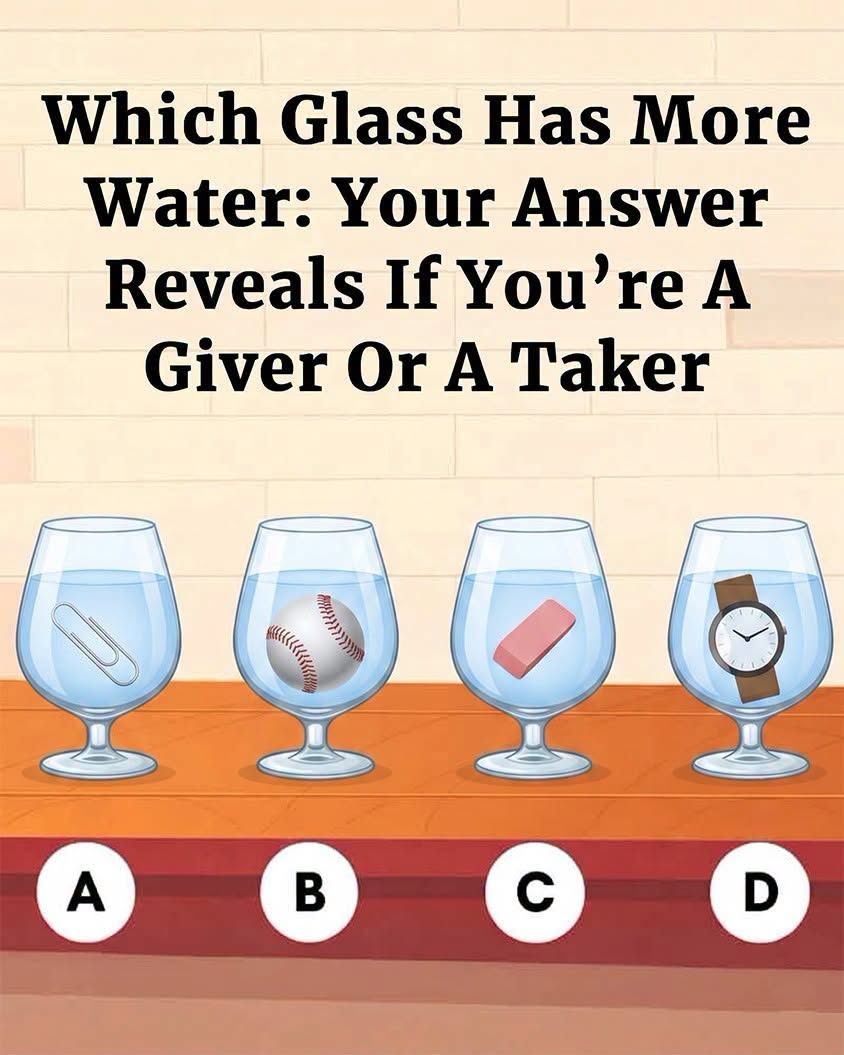
Take a close look at four identical glasses labeled A, B, C, and D. Each glass appears to be filled to about the same water level, but each one contains a different object. Glass A contains a paperclip, Glass B contains a baseball, Glass C contains an eraser, and Glass D contains a wristwatch.
The question is simple: which glass contains the most actual water?
At first glance, many people assume all four glasses hold the same amount of water because the visible water level looks nearly identical. However, there's one important scientific concept that changes the answer.
The Science Behind the Puzzle
The key idea is water displacement. Whenever an object is placed into water, it takes up space, pushing water aside. The larger the object, the more space it occupies, leaving less room for water inside the glass.
This principle was famously discovered by Archimedes in ancient Syracuse, supposedly when he noticed water rising in his bath and ran through the streets shouting "Eureka!" The version relevant here is simple: a submerged object displaces a volume of water equal to the object's own volume.
Since all four glasses are the same size and appear filled to the same level, the glass containing the smallest object will have the greatest amount of water. The water you see is only part of the story; the rest of the glass's volume is occupied by the object hiding beneath the surface.
The Correct Answer
The correct answer is Glass A. Because the paperclip is much smaller than the other objects, it displaces the least amount of water. This means Glass A contains the largest volume of actual water.
Ranking them from most to least water:
1. Glass A (paperclip): The tiny paperclip displaces almost nothing, so nearly the entire glass is water.
2. Glass C (eraser): Small but substantially larger than a paperclip, displacing a modest amount.
3. Glass D (wristwatch): Larger still, with its case, band, and hollow spaces displacing considerably more.
4. Glass B (baseball): The baseball is by far the largest object, occupying a huge portion of the glass and leaving the least room for water.
The visual trick is that the water level looks the same in all four glasses. Your eyes tell you "equal water," but equal levels with different displacements mean very different water volumes. The level is the same precisely because the objects make up the difference.
Why This Puzzle Fools So Many People
Several cognitive shortcuts conspire to make the wrong answer feel right:
- Level equals volume heuristic: In everyday life, when containers look equally full, they usually contain equal amounts. The puzzle exploits this reliable rule by hiding the variable that breaks it.
- Object blindness: Viewers focus on the water, the thing being asked about, and mentally edit out the objects as irrelevant decoration. But the objects are the entire puzzle.
- Speed over analysis: Social media trains quick reactions. The puzzle rewards the ten seconds of thought most scrollers don't give it.
- The "trick question" deflection: Some people assume there must be a trick and overthink into wrong answers, guessing the biggest object or declaring it unknowable.
Displacement in the Real World
This isn't just a party trick. Displacement principles show up constantly:
- Ships float because their hulls displace a weight of water equal to the ship's weight, which is why a massive steel vessel floats while a tiny steel paperclip sinks.
- Measuring irregular volumes: Dropping an object into a graduated cylinder and measuring the water rise is the standard way to find the volume of oddly shaped items.
- The bathtub effect: Getting into a full tub raises the water level by exactly your body's submerged volume, which is why overfilled tubs overflow.
- Ice in drinks: Melting ice doesn't raise the water level (it was already displacing its melt volume), but adding ice to a full glass spills it. Bartenders know displacement intuitively.
Understanding displacement means understanding why the glass with the paperclip wins: less stuff in the way, more room for water.
Try It Yourself: The Kitchen Experiment
You can verify the answer with four identical cups, water, and household objects:
1. Fill each cup to the same marked level with water.
2. Gently lower a different object into each: a coin, a small toy, a piece of fruit, a larger item.
3. Observe the water levels rise by different amounts, larger objects push water higher.
4. Now reverse it: remove water from each until levels match again. The cup with the biggest object will have the least water remaining.
It's a perfect five-minute science demonstration for kids, and it makes the abstract principle physically obvious in a way no explanation can.
More Puzzles That Play the Same Trick
If you enjoyed this one, try these classics that similarly hide the key variable:
- The ice cube puzzle: "If the ice in a glass of water melts, does the level rise, fall, or stay the same?" (Stays the same, floating ice already displaces its melt weight.)
- The boat and the rock: "A rock sits in a boat floating in a pool. The rock is thrown overboard and sinks. Does the pool level rise, fall, or stay the same?" (Falls, the rock displaces less water sitting on the bottom than it did floating in the boat.)
- The candle and the water: Variations involving displacement, pressure, and water levels that all reward thinking about what's actually occupying space.
Each one trains the same skill: looking past what's visible to account for what's hidden.
Frequently Asked Questions
Which glass holds the most water?
Glass A, the one with the paperclip. The smallest object displaces the least water, leaving the most room for actual water in the glass.
What is water displacement?
When an object is submerged, it pushes aside (displaces) a volume of water equal to the object's volume. Larger objects displace more water.
Why do the water levels look the same if the water amounts differ?
Because the objects make up the difference. Equal levels plus different object sizes means the water volumes must differ to fill the identical glasses to the same height.
Does the object's weight matter or just its size?
For this puzzle, only the submerged volume matters. A heavy small object displaces less than a light large one, as long as both are fully underwater.
Can I really test this at home?
Absolutely. Four identical cups, water, and different-sized objects demonstrate the principle in minutes. It's an excellent hands-on science activity for kids and adults alike.