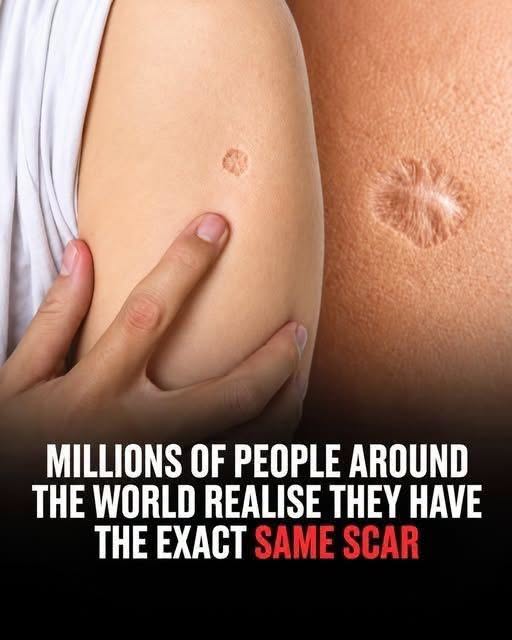
Have you ever noticed a small, round scar on the upper part of your arm and wondered where it came from?
For many people, the mark has been there for as long as they can remember. It is usually small, circular, and easy to overlook. But when friends or family members compare their arms, they sometimes discover something surprising: they have almost the exact same type of scar.
The similarity has led to plenty of questions over the years. Was it caused by an injury? Was it something people commonly received as children? And why does the mark appear in such a familiar location?
The answer is connected to an important chapter in medical history.
The Scar Is Often Linked to Smallpox Vaccination
For many people born during the years when smallpox vaccination was routinely used, the small circular scar on the upper arm is a reminder of having received a smallpox vaccine.
Smallpox was once one of the world’s most serious infectious diseases. It caused severe illness and claimed millions of lives over the course of human history.
Because the disease could spread between people, vaccination became an important part of public-health campaigns designed to reduce transmission and protect communities.
The distinctive scar was not simply an accidental result of an ordinary injection. It was closely connected to the particular way the smallpox vaccine was administered.
Why Did the Vaccine Leave a Scar?
The technique used for the smallpox vaccine was different from the familiar injection method used for many modern vaccines.
Instead of receiving one simple injection beneath the skin, the vaccine was administered using a specialized technique involving multiple small punctures in the skin.
This created a localized reaction at the vaccination site.
As the area healed, it could develop into a small blister or lesion. Eventually, the skin recovered, but the healing process could leave a permanent circular scar.
Because the same general vaccination technique was used on large numbers of people, many of the resulting scars had a remarkably similar appearance.
Why Does the Scar Look Almost the Same on So Many People?
The similarity makes more sense when you consider how widely smallpox vaccination was used.
Millions of people received the vaccine, and healthcare workers followed established methods for administering it. The repeated puncturing technique produced a characteristic skin reaction.
After healing, the remaining mark could be round and relatively noticeable compared with the tiny marks left by many modern injections.
That is why two people who have never met before can compare their upper arms and discover that they have a very similar scar.
What initially looks like a coincidence is actually connected to a shared piece of medical history.
Why Do Some People Have the Scar While Others Don’t?
One of the easiest ways to notice the difference is by comparing generations.
Older adults are more likely to have the familiar smallpox-vaccination scar because routine vaccination was part of childhood healthcare in many places during the years when smallpox remained a public-health concern.
Many younger people do not have the scar.
The reason is straightforward: routine smallpox vaccination eventually stopped in many countries after sustained vaccination efforts dramatically reduced the disease worldwide.
As a result, the scar became something increasingly associated with earlier generations.
A Small Mark With a Remarkable History
Today, a small circular scar on someone’s arm may seem like an ordinary detail.
For many people, however, it represents something much bigger.
It is evidence of a time when communities around the world were working to control a disease that had affected human populations for centuries.
The smallpox vaccination campaigns eventually contributed to one of the most significant achievements in public health: the global eradication of smallpox.
That makes the little mark more than just a scar. It can serve as a quiet reminder of the enormous effort involved in protecting generations of people from a dangerous disease.
So, What Is That Small Scar?
If you have a small, round scar on your upper arm and have always wondered why it is there, a previous smallpox vaccination may explain it.
The distinctive appearance came from the older vaccination technique, which involved multiple small punctures rather than the single injection commonly associated with many modern vaccines.
The resulting skin reaction could heal into the characteristic circular mark that millions of people carried for the rest of their lives.
What looks like a mysterious childhood scar may therefore be a small reminder of a remarkable moment in medical history.