
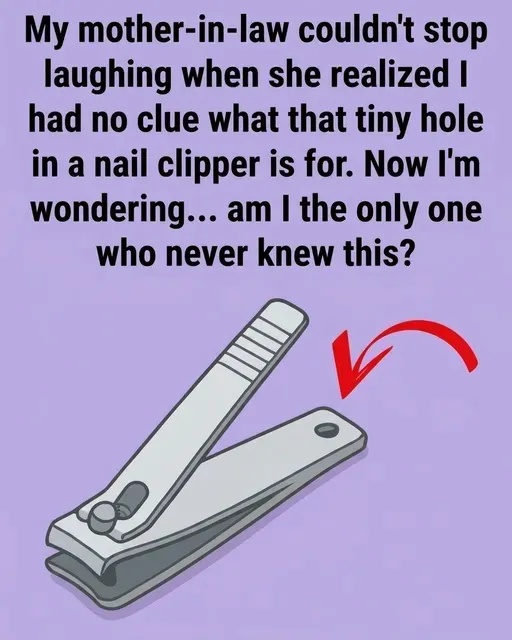
Why Nail Clippers Often Include a Small Round Hole in Their Design
Nail clippers are one of those everyday tools most people use without giving much thought to their design. They are small, simple, and commonly found in bathroom drawers, travel kits, or grooming bags. However, if you look closely at many standard nail clippers, you will notice a small round hole at the end of one handle. While it may appear to be just a decorative detail, this small feature actually serves several practical purposes.
The Main Purpose: Portability and Convenience
One of the main reasons for the round hole is convenience. The opening allows the clipper to be attached to a keychain, lanyard, or small metal ring. By adding a key ring, people can connect the clipper to house keys, travel bags, or hooks in the bathroom. This simple feature helps prevent the clipper from getting lost among other small items and keeps it within easy reach whenever it is needed.
Anyone who has ever dug through a bathroom drawer looking for nail clippers understands the value of this. Small grooming tools have a way of disappearing into clutter. Attached to a keychain, the clipper becomes findable. Attached to a travel bag, it becomes packable. Hung on a hook, it becomes visible.
Organization for Grooming Routines
The hole is also useful for people who prefer to keep their personal care tools organized. When attached to a keychain or ring, a nail clipper can easily be stored in a gym bag, suitcase, or backpack without disappearing at the bottom. In busy households, the hole allows the clipper to be hung on a hook or organizer so that it can be found quickly.
Some people even place multiple clippers on one ring, using one for fingernails and another for toenails, to maintain a more organized grooming routine. This is actually good hygiene practice: using separate clippers for fingers and toes reduces the transfer of bacteria and fungi between them.
Other organizational uses include:
- Travel kits: Clipped to the outside of a toiletry bag for instant access at security or in hotel bathrooms.
- Gym bags: Always available post-workout without rummaging.
- First aid kits: A nail clipper is surprisingly useful for trimming bandages, hangnails, or loose threads in the field.
- Shared households: Each family member can have their own clipper on a labeled ring, avoiding mix-ups.
Better Grip and Control
In addition to storage, the small opening can provide extra grip while using the clipper. Some users place a finger through the hole to steady the tool when trimming nails, which can offer better control and precision.
This is particularly helpful for people with limited dexterity, arthritis, or shaky hands. The finger-through-hole technique stabilizes the clipper against unwanted rotation, making each cut more deliberate. Occupational therapists sometimes recommend this kind of adapted grip for clients who struggle with small grooming tools.
A Brief History of the Design
This small design detail also reflects how everyday objects evolve over time. Early versions of nail clippers introduced in the late nineteenth century often included similar features to make them easier to carry when personal grooming tools were less commonly stored in dedicated bathroom spaces.
Before the modern bathroom with its drawers and medicine cabinets became standard, personal items traveled with people. Grooming tools needed to be portable, attachable, and losable-proof. The hole solved that problem elegantly, and it solved it so well that the feature survived more than a century of design evolution.
The fact that the round hole continues to appear on many nail clippers today highlights how effective the design has been. In an age of constant redesign, features that serve no purpose get eliminated to save manufacturing costs. The hole remains because it earns its place.
The Philosophy of Small Details
Although it is easy to overlook, this tiny feature shows how thoughtful design can improve the practicality of simple tools. Small details like this can quietly make daily routines a little more convenient without most people ever noticing.
Good design is often invisible. The best features are the ones you use without thinking about them: the hole you thread a keyring through without wondering why it's there, the grip that steadies your hand without you noticing. The nail clipper's hole is a miniature masterclass in functional design.
It also illustrates a broader principle: the objects we use every day deserve the same design care as the objects we admire. A two-dollar tool, thoughtfully designed, can outperform a twenty-dollar tool that wasn't.
Other Clever Details on Nail Clippers
The hole is not the only thoughtful feature hiding in plain sight on nail clippers:
- The nail file: The small textured strip attached to many clippers is for smoothing rough edges after cutting.
- The curved blade: Fingernail clippers typically have curved blades matching the nail's natural shape; toenail clippers are often straighter for a flat cut that prevents ingrown nails.
- The lever mechanism: The compound lever design multiplies hand force, allowing clean cuts with minimal effort.
- The pin: The tiny pivot pin enables the lever action and can sometimes be removed for thorough cleaning.
Each of these features, like the hole, exists because someone thought carefully about how the tool is actually used.
Frequently Asked Questions
What is the hole in nail clippers for?
Primarily for attaching the clipper to a keychain, key ring, lanyard, or hook, which keeps it portable, organized, and easy to find. It can also provide extra grip by placing a finger through it while trimming.
Can I put my nail clipper on my keychain?
Yes, that's exactly what the hole is designed for. Use a small split ring or key ring through the hole. It's a popular way to keep clippers accessible for travel, gym bags, or everyday carry.
Why do some nail clippers not have the hole?
Some premium or specialized designs omit it for aesthetics or because they're intended for stationary use (like heavy-duty toenail clippers kept in one place). The hole remains common on standard portable clippers.
Is it hygienic to share nail clippers?
It's better not to. Sharing can transfer bacteria and fungi. If clippers must be shared, disinfect them with rubbing alcohol between uses. Using separate clippers for fingernails and toenails is also good practice.
How often should nail clippers be replaced or cleaned?
Clean them with soap and water or rubbing alcohol periodically, especially the blades. Replace them when the blades become dull and start tearing rather than cutting cleanly, typically every year or two with regular use.
What's the difference between fingernail and toenail clippers?
Fingernail clippers are smaller with curved blades matching the nail shape. Toenail clippers are larger and sturdier with straighter blades for the thicker toenails and a flat cut that helps prevent ingrown nails.



