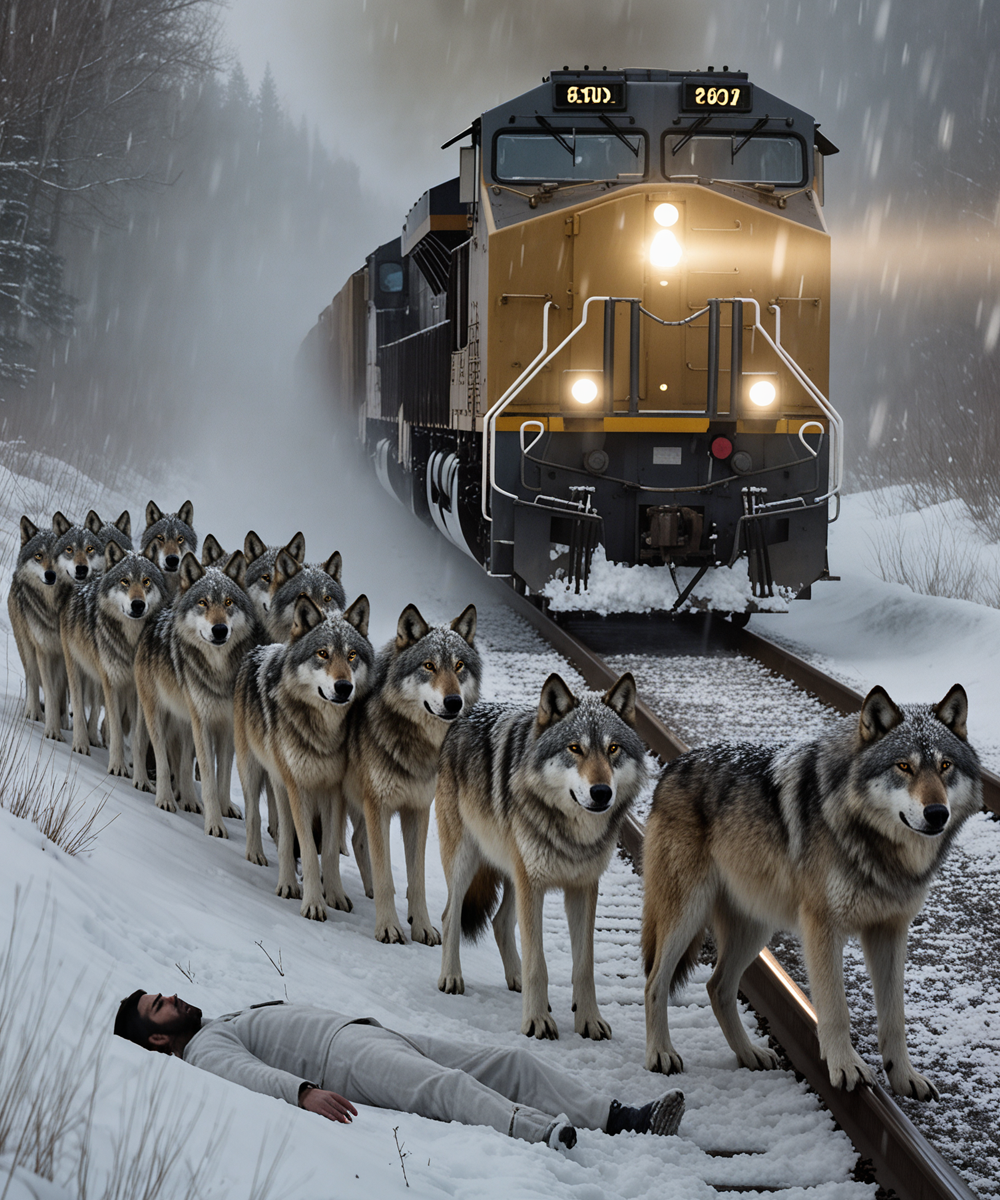
Wolves on the Tracks: A Train Driver’s Unforgettable Winter Morning
On a crisp, snowy morning, the forest surrounding the railway line was silent except for the hum of the train's engine. The driver had made this trip dozens of times before. The frozen landscape rolled by like a painting: white pines heavy with snow, wildlife retreating at the sound of the approaching train. Everything felt routine, until a strange scene appeared ahead.
A Pack Standing Firm in the Snow
Right on the tracks stood a pack of wolves. They were not darting away into the trees as wild animals usually do. Instead, they were motionless, forming a barrier across the rails. Their fur bristled in the cold wind, and their amber eyes glinted in the train's headlights. Long, mournful howls rose into the morning air, echoing across the empty forest.
The driver instinctively slowed down, his pulse quickening. Wolves are known to be shy of people, yet these ones seemed determined to stand their ground. They weren't aggressive, but they weren't moving either.
Anyone who has driven a train through wolf country knows that sightings are rare and brief. Wolves hear a train coming from far away and are gone long before it arrives. A pack standing its ground on the rails is so unusual that the driver's first thought was that something had to be wrong.
Brakes Screech Against the Cold Rails
He slammed on the brakes, and the train screeched across the icy tracks, sliding forward a few more meters before coming to a halt just short of the wolves. Snow swirled around the wheels. Still, the animals did not scatter. They held their position, like silent guardians of something unseen.
Stopping a train is not like stopping a car. On icy rails, braking distances stretch enormously, and every meter matters. The driver had seconds to react, and his quick response is likely the only reason the morning did not end in tragedy.
The Moment of Realization
For a moment, the driver wondered if the wolves were sick or desperate from hunger. Winter drives wild animals to take risks they would never consider in summer, and a starving pack might behave unpredictably. But as he leaned closer to the window, peering through the falling snow, he noticed something unusual lying between them on the tracks. It was small, motionless, and half hidden under a drift of snow.
And then it dawned on him: the wolves weren't just standing there. They were protecting something.
Nature's Protective Instinct on Display
What he had stumbled upon was not an act of aggression but of defense. In the heart of winter, when survival is at its hardest, this pack had chosen to shield whatever lay on the rails rather than abandon it. It could have been a vulnerable pup, an injured pack member, or another animal in need. Whatever it was, their instinct was to guard, not flee.
This behavior is deeply rooted in wolf biology. Wolves are among the most socially bonded animals on earth, and their pack structure revolves around cooperation and mutual protection.
How Wolf Packs Really Work
Popular culture often describes wolf packs in terms of dominance and hierarchy, but modern research paints a richer picture. Most wild packs are families: a breeding pair and their offspring of various ages. Their social bonds resemble those of a human family more than a military unit.
- Cooperative care. Pack members share food, and adults regurgitate meals for pups. The young are everyone's responsibility.
- Collective defense. When a pack member is threatened, others rally. Standing ground against a much larger danger, even a train, fits this pattern.
- Communication. Howls coordinate the pack across distance, and the mournful calls the driver heard were likely the pack signaling to each other, and possibly to him.
- Loyalty under pressure. Studies of wild wolves show injured or weak members are often supported rather than abandoned, especially in family packs.
What the driver witnessed was this social machinery operating at full intensity: a family refusing to leave one of its own, even in the face of a roaring machine bearing down on them.
Winter: The Cruelest Season
Winter is the ultimate test for wolves. Prey becomes scarce, deep snow makes hunting exhausting, and temperatures demand enormous caloric intake just to stay warm. Pups born the previous spring are still vulnerable. An injured animal that might recover in summer can quickly succumb in winter.
It is precisely in these brutal conditions that pack loyalty matters most. A lone wolf in deep winter faces terrible odds. A pack that stays together, shares kills, and protects its weakest members gives everyone the best chance of seeing spring. The wolves on the tracks were demonstrating, in the starkest possible terms, why their species evolved to live as families.
A Powerful Reminder of the Wild
Encounters like this remind us that nature is not only fierce but also deeply bonded. Wolves are known for their loyalty to their pack, their cooperation in hunting, and their remarkable ability to work together to protect their young. Seeing them in such a rare and protective stance left a lasting impression on the driver, and now on everyone who hears his story.
There is something profoundly moving about the image: wild animals, often portrayed as ruthless predators, forming a living shield around something small and helpless. It challenges the simplistic view of nature as nothing but competition and cruelty. Cooperation, care, and sacrifice are just as natural, and just as wild.
Respecting Wildlife From Afar
The story also serves as a gentle lesson in respecting wildlife. Even animals that may seem intimidating have complex social structures and instincts worth admiring. By slowing down and observing instead of reacting with fear, the train driver witnessed something few people ever see: the powerful unity and guardianship of a wild pack.
For those who live, work, or travel in wolf country, a few principles apply:
- Slow down in known wildlife corridors, especially at dawn and dusk in winter.
- Never approach wolves. Admire from a distance. A protective pack is not an opportunity for a closer look.
- Report unusual sightings to local wildlife authorities. Abnormal behavior can signal injury, illness, or habitat problems worth investigating.
- Remember you are the visitor. Railways, roads, and trails cut through their home, not the other way around.
Frequently Asked Questions
Do wolves normally stand their ground against trains?
No. Wolves are typically shy and avoid humans and machines. A pack holding its position on tracks is highly unusual and suggests the animals were protecting something, such as a pup or injured pack member.
Why do wolves howl?
Howling serves multiple purposes: coordinating pack members across distance, reinforcing social bonds, warning rival packs away from territory, and locating separated members.
Are wolves dangerous to people?
Wild wolf attacks on humans are extremely rare. Wolves generally avoid people. The greater risk in encounters like this one is to the animals themselves.
What should a driver do if wildlife is on the tracks?
Slow down and stop if it can be done safely, exactly as this driver did. Never assume animals will move in time, especially on icy rails where braking distances are long.
What was the pack protecting on the tracks?
The driver could see something small and motionless half hidden in the snow between the wolves, but its exact identity remained unclear. The pack's behavior strongly indicated they were guarding a vulnerable member or animal rather than acting aggressively.