
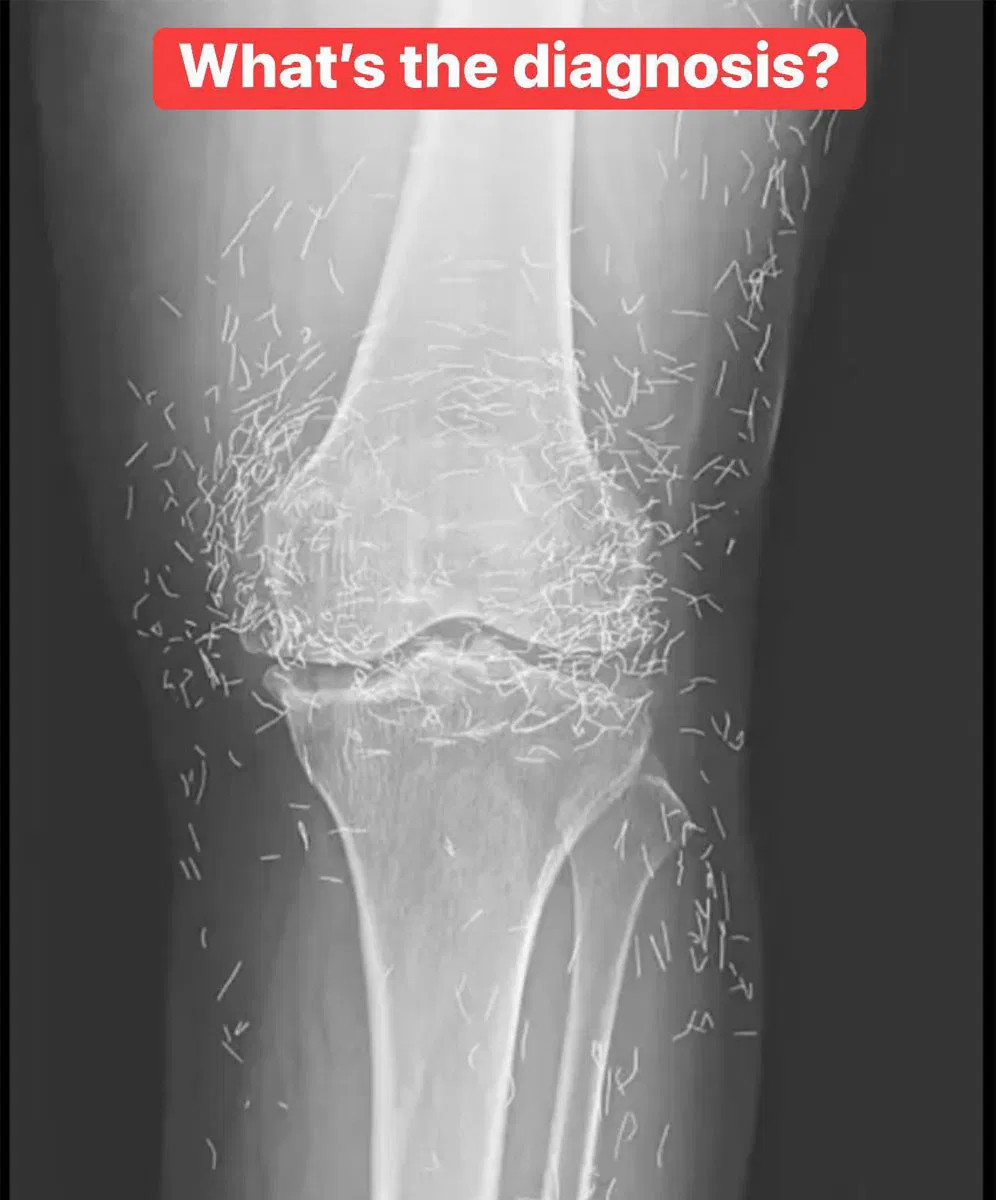
X-Ray Shocks Doctors: Hundreds of Gold Needles Found in Woman’s Knees
Medical teams in South Korea were stunned when an X-ray revealed something highly unusual in the knees of a 65-year-old woman suffering from severe joint pain. Instead of a standard image of bones and cartilage, the scan displayed hundreds of tiny gold acupuncture needles embedded deep within her tissue. It was an image no textbook had prepared them for, and a window into how far people will go to escape chronic pain.
A Patient in Search of Relief
The woman had long battled osteoarthritis, a condition where the protective cartilage between bones wears down, leaving joints stiff, swollen, and painful. Osteoarthritis of the knee is one of the most common causes of disability in older adults worldwide, and it can make walking, climbing stairs, and even standing up from a chair an ordeal.
Standard treatments had failed her. Painkillers and anti-inflammatory medications, the usual first line of defense, had only worsened her stomach discomfort, a common side effect of long term NSAID use. Trapped between pain and the drugs meant to treat it, she did what millions of chronic pain sufferers do: she looked for alternatives.
She turned to acupuncture, a centuries-old practice widely used in Asia to relieve pain and restore balance in the body. But the treatment she received went far beyond the typical session of temporary needles.
Gold Needles Left Behind on Purpose
According to doctors, during her acupuncture sessions, gold needles were intentionally left inside her knees to provide ongoing stimulation to pressure points. This was not an accident or a mistake. It was a deliberate technique.
In parts of Asia, inserting small pieces of sterile gold thread around joints is considered a complementary treatment for arthritis. The theory is that the metal provides continuous stimulation to acupuncture points long after the practitioner has gone home, extending the treatment indefinitely. Gold is chosen because it is relatively inert and was traditionally believed to be well tolerated by the body.
While this approach is practiced in some regions, medical experts caution that leaving foreign objects in the body can be risky, and this case illustrates exactly why.
Why Doctors Were Alarmed
Dr. Ali Guermazi, a radiology professor at Boston University, explained the medical concerns clearly. Retained objects can trigger inflammation, abscesses, and even serious infections. They can also make it more difficult for physicians to read imaging scans, since hundreds of metallic fragments obscure the anatomy doctors are trying to evaluate.
“The body naturally tries to reject any foreign material,” he said, noting that scar tissue may form around the object. That foreign body response is the immune system's standard reaction to anything it did not grow itself, and while gold is less reactive than many metals, it is not invisible to the immune system.
Even more concerning, patients with such embedded needles are unable to undergo certain diagnostic tests, such as MRI scans. The powerful magnets in an MRI machine can cause metallic objects to shift, heat up, or move, potentially causing life threatening damage to arteries and surrounding tissue. For a 65-year-old with severe arthritis, losing access to MRI imaging closes off one of the most important diagnostic tools in modern medicine.
How Common Is This Practice?
Despite the risks, acupuncture remains enormously popular worldwide. A report by the U.S. National Institutes of Health noted that more than 3.1 million American adults and 150,000 children used acupuncture as part of their medical care as far back as 2007, and those numbers have only grown since.
Gold thread therapy specifically has a long history in Korea and parts of China, where it has been used for decades for arthritis and chronic musculoskeletal pain. Practitioners who offer it generally consider it safe when performed with sterile materials. The medical establishment, however, remains skeptical, and cases like this one fuel that skepticism.
Still, scientific evidence supporting acupuncture's effectiveness is limited. While many patients report short-term relief, rigorous clinical trials have produced mixed results, with some of the benefit likely attributable to placebo effects. Doctors emphasize the importance of caution and professional medical advice before relying on alternative therapies, particularly invasive ones.
The Desperation Behind the Decision
It is easy to look at an X-ray full of gold needles and wonder how anyone could agree to such a thing. But the context matters. Chronic pain reshapes a person's decision making. When every step hurts, when standard medications damage your stomach, when surgery feels terrifying or unaffordable, the promise of lasting relief becomes powerfully attractive.
This woman was not reckless. She was a 65-year-old in severe pain who had exhausted conventional options and placed her trust in a traditional practice with deep cultural roots. Her story is less about one unusual treatment and more about the desperation that drives chronic pain patients toward anything that might help.
Safer Paths for Arthritis Relief
For readers dealing with osteoarthritis, medical professionals recommend discussing the full range of evidence based options with a doctor.
- Physical therapy and targeted exercise. Strengthening the muscles around the knee reduces load on the joint.
- Weight management. Even modest weight loss significantly decreases knee stress.
- Topical treatments. Gels and creams can relieve pain with fewer systemic side effects than oral drugs.
- Injections. Corticosteroid or hyaluronic acid injections offer temporary relief for many patients.
- Assistive devices. Braces, canes, and proper footwear change joint mechanics for the better.
- Surgery. Knee replacement, while major, has excellent long term outcomes for severe cases.
- Standard acupuncture. Temporary needle acupuncture, performed by a licensed practitioner, carries far fewer risks than permanent implantation.
The key principle is reversibility. Treatments that can be stopped or undone are inherently safer than permanent alterations, especially when the long term effects are poorly studied.
Frequently Asked Questions
What did the X-ray show?
The X-ray of a 65-year-old South Korean woman's knees revealed hundreds of tiny gold acupuncture needles embedded in the tissue around her joints, intentionally left there during acupuncture treatments for osteoarthritis.
Why were gold needles left in her knees?
In some Asian acupuncture traditions, small sterile gold threads are intentionally implanted near joints to provide ongoing stimulation to pressure points, theoretically extending pain relief indefinitely.
Is this practice dangerous?
Medical experts say yes, it carries real risks, including inflammation, abscesses, infection, difficulty reading future imaging scans, and inability to undergo MRI scans safely.
Why can't patients with embedded needles get an MRI?
MRI machines use powerful magnets that can cause metal objects in the body to shift, heat, or move, potentially damaging arteries and surrounding tissue.
How common is acupuncture overall?
Very common. A U.S. National Institutes of Health report found that more than 3.1 million American adults and 150,000 children had used acupuncture as part of their medical care as of 2007.
What should I do before trying an alternative arthritis treatment?
Talk to your doctor first, research the evidence, favor reversible treatments over permanent ones, and make sure any practitioner is licensed and uses sterile technique.

