A Simple Message That Uncovered a Long Hidden Family Story
Every family has traditions, and in our home, everything centered around Sunday dinners. After my father passed away three years ago, my mother made a quiet promise to herself to keep our family close. No matter how busy life became, she invited my brother and me over every Sunday. Those dinners were more than meals. They were her way of honoring my father's memory and preserving a sense of togetherness.
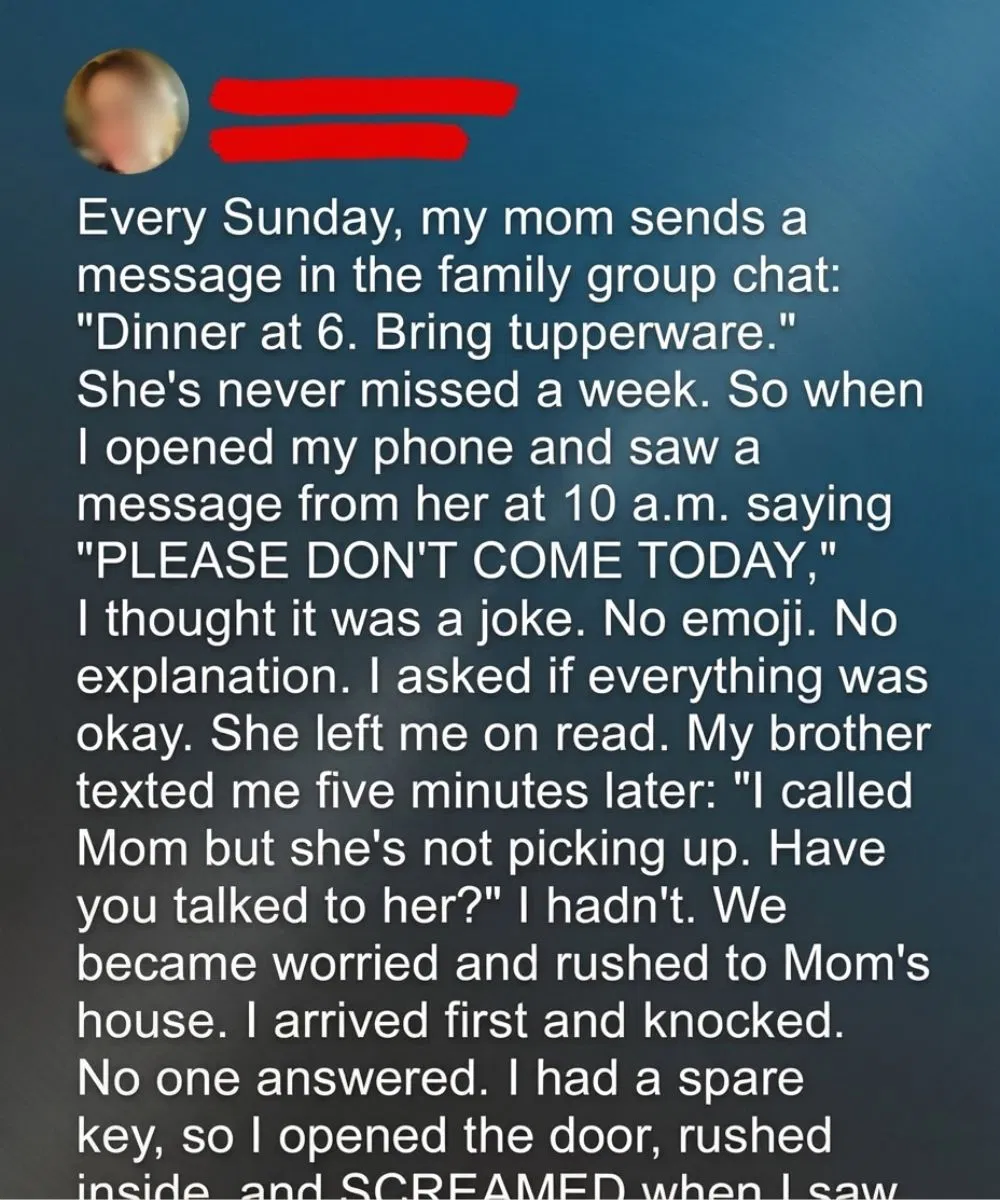
That is why a short message she sent one Sunday afternoon immediately unsettled us. "Please don't come today." There was no explanation, no context, and no warmth in the words.
The Message That Did Not Sound Like Her
My brother and I exchanged worried looks. Something felt wrong. Our mother was the woman who had kept Sunday dinner sacred through grief, through busy seasons, through everything. A cancellation was unusual enough. A cancellation this cold, this abrupt, was alarming.
We considered the possibilities. Was she ill and not wanting us to worry? Had something happened at the house? Was this message even from her? In families with strong routines, a break in the pattern is itself a signal, and we both received it loud and clear.
Instead of staying home, we decided to go to her house anyway, hoping to make sure she was all right.
What We Found
When we arrived, the porch light was on, but no one answered the door. Using a spare key, I stepped inside and called out for her. As I walked into the kitchen, I froze.
A man was sitting at the table. His build and posture were eerily familiar. From behind, he looked so much like our father that it took my breath away. My brother stepped in behind me and stopped short as well. Our mother stood at the counter, slowly preparing vegetables. Without turning around, she quietly asked why we had not listened to her message.
When the man turned to face us, the resemblance was undeniable, though not exact. It felt like looking at a reflection of someone we had lost, slightly altered, as if seen through water.
The Story Unfolds
What followed was a conversation none of us had expected to have. The man was our father's brother, our uncle, though "uncle" hardly captures what he had been. Years earlier, long before we were born, he and our father had quarreled bitterly over something that now seemed impossibly small. Pride had done what pride does: it had calcified a disagreement into an estrangement, and the estrangement had lasted decades.
Our father had died three years ago without reconciling. Our mother had carried the knowledge of this brother alone, unsure whether reopening the wound would honor her husband's memory or betray it.
She had invited him to Sunday dinner in secret, wanting to see him first, to gauge whether the man at her table bore any resemblance to the brother her husband had described in his rare, reluctant mentions. The message telling us not to come had been her attempt to keep that first meeting private, not to deceive us, but to protect a fragile possibility from the weight of our expectations.
Why She Kept It Secret
It would be easy to judge her for the secrecy. We did, briefly, standing in that kitchen. But as she explained, the reasoning became harder to dismiss:
- She did not know who he was anymore. Decades change people. She needed to see for herself before introducing him as family.
- She was protecting our father's memory. Presenting a long-lost brother without context might have felt like rewriting a story we thought we knew.
- She feared our reaction. Would we see this as betrayal? Would we resent a stranger at our father's table?
- Some reconciliations need privacy. A first meeting carries enough emotion without an audience, even a loving one.
Her secrecy was not deception. It was care, applied in the wrong direction perhaps, but care nonetheless.
The Resemblance That Started It All
There is something almost biological about the moment in that kitchen. Humans are wired to recognize kin. The man's build, his posture, the way he held himself at the table, these were our father's mannerisms living in another body. My brother and I both felt it before we understood it: the uncanny sense of a presence we had mourned, partially restored.
Family resemblance is more than faces. It is gestures, stances, laughs, the angle at which someone holds a coffee cup. These are the inheritances no will can convey, and they are why the moment felt so disorienting. We were not just meeting an uncle. We were encountering our father as he might have been in another life.
What Sunday Dinners Mean Now
That Sunday dinner, the one we were told not to attend, became the most important one in years. We stayed. Our mother finished preparing the vegetables, her hands steadier now that the secret was out. Our uncle, for that is what he is, told stories about our father as a young man that we had never heard. He cried. We cried. The food, when we finally ate it, tasted like something more than food.
In the weeks since, the tradition has continued, expanded rather than broken. There is an extra chair at the table now. Our mother, who once guarded her husband's memory through the ritual of Sunday dinner, has found that the ritual is strong enough to hold more than memory. It can hold reconciliation too.
Lessons From a Simple Message
- Breaks in routine are signals. When someone who never cancels suddenly does, pay attention. The pattern break is the message beneath the message.
- Showing up matters. If we had obeyed the text, we would have missed the beginning of this chapter. Checking on someone you love is never the wrong choice.
- Secrets are not always betrayals. Our mother's silence came from care, not malice. Motive matters when judging what people hide.
- It is never too late. Decades of estrangement ended at a kitchen table on a Sunday afternoon. Time passed, but the door was never fully closed.
- Traditions can grow. Sunday dinner survived grief. It can survive, and be enriched by, new family.
Frequently Asked Questions
What was the unsettling message?
Their mother texted "Please don't come today" on a Sunday afternoon, breaking a three-year tradition of weekly family dinners with no explanation.
Who was the man at the kitchen table?
Their father's long-estranged brother. He and their father had quarreled decades earlier and never reconciled before their father's death three years prior.
Why did their mother keep the meeting secret?
She wanted to meet him privately first to see who he had become, protect her late husband's memory, and avoid burdening her children with expectations before she understood the situation herself.
How did the story resolve?
The children stayed for dinner, the family began reconciling with their uncle, and the Sunday dinner tradition continued with an extra chair at the table.