
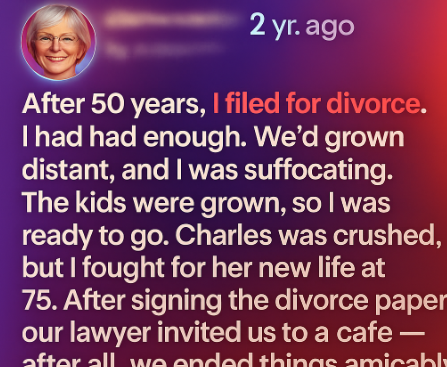
After 50 Years of Marriage We Signed the Papers, Then One Phone Call Changed Everything
After fifty years together, a couple sits in a lawyer's office and signs the papers ending their marriage. No shouting, no tears. Just a quiet finality, followed by coffee at their usual cafe, where he still orders her usual drink out of decades of habit. That evening the phone rings: he has suffered a sudden stroke and is in intensive care. She rushes to the hospital. In the weeks that follow, she visits every day, reads to him, talks about their shared life. He slowly begins to respond. They do not remarry. What grows between them instead is something gentler: respect, kindness, and understanding. Together they start a small scholarship fund for women beginning new chapters later in life.
Stories like this spread because they compress a lifetime of complicated feeling into a single pivot: the moment crisis strips away years of grievance and reveals what remains. The anecdote itself cannot be verified, so it is best read as an illustration rather than a proven event. But the themes it raises are deeply real for many older adults: divorce late in life, how crisis reshuffles our priorities, caring for someone you chose to leave, and finding purpose in a new chapter. Here is thoughtful guidance on each.
Divorce After Decades: More Common Than You Think
Ending a marriage after thirty, forty, or fifty years has become increasingly recognized, and it carries a weight that younger divorce does not. The grief is not just for the partner. It is for the shared identity: the couple friends, the routines, the shorthand language built over half a century. People who divorce late in life often describe a strange doubleness. Relief and terror. Freedom and disorientation. The certainty that it was time, sitting right beside the question of who they are without the marriage.
Common reasons long marriages end include:
- Growing apart slowly. Not one betrayal but thousands of small disconnections, until two people realize they are living parallel lives.
- The empty nest effect. Children leave, and the couple discovers the marriage was organized around parenting, with little left underneath.
- Retirement. Suddenly together all day, couples meet versions of each other they had not spent much time with in decades.
- One partner's growth. Sometimes one person changes, through therapy, new friendships, or simply aging into honesty, and the marriage cannot stretch to fit.
- Long tolerated unhappiness. What was endured for the children's sake becomes unendurable once that reason expires.
None of these make the decision easy. Signing papers after fifty years, as the story describes, is often calm precisely because the grief was processed long before the appointment.
When Crisis Rewrites the Story
The phone call in the story is the hinge: news of his stroke dissolves years of bitterness in an instant. This is a recognizable human response. Crisis has a way of editing our grievances down to their essentials. The annoyances that felt enormous in the lawyer's office suddenly look small next to a hospital bed.
But it is worth being honest about what crisis does and does not change:
- It clarifies what you feel, but it does not rewrite history. Compassion flooding back does not mean the reasons for the divorce were invalid.
- It can create a new relationship, not restore the old one. Notice that in the story they do not remarry. What grows is described as gentler: respect and kindness rather than romance. That distinction matters.
- Guilt can masquerade as love. Rushing to the hospital can be pure compassion, or it can be tangled with guilt about leaving. Both can be true at once. A little self honesty helps.
- The clarity may fade. Crisis feelings are intense but temporary. Decisions made in the hospital corridor deserve revisiting once the emergency passes.
If you find yourself caring for a former spouse through illness, you do not need to resolve the philosophical question of what it means. You can simply show up, set whatever boundaries keep you well, and let the relationship be whatever it becomes.
Caring for an Ex: Practical and Emotional Realities
Showing up for a former partner's illness is admirable, and it is also complicated. A few things help:
- Decide your role deliberately. Are you a daily visitor, an occasional caller, the person handling logistics? Choose consciously rather than sliding into the full time caregiver role by default, especially if that role contributed to the marriage ending.
- Involve others. Adult children, siblings, friends, and professional caregivers should share the load. One person doing everything, again, is how resentment rebuilds.
- Protect your new life. If you have begun a new chapter, new relationships, new routines, do not let crisis erase the boundaries you set. You can be compassionate without moving back in, literally or emotionally.
- Watch your own health. Caregiver strain does not care about divorce papers. Exhaustion, skipped checkups, and chronic stress affect former spouses exactly as they affect current ones.
- Let family dynamics be what they are. Adult children may have strong feelings about your involvement. Brief, kind communication about your intentions prevents misunderstandings.
Finding Purpose in the New Chapter
One of the most hopeful details in the story is the scholarship fund the two start together for women beginning new chapters later in life. Whether or not the anecdote is factual, the impulse it describes is real and well supported: people who build new purpose after major life upheavals tend to fare better emotionally than those who do not.
Ideas that many people find meaningful in the years after a late life divorce:
- Mentoring or teaching. Decades of professional and life experience are genuinely valuable to younger people starting out.
- Volunteering with a cause you care about. Regular commitment beats occasional volunteering for building new social bonds.
- Learning something entirely new. A language, an instrument, a craft. Novelty is good for the aging brain and the spirit alike.
- Travel with intention. Not escape, but exploration: the trips you always talked about and never took.
- Writing. Memoir, letters to grandchildren, even a private journal. Making meaning out of fifty years is real work, and writing helps.
- Community building. Book clubs, walking groups, faith communities, classes. New chapters need new people.
The point is not to fill time. It is to build a life that belongs to you, not to the marriage that ended.
The Legal and Financial Side Deserves Attention Too
Stories tend to skip the paperwork, but real late life divorce involves practical matters that deserve professional guidance:
- Retirement accounts and pensions are often the largest assets and the most complex to divide. Get qualified legal advice, not just a quick agreement.
- Health insurance changes after divorce, and at this stage of life that matters enormously. Understand your options before the divorce is final.
- Estate plans, wills, and beneficiaries all need updating. Many people forget old designations and create painful surprises years later.
- Social Security rules around divorced spouse benefits are specific and worth understanding with professional help.
This is not legal advice, just a reminder: the emotional story and the financial reality both deserve care.
Frequently Asked Questions
Is it normal to still care deeply about an ex after choosing divorce?
Completely. Divorce ends a legal arrangement and often a romantic one. It does not erase fifty years of shared life, and compassion for someone you knew that long is a sign of humanity, not confusion.
Does rushing to help mean the divorce was a mistake?
Not necessarily. Crisis compassion and marital compatibility are different things. You can be the right person to sit at a hospital bed and still have been right to end the marriage. Let the two truths coexist.
How do I handle family members who judge my involvement with my ex?
Briefly and kindly: "We shared fifty years, and I am comfortable with the role I am playing." You do not owe anyone a detailed justification for your own compassion.
What if I feel guilty about leaving, especially now that he is ill?
Guilt is common and worth examining honestly, ideally with a counselor. But remember: you made the decision with the information you had, and illness does not retroactively make it wrong. Compassion now does not require rewriting the past.
The Takeaway
The story's real insight is not that the couple got back together. They did not. It is that an ending can soften into something else: two people who could not be married anymore, but could still be kind. Fifty years leaves marks that no paperwork erases, and sometimes the most honest outcome is not reconciliation but a gentler form of love. Respect, kindness, understanding, and a shared project that helps others begin again. That is a fine place to land.


