Can You Spot the Identical Sticky Buns? A Fun Test for Your Eyes and Maybe Your Personality
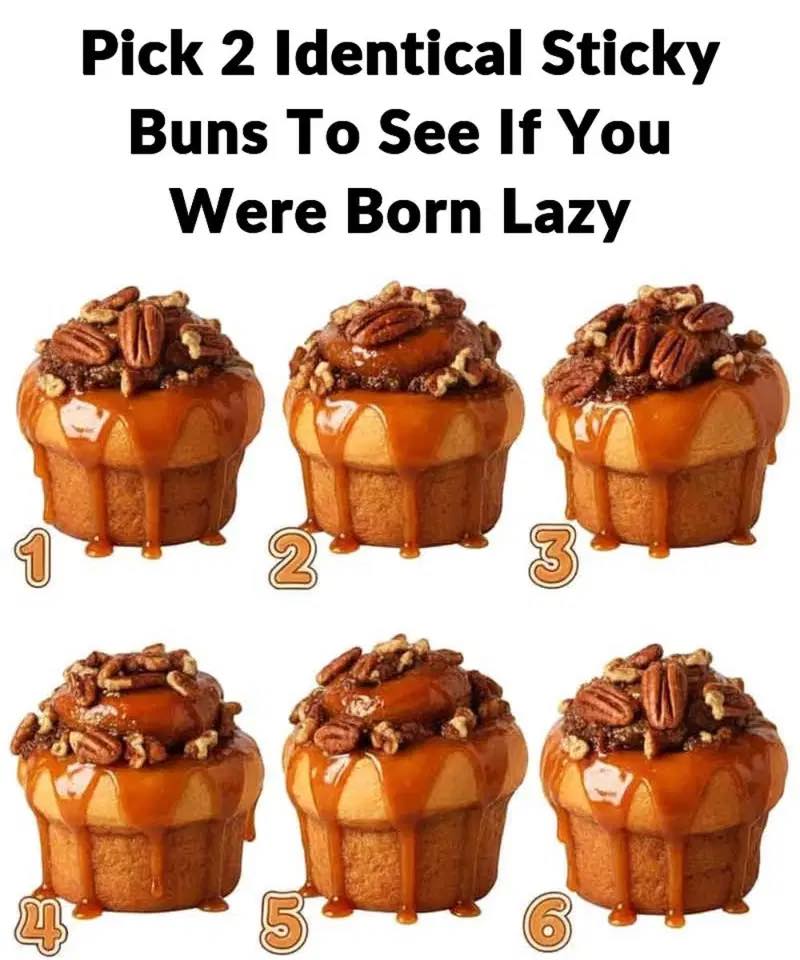
Some of the simplest online challenges spark the biggest conversations. Today's puzzle is a perfect example: six mouth-watering sticky buns, dripping with caramel and topped with pecans. They all look delicious, but two of them are identical. Can you find the pair?
This sweet little game is more than a treat for your eyes. Many people believe that how you approach it might reveal something about your personality too. Ready to give it a try?
The Rules Are Simple
- Take a careful look at the six sticky buns.
- Find the two that match exactly.
- Trust your instincts. Sometimes your first guess reveals more than you think.
Once you have made your choice, keep reading to see what your approach might say about you.
How to Spot the Identical Pair
Finding two identical items among six similar ones is harder than it sounds, because caramel drizzle and pecan placement create a riot of similar-but-different detail. Here is a method:
Compare one feature at a time. Do not try to match whole buns at once. Start with the pecan arrangement: count the visible pecan pieces on each bun and note their positions. Then compare the caramel drizzle pattern. Then the bun's shape and color. Eliminating candidates feature by feature is far more reliable than eyeballing.
Work in pairs. Compare bun 1 with bun 2, then bun 1 with bun 3, and so on. With six buns, there are fifteen possible pairs, but you will eliminate most candidates within seconds.
Look for the unique markers. A pecan sitting at an odd angle, a drip of caramel running in an unusual direction, a darker patch on one edge. Identical buns share every marker; near-matches differ in at least one.
Zoom in. On a phone screen, fine details blur together. Enlarge the image or view it on a bigger screen. The difference between "identical" and "almost identical" often lives in a single pecan.
Why Do These Puzzles Feel So Addictive?
Find-the-pair challenges have been around for decades, but social media has given them a huge comeback. People love them because they combine three irresistible elements:
- A simple challenge. It feels achievable, yet tricky enough to hold your attention.
- Visual appeal. Staring at gooey, golden-brown sticky buns is hardly a chore.
- Social fun. Comparing answers with friends, and laughing at the wrong guesses, makes it even better.
But there is also a psychological side. The way you approach details, whether you are patient, impulsive, or analytical, can reflect aspects of how you handle challenges in everyday life. That is where the personality angle comes in.
What Your Approach Might Say About You
This is, of course, all in good fun. No puzzle can really diagnose your personality. But many people enjoy linking their puzzle-solving style to character traits. Here is a playful look at what your approach could mean:
You spotted the pair instantly. You are confident, trust your gut, and do not waste time second-guessing yourself. In daily life, you probably make decisions quickly and stand by them.
You hesitated before choosing. You are thoughtful and analytical, preferring to double-check before committing. You would rather be right than fast, and people trust your judgment because of it.
You compared every bun methodically. You are organized and thorough. You like systems, checklists, and doing things properly the first time. Details do not escape you for long.
You gave up after a while. You are practical. You know when something is not worth your energy and prefer focusing on bigger priorities. Quitting the small stuff is a skill, not a flaw.
You got distracted by how delicious they look. You know how to enjoy life's simple pleasures, and that is a personality trait worth keeping. You experience the world fully instead of rushing past it.
You immediately sent it to a friend. You are social and collaborative. Everything is more fun shared, and you are usually the one keeping the group chat alive.
Remember: this is entertainment, not psychology. Real personality assessment takes far more than a pastry puzzle. But as a conversation starter, it is hard to beat.
The Psychology of "Identical"
Why is this puzzle tricky at a deeper level? Because human vision is excellent at spotting differences but surprisingly bad at confirming sameness. When two buns differ, the difference jumps out. When two buns match, your brain keeps searching for a difference that is not there, which feels uncertain and uncomfortable.
This is related to a well-known effect: it is easier to prove things different than to prove things identical. Inspectors, editors, and quality-control workers all know this feeling. The puzzle gives everyone a taste of that professional challenge, wrapped in caramel.
There is also the interference of appetite. Looking at delicious food activates reward centers in the brain, which mildly competes with the focused attention needed for visual comparison. In other words, the buns are distracting you by being delicious. That is not a flaw in your focus; it is the puzzle's secret weapon.
Turn It Into a Game Night Challenge
This puzzle works beautifully as a quick social game:
- Time trial. Everyone gets sixty seconds. Fastest correct answer wins.
- No second guesses. You get one pick. This raises the stakes and reveals who trusts their instincts.
- Team mode. Pairs work together, one person describing while the other looks. Communication becomes the real challenge.
- Loser bakes. The person who picks wrong has to bake (or buy) a batch of sticky buns for the group. Everybody wins.
Inspired to Bake? Sticky Bun Basics
If staring at the puzzle made you hungry, you are not alone. While a full recipe is beyond this article's scope, here are the fundamentals of great sticky buns for anyone inspired to try:
- Start with a soft, enriched yeast dough, similar to cinnamon roll dough.
- The signature topping is a caramel made from butter, brown sugar, and a little corn syrup or honey, poured into the pan before the buns go in.
- Toasted pecans pressed into the caramel add crunch and flavor.
- Bake until deeply golden, then invert the pan while warm so the caramel coats every bun.
- Serve warm. There is no other acceptable temperature.
Homemade buns will never be identical to each other, which is exactly as it should be.
Frequently Asked Questions
How many pairs are there in the puzzle?
Just one pair among the six buns. Every other bun is unique in at least one detail.
What is the hardest part of the puzzle?
The caramel drizzle. It looks random, so your brain discounts it, but the drizzle pattern is often what distinguishes the true pair from the near-matches.
Can kids do this puzzle?
Absolutely. It is a great visual discrimination exercise, and the tasty subject matter keeps them engaged.
Does my solving style really reveal my personality?
Not scientifically. But the way you approach any challenge does say something about your habits, and reflecting on that is worthwhile whether or not the categories are rigorous.
So, did you find them? Whether you spotted the identical sticky buns in seconds or are still squinting, you have exercised your eyes, maybe learned something about yourself, and definitely worked up an appetite. Not a bad return on a picture of pastries.