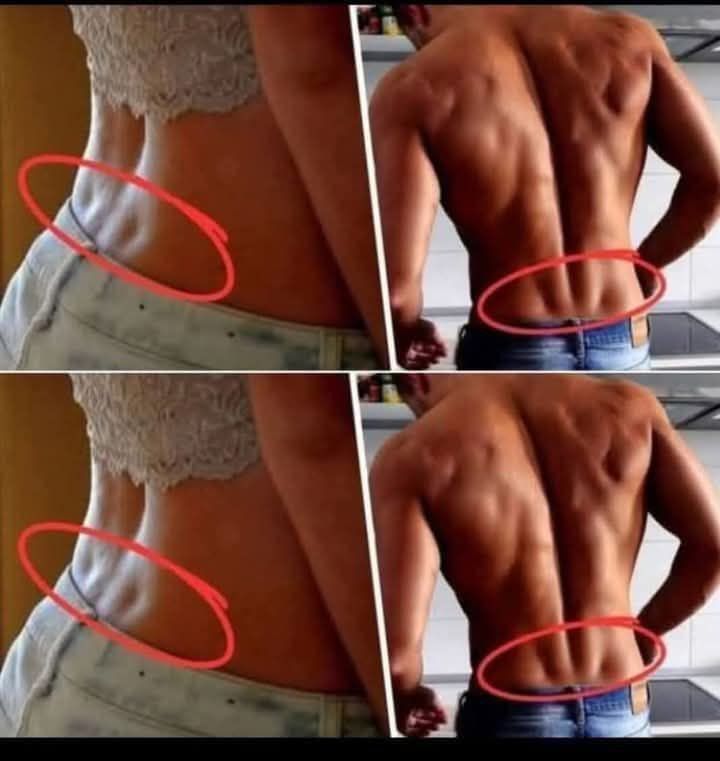
Have you ever noticed two small indentations on your lower back, just above your hips? These subtle dips are commonly known as Venus dimples. While some people see them as a unique beauty feature, others are simply curious about what causes them and whether they have any deeper meaning.
Let’s take a closer look at what these dimples are, why they appear, and what they might (and might not) say about your body.
What Are Venus Dimples?
Venus dimples are small, symmetrical indentations located on the lower back, right where the pelvis meets the spine. They form due to a natural connection between the skin and a specific point on the pelvic bone called the posterior superior iliac spine.
This anatomical structure creates a slight inward pull on the skin, resulting in the visible “dimples.” They are completely natural and harmless.
Although often associated with women and named after the Roman goddess of beauty, men can have them too. In some cases, they’re informally referred to as “Apollo dimples” when seen in men.
Are Venus Dimples Genetic?
Yes—genetics play the biggest role in whether or not you have these dimples. If your parents or grandparents have them, there’s a higher chance you might as well.
Unlike muscles or body fat, Venus dimples are not something you can fully control. They depend on how your ligaments and bones are structured beneath the skin. That’s why some people have very noticeable dimples, while others don’t have them at all.
Can You Get Venus Dimples Through Exercise?
This is one of the most common questions—and the answer is straightforward: you can’t create Venus dimples through exercise alone.
Because they’re tied to your bone structure and connective tissue, no specific workout can “build” them. However, there’s a small nuance worth understanding.
If you already have the underlying structure for Venus dimples, maintaining a healthy weight and staying active may make them more visible. Reducing excess body fat can highlight natural contours of the body, including these indentations.
So while exercise won’t create them, it can enhance their appearance if they already exist.
Do They Mean You’re Fit or Healthy?
There’s a popular belief that Venus dimples are a sign of good health or fitness. While there’s no strong scientific proof to support this claim, there is a bit of logic behind it.
These dimples tend to be more visible in people with lower levels of body fat and good muscle tone. Because of this, they are sometimes associated with an active lifestyle and physical conditioning.
However, it’s important not to overinterpret their meaning. Having Venus dimples doesn’t automatically mean someone is healthier, just like not having them doesn’t mean anything is wrong.
Health is influenced by many factors, including diet, physical activity, sleep, and overall lifestyle—not just physical features.
Why Are They Considered Attractive?
Over time, Venus dimples have gained attention in beauty and fitness communities. Some people consider them aesthetically pleasing because they highlight the natural curves of the lower back and hips.
In certain cultures, they’ve even been associated with attractiveness, symmetry, and vitality. But beauty standards vary widely, and features like these are subjective.
What one person finds appealing, another may not even notice—and that’s completely normal.
Final Thoughts
Venus dimples are simply a natural anatomical feature that some people have and others don’t. They’re largely determined by genetics and have little to do with your overall health or fitness level.
While they may be seen as a sign of beauty or physical condition in some circles, they are ultimately just one of many small details that make each body unique.
Instead of focusing on specific traits, it’s far more important to prioritize your overall well-being—staying active, eating well, and feeling comfortable in your own skin.
At the end of the day, confidence and health matter far more than any single physical feature.