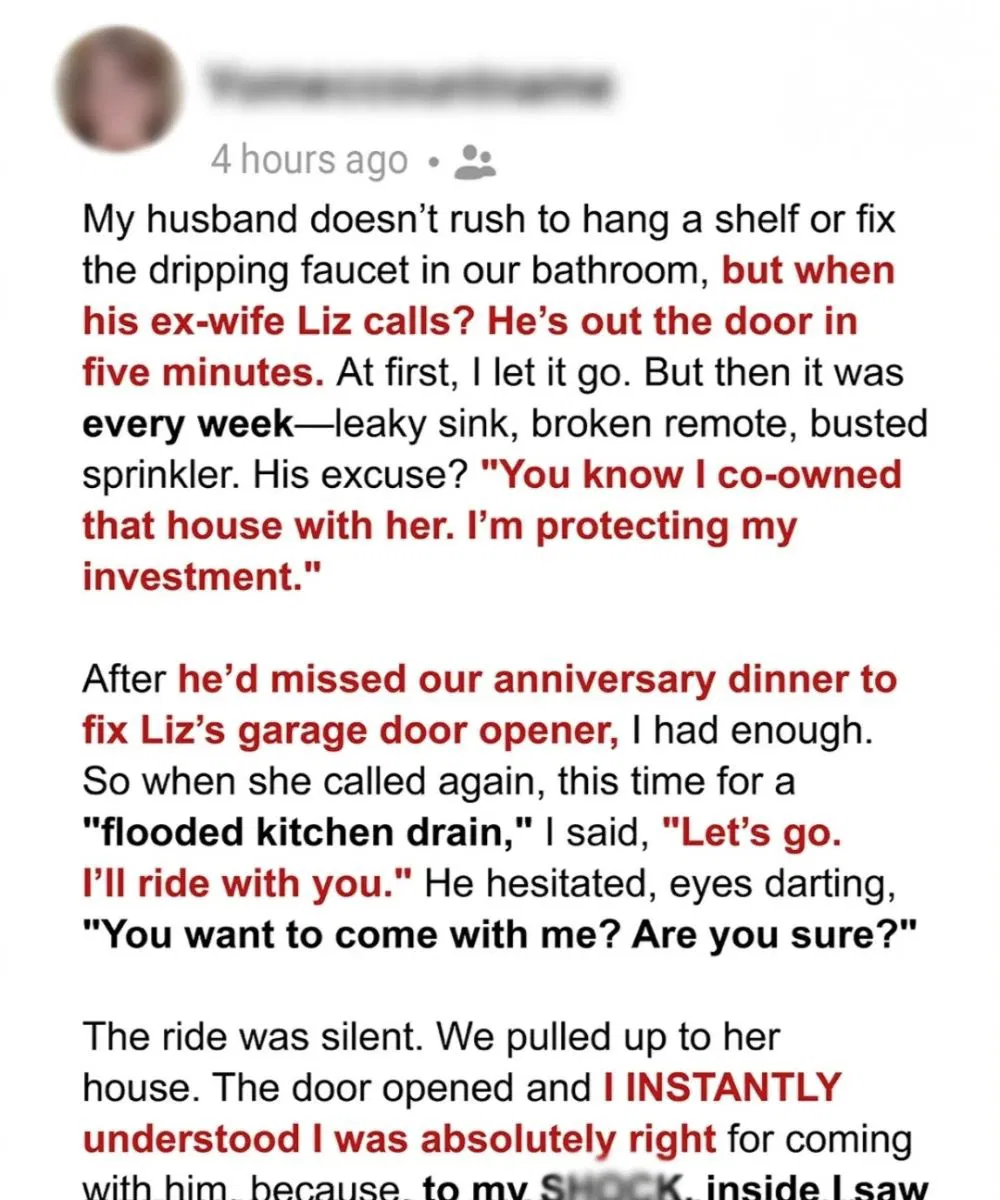
My Husband Always Rushed to Help His Ex Until I Decided to Go With Him
Few situations test a marriage quite like a former spouse who keeps calling. In this story, a wife watches her husband drop everything, again and again, to rush over and fix things at his ex-wife's house. A loose doorknob, a leaky faucet, a flickering light: each minor problem summons him like an emergency. One day she decides to stop waiting at home. She grabs her keys and goes with him. Standing in the ex-wife's doorway, she calmly hands over a list of reliable repairmen and draws a line, politely but firmly. On the drive home, her husband admits he had not realized how much he had been neglecting. That evening, she says, marked a turning point.
Stories like this strike a nerve because the dilemma is so common: how do you stay kind to an ex without letting the past crowd out the present? The anecdote itself cannot be verified, so treat it as a vivid illustration rather than a proven event. The underlying question, though, is real for countless blended families. Here is genuinely useful guidance for drawing healthy boundaries with a former spouse.
Why Ex Boundaries Are So Tricky
Helping an ex is not automatically wrong. Many divorced couples share children, property, or long histories, and basic decency does not end at divorce. The problem begins when helpfulness becomes a pattern that costs the current marriage. A few reasons this dynamic is hard to fix:
- Guilt lingers after divorce. A husband may rush to help because he feels responsible for how the marriage ended, not because the request is urgent.
- Old roles die hard. If he was always the fixer in that household, stepping into the role can feel automatic, almost like muscle memory.
- The requests seem small. No single leaky faucet looks like a marriage threat. It is the accumulation that does the damage.
- Saying no feels like being the villain. Nobody wants to be the person who refused to help, especially in front of an ex who knows how to apply pressure.
Recognizing these forces is not about blaming anyone. It is about seeing the pattern clearly so you can change it.
Signs the Line Has Been Crossed
How do you tell the difference between reasonable kindness and a boundary problem? Look for these signals:
- Your partner drops plans with you, or your children, to handle the ex's non-urgent requests.
- The requests keep increasing in frequency rather than tapering off.
- Household needs in your own home go unaddressed while the ex's get immediate attention.
- You feel like a background character in your own marriage, always waiting for the next phone call.
- Your partner gets defensive or secretive about the contact instead of being open about it.
- The ex contacts your partner for things any competent professional could handle.
One or two of these might be growing pains in a blended family. A cluster of them is a pattern worth addressing directly.
Have the Conversation Before Resentment Sets In
The wife in the story waited years, watching the pattern grow, until she acted in the moment. Acting took courage, but an earlier conversation might have saved everyone years of quiet frustration. When you raise the topic, approach and timing matter enormously.
Do:
- Bring it up at a calm, neutral time, never right after he has rushed out the door.
- Use "I" language: "I feel sidelined when our evening plans get dropped for Liz's repairs" instead of "You always choose her over me."
- Be specific about what you need: fewer interruptions during family time, a plan for handling non-urgent requests, more presence at home.
- Acknowledge his good intentions. He is trying to be a decent person. The request is that he be decent without disappearing.
Avoid:
- Ultimatums about cutting off all contact, especially if children are involved.
- Name-calling or mocking the ex. It puts your partner in the middle and makes him defensive.
- Keeping score out loud. "That is the fourteenth time this month" sounds like a courtroom, not a marriage.
The goal is not to win an argument. It is to make him see the pattern the way you see it, the way the husband in the story finally did on that quiet drive home.
Practical Solutions That Respect Everyone
Boundaries work best when they come with alternatives. "Stop helping her" is a demand. "Here is how her needs get met without it always being you" is a plan. Consider options like these:
- The professional list. Just as the wife in the story handed over repairmen contacts, keep a short list of trusted handymen, plumbers, and electricians. A non-urgent request gets a referral, not a house call.
- The emergency rule. Agree together on what counts as a genuine emergency: safety issues, flooding, no heat in winter. Everything else waits or goes to a professional.
- Scheduled help, not on-call help. If he wants to help with bigger things, it happens on an agreed day, not by dropping everything mid-dinner.
- A shared understanding about communication. Calls and texts about logistics are fine. Long personal chats that exclude you are worth discussing.
- Include, don't sneak. The wife's decision to go along was powerful precisely because it removed the secrecy. Transparency defuses suspicion on all sides.
If children are shared with the ex, keep the focus on the kids' needs. Co-parenting contact about school, health, and schedules is normal and healthy. The boundary is about the extras: the household repairs, the favors, the constant availability that has nothing to do with parenting.
When the Ex Is Testing the Boundary
Sometimes an ex increases the requests precisely because a boundary was set. The silk robe, the faltering smile, the faintly territorial energy in the story: these details hint at an ex who enjoyed the attention. You cannot control another adult's behavior, but you can control your response to it. Stay consistent, stay polite, and do not get drawn into competition. The moment you start competing with the ex, she wins, because the marriage becomes about her.
If the ex's behavior crosses into harassment, manipulation involving the children, or deliberate sabotage of your marriage, that is beyond a boundary conversation. Document what happens and consider involving a mediator or attorney, especially where custody arrangements exist.
When to Get Outside Help
Consider couples counseling if:
- The conversation about the ex keeps exploding into the same fight.
- Your partner agrees to boundaries but keeps breaking them.
- You cannot tell anymore whether you are being reasonable or jealous, and you need a neutral perspective.
- Trust has been damaged by secrecy around the contact.
A good counselor does not take sides between you and the ex. They help you two function as a team with a shared plan.
Frequently Asked Questions
Is it unreasonable to ask my husband to stop helping his ex entirely?
Total cutoff is rarely necessary and often backfires, especially with shared children. What is reasonable is asking that non-urgent help goes through professionals, that family time is protected, and that you are never the last to know about contact.
What if he says I am just jealous?
Jealousy and legitimate concern can look alike from the outside. The test is proportionality: are you upset about one reasonable favor, or about a sustained pattern that neglects your home? Name the pattern, not the person, and ask him to look at the frequency honestly.
Should I confront the ex directly?
Direct confrontation usually escalates things. The story's approach worked because it was calm, brief, and solution-oriented rather than hostile. But the primary conversation should always be with your spouse first. He is the one whose behavior you can actually influence.
What if the ex is also the mother of his children?
Then she is a permanent part of your family's life, and the goal is a respectful, boundaried co-parenting relationship. Keep communication focused on the kids, keep handoffs predictable, and keep the extras out.
The Takeaway
The turning point in the story was not really the list of repairmen. It was the moment the wife stopped disappearing into the background and the husband finally saw the pattern from her side. Healthy marriages are not built on never helping an ex. They are built on both partners agreeing, out loud, where the helping stops and the marriage begins. Draw the line with kindness, offer real alternatives, and protect the small daily moments, the coffee dates and burnt pancakes, that the relationship is actually made of.