Only the Most Observant Can Spot Both Cats in This Photo: Can You Find Them?
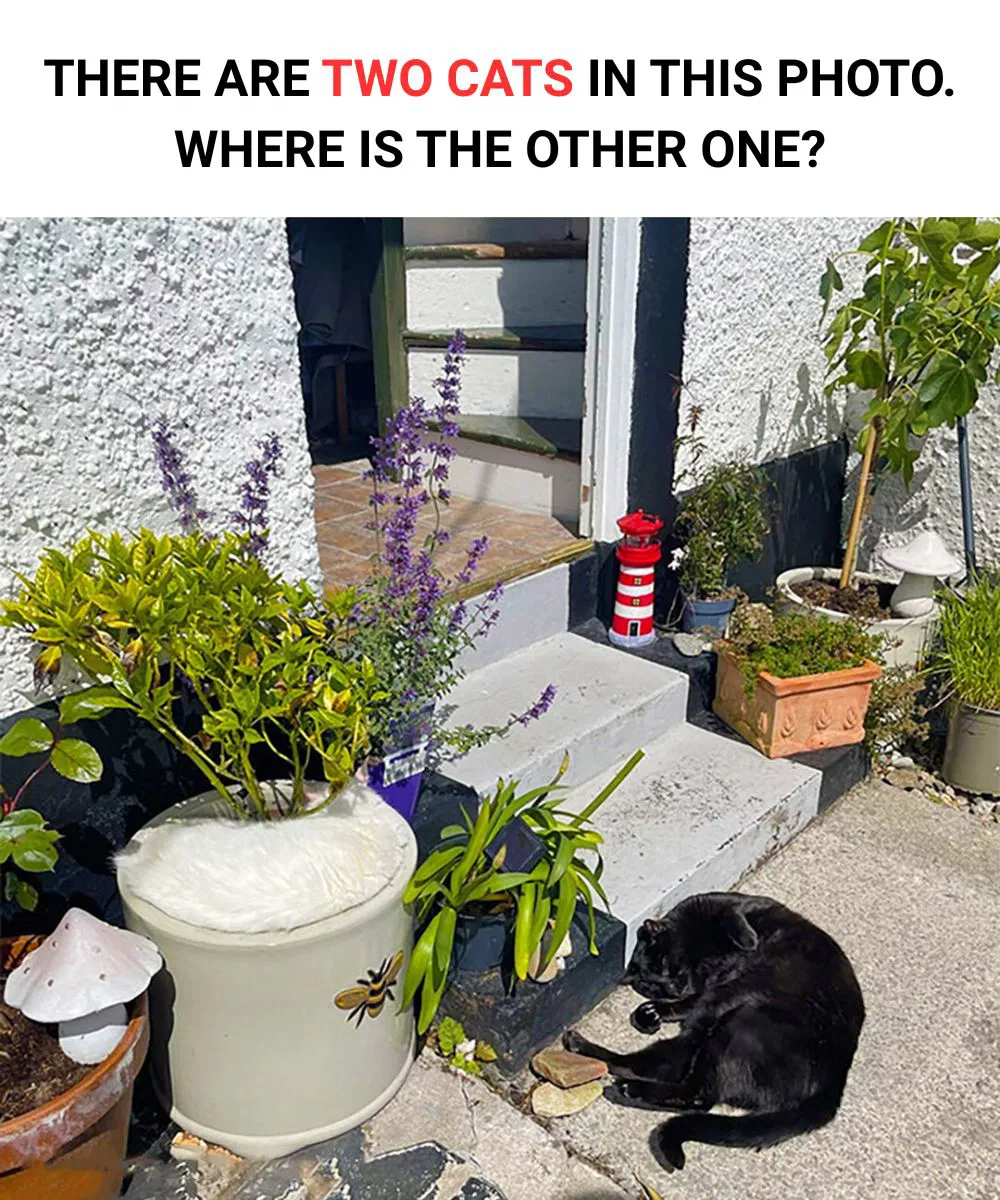
Have you ever looked at an image and felt certain there was nothing unusual about it, only to discover later that you missed something obvious? That familiar mix of frustration and surprise is exactly what draws attention to hidden-object photo puzzles currently circulating online, like the one that inspired this article: a photo that appears to show a single cat resting in the sunlight, while a second cat is camouflaged somewhere in the scene.
These puzzles are simple to play and surprisingly hard to quit. This guide explains why hidden cats are so hard to spot, how animal camouflage works, practical techniques for finding concealed details in photos, and why these visual challenges keep taking over feeds everywhere.
Why the brain misses what is right there
The effectiveness of a hidden-object puzzle comes from how the human brain processes images. We naturally focus on the most noticeable element first. In a photo puzzle, that is usually the obvious cat sitting in clear view. Once the brain registers a clear subject, it often stops searching for additional information, treating the rest of the image as background.
This is a feature, not a bug. The visual system evolved to filter enormous amounts of information quickly, and it does this by predicting what matters and ignoring the rest. But that efficiency creates blind spots. The mind sees what it expects to see, and a second cat blended into shadows, patterns, or objects gets dismissed as part of the scenery. Psychologists sometimes describe this as a form of selective attention: the moment your brain decides it has found the subject, it relaxes, and anything that does not match that expectation becomes invisible.
The satisfaction of finally spotting the hidden detail is part of the appeal. Solving a visual puzzle triggers a small sense of achievement, that little jolt of "I found it," which makes the experience both entertaining and rewarding. The harder the puzzle, the bigger the payoff.
Real-life camouflage: why cats are so good at disappearing
Hidden-cat puzzles work because cats are genuinely masters of concealment. Unlike many animals, cats combine physical traits with behavior that makes them blend into almost any environment.
- Coat patterns as camouflage. Tabby stripes, tortoiseshell patches, and solid dark coats all evolved from wild cats that needed to disappear into shadows, grass, or tree bark. A tabby's striped coat breaks up its outline in dappled sunlight, while a dark cat vanishes into shade.
- Stillness as a strategy. Cats can remain completely motionless for long periods. In the wild, movement gives away a predator or prey long before shape or color does. A statue-still cat in a cluttered room is remarkably easy to overlook.
- Shape-shifting posture. A curled-up cat has no obvious head, legs, or tail silhouette. Tucked into a box, a folded blanket, or a basket, a cat's body becomes just another rounded shape in the room, and the brain files it under "ordinary object."
- Seeking matching backgrounds. Anyone who has owned a cat knows the phenomenon: the cat that only sleeps on the laundry that matches its fur, or the black cat that exclusively rests in the darkest corner. Cats gravitate toward backgrounds that make them nearly invisible, partly by instinct and partly by sheer preference.
It is no coincidence that hidden-cat puzzles are a whole genre. Few animals combine all these traits so completely, which is why a photograph can hide a cat in plain sight and fool thousands of viewers.
Techniques for spotting the hidden detail
Getting better at visual challenges does not require special training. These habits, used by puzzle enthusiasts and professional image analysts alike, make concealed details much easier to find:
- Scan the background, not the subject. Start at the edges and corners of the image, where the hidden element usually sits. The main subject is a distraction; your real target is everything around it.
- Look for patterns that break. Shadows, fabric folds, and textures that repeat across the photo can hide an animal, but one area will usually be slightly "wrong," an asymmetry, an outline that does not quite belong. Train yourself to notice the interruption.
- Zoom in sections. Divide the photo into quadrants and examine each one closely. On a phone, pinch to zoom and sweep slowly. On a screen, a hidden shape often reveals itself only at larger sizes.
- Squint or shrink the image. This sounds backwards, but reducing detail can help: when fine texture fades, the larger outline of a hidden shape stands out more clearly. Squinting at the screen does the same thing.
- Flip the image. Viewing a photo upside down breaks the brain's expectations. Objects your mind had filed as "plant" or "furniture" suddenly reveal their true shapes when the usual context is removed.
- Adjust brightness. Many hidden elements hide in shadows. Slightly increasing your screen brightness, or mentally tracing the dark areas of a photo, can reveal eyes, ears, or a paw tucked out of sight.
- Take a break and return. Fatigue narrows attention. Stepping away for a few minutes and looking again with fresh eyes often works better than staring harder.
Why these puzzles take over social media
Hidden-object photos spread quickly because they are easy to understand and enjoyable for people of all ages. There is no language barrier, no setup, no skill requirement. You look, you hunt, and you either find it or you demand hints in the comments. That interactive loop is perfect for social media.
They also invite conversation. People share the puzzle to test friends, debate possible hiding spots, and post triumphant "found it" comments. Each share pulls in new viewers who have to see the image for themselves, and each failed attempt deepens the determination to look again. Unlike content you passively consume, a puzzle demands participation, and participation drives engagement.
From a broader perspective, these images offer a brief mental break. In a feed full of news and advertising, a playful challenge that takes thirty seconds to attempt is genuinely refreshing. It is no surprise they have become a reliable format across platforms.
Beyond entertainment: what observation practice actually trains
There is real value hidden behind the fun. Regularly practicing careful observation sharpens attention to detail in everyday life. People who play with visual puzzles often report getting better at noticing small changes in their surroundings, from spotting a wallet that fell under a car seat to reading a room more accurately.
For children, hidden-object games build patience, focus, and spatial reasoning. For adults, they are a small daily workout for sustained attention in an age of constant distraction. Some professionals, from radiologists to quality inspectors, rely on exactly this kind of disciplined visual scanning, and while a cat photo is not job training, the underlying skill is the same: slow down, look systematically, and question your first impression.
A final challenge
The next time you come across a seemingly ordinary image, take a second look before you scroll past. Scan the edges, question the shadows, and resist the urge to accept your first impression. You might be surprised by what you find hiding in plain sight, and you will have given your observation skills a small but genuine workout. After all, somewhere out there, a cat is sitting perfectly still in a photo right now, confident that nobody will ever notice.